<?xml version="1.0" encoding="ISO-8859-1"?><article xmlns:mml="http://www.w3.org/1998/Math/MathML" xmlns:xlink="http://www.w3.org/1999/xlink" xmlns:xsi="http://www.w3.org/2001/XMLSchema-instance">
<front>
<journal-meta>
<journal-id>2078-8606</journal-id>
<journal-title><![CDATA[TropIKA.net]]></journal-title>
<abbrev-journal-title><![CDATA[TropIKA.net]]></abbrev-journal-title>
<issn>2078-8606</issn>
<publisher>
<publisher-name><![CDATA[TDR/WHO]]></publisher-name>
</publisher>
</journal-meta>
<article-meta>
<article-id>S2078-86062010005000001</article-id>
<title-group>
<article-title xml:lang="en"><![CDATA[The geographic distribution of dengue fever and the potential influence of global climate change]]></article-title>
</title-group>
<contrib-group>
<contrib contrib-type="author">
<name>
<surname><![CDATA[Van Kleef]]></surname>
<given-names><![CDATA[Esther]]></given-names>
</name>
<xref ref-type="aff" rid="A01"/>
</contrib>
<contrib contrib-type="author">
<name>
<surname><![CDATA[Bambrick]]></surname>
<given-names><![CDATA[Hilary]]></given-names>
</name>
<xref ref-type="aff" rid="A02"/>
</contrib>
<contrib contrib-type="author">
<name>
<surname><![CDATA[Hales]]></surname>
<given-names><![CDATA[Simon]]></given-names>
</name>
<xref ref-type="aff" rid="A03"/>
</contrib>
</contrib-group>
<aff id="A01">
<institution><![CDATA[,World Health Organization Intern, Public Health and Environment ]]></institution>
<addr-line><![CDATA[Geneva ]]></addr-line>
<country>Switzerland</country>
</aff>
<aff id="A02">
<institution><![CDATA[,University of Western Sydney School of Medicine ]]></institution>
<addr-line><![CDATA[Sydney ]]></addr-line>
<country>Australia</country>
</aff>
<aff id="A03">
<institution><![CDATA[,University of Otago School of Medicine and Health Sciences ]]></institution>
<addr-line><![CDATA[Wellington ]]></addr-line>
<country>New Zealand</country>
</aff>
<pub-date pub-type="pub">
<day>00</day>
<month>00</month>
<year>2010</year>
</pub-date>
<pub-date pub-type="epub">
<day>00</day>
<month>00</month>
<year>2010</year>
</pub-date>
<numero>ahead</numero>
<fpage>0</fpage>
<lpage>0</lpage>
<copyright-statement/>
<copyright-year/>
<self-uri xlink:href="http://journal.tropika.net/scielo.php?script=sci_arttext&amp;pid=S2078-86062010005000001&amp;lng=en&amp;nrm=iso"></self-uri><self-uri xlink:href="http://journal.tropika.net/scielo.php?script=sci_abstract&amp;pid=S2078-86062010005000001&amp;lng=en&amp;nrm=iso"></self-uri><self-uri xlink:href="http://journal.tropika.net/scielo.php?script=sci_pdf&amp;pid=S2078-86062010005000001&amp;lng=en&amp;nrm=iso"></self-uri><abstract abstract-type="short" xml:lang="en"><p><![CDATA[BACKGROUND Approximately 2.5 billion people are at risk from dengue infection. Dengue is endemic to urban populations in tropical areas; large epidemics have occurred less frequently in subtropical regions, and rarely in cities in temperate regions. The virus is transmitted by the freshwater mosquito, Aedes aegypti. During the past century, surface temperatures have increased by a global average of 0.75°C. Temperature increases of this magnitude may be associated with substantial increases in dengue epidemic potential. OBJECTIVE We aimed to describe the geographic distribution of dengue transmission (current and historical) and to estimate possible impacts on transmission from climate change. METHODS We conducted two systematic reviews. We searched PubMed, digital books and archives for literature describing geographically defined outbreaks of dengue. We also searched PubMed and Scopus for studies modelling the potential effects of climate change on dengue transmission. Data from studies meeting the inclusion criteria were considered by all of our team and we collaborated to draw our conclusions. No meta-analysis was attempted. RESULTS One hundred and one articles met the eligibility criteria for the first review; there were some contradictions and ambiguities in the data. Current global distribution of dengue is generally less extensive than historical limits of dengue-like illness. In recent years, several countries have reported local transmission of dengue for the first time, but it is unclear whether this represents true geographic spread, rather than increased awareness and reporting. Areas of geographic contraction of dengue include the southern states of North America, much of Australia, parts of southern Europe, Japan, China and South Africa. Piped water supplies, removal of water storage tanks, changes in housing conditions and vector control measures have plausibly contributed to this contraction. Six papers met the inclusion criteria for the second review. The findings of theoretical and statistical models of dengue and climate are broadly consistent: the transmission of dengue is highly sensitive to climate. Relatively small increases in temperature (around 1°C) can lead to substantial increases in transmission potential. Studies modelling the potential effects of climate change on dengue project that there will be increases in climatic suitability for transmission and an expansion of the geographic regions at risk of dengue during this century. CONCLUSIONS Geographic distribution of dengue has generally contracted, despite increases in global average temperature in the past century. Theoretically, however, temperature trends have increased the risk of dengue in some areas. The independent effect of climate change on historical patterns of dengue transmission cannot be quantified based on current evidence, as existing models of disease transmission provide limited, incomplete, projections of disease risk. The geographic limits of dengue result from a complex interaction between physical, ecological and social factors which have not been included in current climate change models. Keeping this limitation in mind, models estimating changes to geographic boundaries of transmission suggest an increase in the future population at risk of dengue. Factors associated with urban poverty and minimal capacities for surveillance and control measures remain important promoters of dengue transmission in regions with favourable climate.]]></p></abstract>
</article-meta>
</front><body><![CDATA[ <p align="right"><font face="Verdana, Arial, Helvetica, sans-serif" size="2"><b>Review</b></font></p>     <p>&nbsp;</p>     <p align=left><font face="Verdana, Arial, Helvetica, sans-serif" size="4"><b>The    geographic distribution of dengue fever and the potential influence of global    climate change </b></font></p>     <p>&nbsp;</p>     <p>&nbsp;</p>     <p><font face="Verdana, Arial, Helvetica, sans-serif" size="2"><b>Esther Van Kleef    <sup>I</sup>; Hilary Bambrick <sup>II</sup>; Simon Hales <sup>III</sup></b></font></p>     <p align=left><font face="Verdana, Arial, Helvetica, sans-serif" size="2"><sup>I</sup>    Intern, Public Health and Environment, World Health Organization, Geneva, Switzerland    <br>   <sup>II</sup> Population Health, School of Medicine, University of Western Sydney,    Sydney, Australia    <br>   <sup>III</sup> School of Medicine and Health Sciences, University of Otago,    Wellington, New Zealand</font></p>      <p><font face="Verdana, Arial, Helvetica, sans-serif" size="2"><b><a name="topo"></a><a href="#cor">Corresponding    author</a></b></font></p>     ]]></body>
<body><![CDATA[<p>&nbsp; </p>     <p>&nbsp;</p> <hr size="1" noshade>     <p><font face="Verdana, Arial, Helvetica, sans-serif" size="2"><b>ABSTRACT</b></font></p>     <p><font face="Verdana, Arial, Helvetica, sans-serif" size="2"> <b>BACKGROUND</b>    Approximately 2.5 billion people are at risk from dengue infection. Dengue is    endemic to urban populations in tropical areas; large epidemics have occurred    less frequently in subtropical regions, and rarely in cities in temperate regions.    The virus is transmitted by the freshwater mosquito, Aedes aegypti. During the    past century, surface temperatures have increased by a global average of 0.75&deg;C.    Temperature increases of this magnitude may be associated with substantial increases    in dengue epidemic potential.     <br>   <b>OBJECTIVE</b> We aimed to describe the geographic distribution of dengue    transmission (current and historical) and to estimate possible impacts on transmission    from climate change.    <br>   <b>METHODS</b> We conducted two systematic reviews. We searched PubMed, digital    books and archives for literature describing geographically defined outbreaks    of dengue. We also searched PubMed and Scopus for studies modelling the potential    effects of climate change on dengue transmission. Data from studies meeting    the inclusion criteria were considered by all of our team and we collaborated    to draw our conclusions. No meta-analysis was attempted.    <br>   <b>RESULTS</b> One hundred and one articles met the eligibility criteria for    the first review; there were some contradictions and ambiguities in the data.    Current global distribution of dengue is generally less extensive than historical    limits of dengue-like illness. In recent years, several countries have reported    local transmission of dengue for the first time, but it is unclear whether this    represents true geographic spread, rather than increased awareness and reporting.    Areas of geographic contraction of dengue include the southern states of North    America, much of Australia, parts of southern Europe, Japan, China and South    Africa. Piped water supplies, removal of water storage tanks, changes in housing    conditions and vector control measures have plausibly contributed to this contraction.    Six papers met the inclusion criteria for the second review. The findings of    theoretical and statistical models of dengue and climate are broadly consistent:    the transmission of dengue is highly sensitive to climate. Relatively small    increases in temperature (around 1&deg;C) can lead to substantial increases    in transmission potential. Studies modelling the potential effects of climate    change on dengue project that there will be increases in climatic suitability    for transmission and an expansion of the geographic regions at risk of dengue    during this century.    <br>   <b>CONCLUSIONS</b> Geographic distribution of dengue has generally contracted,    despite increases in global average temperature in the past century. Theoretically,    however, temperature trends have increased the risk of dengue in some areas.    The independent effect of climate change on historical patterns of dengue transmission    cannot be quantified based on current evidence, as existing models of disease    transmission provide limited, incomplete, projections of disease risk. The geographic    limits of dengue result from a complex interaction between physical, ecological    and social factors which have not been included in current climate change models.    Keeping this limitation in mind, models estimating changes to geographic boundaries    of transmission suggest an increase in the future population at risk of dengue.    Factors associated with urban poverty and minimal capacities for surveillance    and control measures remain important promoters of dengue transmission in regions    with favourable climate. </font></p> <hr size="1"noshade>     <p>&nbsp;</p>     <p>&nbsp;</p>     ]]></body>
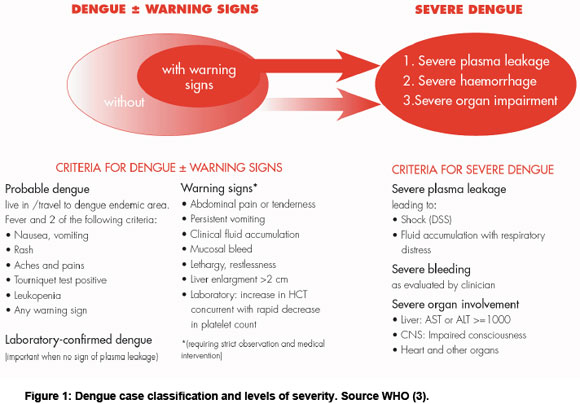
<body><![CDATA[<p><font face="Verdana, Arial, Helvetica, sans-serif" size="3"> <b>Introduction</b></font></p>     <p><font face="Verdana, Arial, Helvetica, sans-serif" size="2">An estimated 2.5    billion people are at risk of dengue, in tropical and subtropical areas throughout    the world (1). Dengue is mainly an urban and peri-urban disease, but also occurs    in rural areas. Dengue infection causes a spectrum of disease, from mild flu-like    symptoms to severe life threatening haemorrhage (2). The definition of severe    dengue is based on clinical features (see <a href="#fig1">Figure 1</a>) (3).    There has been a dramatic increase in the incidence of dengue in the past 50    years and some geographic expansion of transmission (4). In particular, an intensive    campaign was successful in interrupting dengue transmission in South America    during the 1960s and 1970s, but mosquito control measures were not maintained    and the disease has subsequently returned (4). Recently, local transmission    of dengue has been reported for the first time in several African countries    (see below), Bhutan; Nepal and France (5-7). Dengue has also returned after    many decades of absence in Hawaii  and Florida, USA (8,9). The reasons for the    emergence of dengue are complex and not completely understood. Probable causes    include increases in poor, urban populations, breakdown in public health measures,    especially vector control programmes, increased travel and trade, and environmental    disturbances (10-13). </font></p>     <p><a name="fig1"></a></p>     <p>&nbsp;</p>     <p align="center"><img src="/img/revistas/tropika/2010nahead/a01fig1.jpg"></p>     <p>&nbsp;</p>     <p><font face="Verdana, Arial, Helvetica, sans-serif" size="2">There is debate    about the potential role of climate change as a contributor to global trends    in vector borne diseases (14,15). Transmission of the dengue virus is sensitive    to climate. Temperature, rainfall and humidity affect the breeding cycle, survival    and biting rate of the mosquito vectors (principally <i>Aedes aegypti</i>).    Higher ambient temperatures favour rapid development of the vector, increase    the frequency of blood meals, and reduce the extrinsic incubation period (EIP).    The EIP is the time taken between the vector ingesting an infective blood meal    and it being able to transmit the virus in a subsequent feed. A short EIP increases    the opportunities for virus transmission during the lifetime of an infected    mosquito. If the ambient temperature is too low, mosquitoes are unlikely to    survive long enough to become infectious and pass on dengue (11). </font></p>     <p><font face="Verdana, Arial, Helvetica, sans-serif" size="2">Suitable climate    is a necessary but, not on its own, sufficient factor for dengue transmission.    A source of infection (either locally acquired or imported), a competent vector,    and vector contact with a susceptible human population must all be present for    dengue transmission to occur. Climatic conditions provide an absolute constraint    on the geographic area suitable for transmission of dengue, but within climatically    suitable areas, non-climate factors are important in determining the extent    to which transmission of dengue actually occurs. </font></p>     <p><font face="Verdana, Arial, Helvetica, sans-serif" size="2">In this paper,    we review published evidence concerning: </font></p>     <blockquote>       ]]></body>
<body><![CDATA[<p><font face="Verdana, Arial, Helvetica, sans-serif" size="2">1.the current      and historical geographic limits of the local transmission of dengue fever          <br>     2.the potential effects of global climate change on dengue transmission. </font></p> </blockquote>     <p><font face="Verdana, Arial, Helvetica, sans-serif" size="2">We hypothesize    that, if changes in the geographic distribution of dengue correspond with long-term    climate trends, this would suggest an important climate influence.</font></p>     <p>&nbsp;</p>     <p><font face="Verdana, Arial, Helvetica, sans-serif" size="3"><b>Methods</b></font></p>     <p><font face="Verdana, Arial, Helvetica, sans-serif" size="3"><b><font size="2">Review    of historical distribution</font></b></font></p>     <p><font face="Verdana, Arial, Helvetica, sans-serif" size="2">Our primary focus    was on the boundaries of current transmission, where geographic shifts of dengue    epidemic activity were likely. PubMed, an online medical and life sciences database,    was consulted for the retrieval of peer-reviewed articles on dengue outbreaks.    In addition, digital books and archives were searched to retrieve documents    on reports of outbreaks occurring before 1950. We retrieved articles relevant    to the following countries and regions: Africa, Australia, Argentina, Chile,    Uruguay, China, the Middle East, and the United States. For the Asia-Pacific    region, we used data from a recent map produced by the World Health Organization    (WHO).</font></p>     <p><font face="Verdana, Arial, Helvetica, sans-serif" size="2">The Global Infectious    Diseases and Epidemiology Online Network (GIDEON) database (<a href="http://www.gideononline.com/" target="_blank">http://www.gideononline.com</a>)    was used to cross-reference the PubMed search. GIDEON provides information on    diagnosis and epidemiology, microbiology and antimicrobial chemotherapy of tropical    and infectious disease. The database includes 224 countries and 337 diseases    and is based on literature and reports from all over the world. GIDEON incorporates    data from the Program for Monitoring Emerging Diseases (ProMED)-mail (<a href="http://www.promedmail.org/" target="_blank">http://www.promedmail.org</a>).    </font></p>     <p><font face="Verdana, Arial, Helvetica, sans-serif" size="2"><b>Search strategy</b></font></p>     <p><font face="Verdana, Arial, Helvetica, sans-serif" size="2">The PubMed database    was searched using the terms &#34;dengue&#34;, &#34;disease outbreak&#34;    and &#34;epidemiology&#34; as free text. (Search: dengue (and possible synonyms)[ALL]    AND disease outbreak (and possible synonyms)[ALL] OR epidemiology [ALL] to 2009.)    These search terms were combined with the following region and country names    of areas on the fringe of established transmission: Africa, Australia (<i>except    Queensland</i>), Argentina, Chile, Uruguay, China, the Middle East, and the    United States (<i>except South Texas)</i>. </font></p>     ]]></body>
<body><![CDATA[<p><font face="Verdana, Arial, Helvetica, sans-serif" size="2"><b>Inclusion criteria</b></font></p>     <p><font face="Verdana, Arial, Helvetica, sans-serif" size="2">Publications retrieved    from the search were considered eligible for inclusion in our review if they    provided any of the following data on outbreaks of dengue:</font></p>     <p><font face="Verdana, Arial, Helvetica, sans-serif" size="2">a) data on the    spatial distribution of local transmission    <br> b) case reports    of dengue in travellers returning from countries outside the established transmission    zone    <br> c) dengue reports    from countries outside the established transmission zone.</font></p>     <p>&nbsp;</p>     <p><font face="Verdana, Arial, Helvetica, sans-serif" size="3"><b>Review of climate    change models</b></font></p>     <p><font face="Verdana, Arial, Helvetica, sans-serif" size="2">We searched for    published studies that modelled the potential impacts of climate change on either    the dengue vector (<i>Ae. aegypti</i>) or on dengue cases. </font></p>     <p><font face="Verdana, Arial, Helvetica, sans-serif" size="2"><b>Search strategy</b></font></p>     <p><font face="Verdana, Arial, Helvetica, sans-serif" size="2">Peer-reviewed articles    written in English were identified through PubMed and Scopus, using the search    terms &#34;climate change&#34; and &#34;dengue&#34;, as free text appearing    anywhere in the article. (Search: (climate[ALL] AND change[ALL]) AND dengue[ALL])    to 2009 with no restrictions on minimum publication date.) </font></p>     ]]></body>
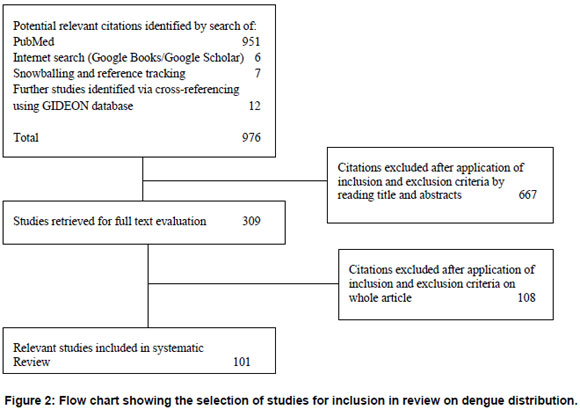
<body><![CDATA[<p><font face="Verdana, Arial, Helvetica, sans-serif" size="2"><b>Inclusion criteria</b></font></p>     <p><font face="Verdana, Arial, Helvetica, sans-serif" size="2">Publications were    considered eligible for inclusion if they reported original research either    describing or modelling the distribution of dengue, specifically:</font></p>     <p><font face="Verdana, Arial, Helvetica, sans-serif" size="2">a)spatial models    of dengue transmission    <br> b)empirical models    of relationships between the spatial distribution of dengue and climate, with    reference to climate change    <br> c)biological models    of the relationship between the pathogen and/or vectors and climate, with reference    to climate change.</font></p>     <p><font face="Verdana, Arial, Helvetica, sans-serif" size="2">Studies of short-term    variability were excluded from the formal analysis, as the aim was to assess    the potential longer term impacts of climate change <br clear=ALL>   rather than existing seasonal or interannual effects (e.g. El Niño southern    oscillation). Review articles were also excluded.</font></p>     <p>&nbsp;</p>     <p><font face="Verdana, Arial, Helvetica, sans-serif" size="3"><b>Results</b></font></p>     <p><font face="Verdana, Arial, Helvetica, sans-serif" size="3"><b><font size="2">Review    of historical distribution</font></b></font></p>     <p><font face="Verdana, Arial, Helvetica, sans-serif" size="2">The initial search    resulted in 951 papers. Further steps in article selection are outlined in <a href="#fig2">Figure    2</a>. There were 101 articles that met the eligibility criteria, including    twelve historical overviews. </font></p>     ]]></body>
<body><![CDATA[<p><a name="fig2"></a></p>     <p>&nbsp;</p>     <p align="center"><img src="/img/revistas/tropika/2010nahead/a01fig2.jpg"></p>     <p>&nbsp;</p>     <p><font face="Verdana, Arial, Helvetica, sans-serif" size="2">There were some    contradictions and ambiguities in the available data on dengue cases. It is    impossible to be certain that all reports of dengue-like illness were really    dengue, since the symptoms of the disease are non-specific and serological results    are often not available, especially in early reports. Dengue outbreak reports    dating from before 1870 are considered less reliable (16). </font></p>     <p><font face="Verdana, Arial, Helvetica, sans-serif" size="2">Infectious diseases    commonly confused with dengue include: chikungunya, Rift Valley fever, Ross    River fever, West Nile fever, yellow fever, influenza, malaria, measles, typhoid    fever, leptospirosis, <i>pappataci</i> fever (sandfly fever), and scarlet fever.    Chikungunya might be suspected if common features of dengue (such as rash, adenopathy    and postorbital pain) were not present or if joint pains were present for a    long period of time. Serological and virus-specific laboratory tests became    available for the confirmation of dengue in 1950. (Dengue virus was isolated    for the first time in 1943.) Certain outbreaks between 1920 and 1950 have been    confirmed by retrospective serological studies. </font></p>     <p><font face="Verdana, Arial, Helvetica, sans-serif" size="2">Historical overviews    revealed several areas and countries where dengue-like outbreaks were reported    before 1950 but not since. For example, dengue appeared frequently in Japan    from 1900 to 1945 (17). The 1942-1945 outbreak was said to be one of the largest    epidemics ever recorded in a temperate region. Dengue has disappeared from Japan    since 1945 (18). In Europe, dengue was reported in Greece (Athens and Piraeus)    and Spain (Seville and Cadiz). It is difficult to establish the reliability    of the reports of the Spanish outbreaks, since these occurred in 1784-1788 and    in 1860-1868 (10, 19). The two outbreaks in Greece in 1927-1928 and 1929-1933,    however, are confirmed by retrospective serological studies (16). Dengue was    probably endemic in many Eastern Mediterranean countries at the end of the 19<sup>th</sup>    century, including Lebanon, Turkey, Palestine, Syria, and unspecified neighbouring    countries (18,20). </font></p>     <p><font face="Verdana, Arial, Helvetica, sans-serif" size="2">Changes in the    distribution of dengue have occurred in other parts of the world. More detail    is provided below.</font></p>     <p><font face="Verdana, Arial, Helvetica, sans-serif" size="2"><b>Africa</b></font></p>     <p><font face="Verdana, Arial, Helvetica, sans-serif" size="2"><i><b>North Africa</b></i></font></p>     ]]></body>
<body><![CDATA[<p><font face="Verdana, Arial, Helvetica, sans-serif" size="2">The first reported    dengue-like epidemic located in Africa occurred in Cairo and Alexandra, Egypt,    in 1779 under the name <i>Mal de Genoux</i>. According to Carey and Scott this    disease was probably chikungunya (21,22). Nonetheless, dengue epidemics were    reported frequently in Egypt between 1824 and 1937. The disease appeared in    Alexandra, Cairo, Suez, and Port Said (10-17,19,23). The last reported outbreak    for Egypt was in 1937 in Cairo, where there were 2600 cases and 55 deaths. Kuno    suggests that, of the early dengue reports, this was the more reliable (16).    </font></p>     <p><font face="Verdana, Arial, Helvetica, sans-serif" size="2">In the 1940s in    North Africa, the Sudan and Egypt were considered endemic for dengue (20). The    first report of dengue in the Sudan was reported to have occurred from 1914    to 1918 (24). Dengue-like outbreaks were also reported for Libya; at least one    outbreak occurred in the mid 19<sup>th</sup> century and another in 1878 in    Benghazi and Tripoli (10,18,19). Sudan reported an epidemic of dengue in 1985-86    in the Red Sea State (25). The first outbreak in south Kordofan, a central state    of the Sudan region, occurred in 2005 (ProMED). Dengue was believed to have    been introduced to Djibouti in 1991-1992 (26). From 1993 to 1994 dengue appeared    again here during the winter (27). </font></p>     <p><font face="Verdana, Arial, Helvetica, sans-serif" size="2"><i><b>East sub-Saharan    Africa</b></i></font></p>     <p><font face="Verdana, Arial, Helvetica, sans-serif" size="2">Hirsch identified    a dengue pandemic in 1870-1873 (19). The outbreak was believed to have started    and ended in East Africa. The outbreak began in 1870, in Tanzania. The disease    was known under the names <i>Dinga, dyenga </i>or<i> dengue </i>and spread towards    Egypt, Saudi Arabia (Jeddah, Mecca and Medina), Yemen (Aden), India, China,    Indonesia, Indochina (Vietnam, Laos and Cambodia) and then back to Mauritius    in 1873 (19). Despite the fact that outbreaks were reported for Tanzania at    least four times between 1823 and 1926, the outbreaks of 1823 and 1870 are,    according to Carey  more likely to be chikungunya (10,18,21). We found pre-1900    reports for Mauritius (1851 and in 1873) and from 1897-1899, in Somalia (10,19).    The first reported outbreak in Kenya appeared in 1860-1868. An early outbreak    occurred in Eritrea at the same time as the Somalia outbreak (1897-1899). Unfortunately,    the exact location of the outbreak in all these countries is not specified (10).    There were outbreaks in Réunion in 1851 and during 1870-1873, and there was    a likely outbreak in 1926, in the Seychelles, based on reports of local authorities    (10,18). </font></p>     <p><font face="Verdana, Arial, Helvetica, sans-serif" size="2">In the early 20<sup>th</sup>    century, Mozambique and the Seychelles were said to be endemic (20). Robinson    argued that dengue was relatively uncommon in East Africa before 1952 (28).    Nonetheless, the author refers to several countries where outbreaks have occurred    in the period from 1924 and 1950; Mozambique, Madagascar, Ethiopia, Somalia,    and the Comoros (28). McCarthy and Bagster Wilson state that dengue was present    in Ethiopia (Dire Dawa and Harrar), Somalia (Mogadishu), Madagascar (Diego Suarez)    and in the Comoros Islands (Mayotte) and in other parts of Somalia (Kismayu,    Berbera and Hargeisa) and Mauritius (29). In the Comoros, outbreaks occurred    in 1943 and in 1948 (30). </font></p>     <p><font face="Verdana, Arial, Helvetica, sans-serif" size="2">The Comoros, Ethiopia,    Kenya, the Seychelles, Somalia, Tanzania, Réunion, Mauritius, and Mozambique    were considered endemic from 1975 to 1996 (18). Outbreaks occurred in 1984 and    1993 in the Grande Comoros (30-32). Dengue occurs sporadically in Kenya (33-35).    Somalia experienced four major outbreaks between 1982 and 1993 in Jubbaada Hoose    (Kismayu), and in Shabeellaha Hoose (Afgoi), Banaadir (Mogadishu) (27,36-38).    </font></p>     <p><font face="Verdana, Arial, Helvetica, sans-serif" size="2">Both the Seychelles    and Reunion had an outbreak in 1977-1979. In 2009 an outbreak in Mauritius was    reported for all three islands. The vector predominantly responsible was <i>Ae.    albopictus,</i> but a contributing role of <i>Ae. aegypti </i>is not excluded    (30,39-42). In 1982-1983 an outbreak occurred in Pemba, Mozambique (43,44).    </font></p>     <p><font face="Verdana, Arial, Helvetica, sans-serif" size="2">For Tanzania, we    found evidence of a dengue-like outbreak in the more recent period of 1952-1953,    in the Makonde Plateau (23,28). This was probably the first dengue-like disease    of this region and affected 60-70% of the population. This outbreak may have    been chikungunya. Several common features of dengue were frequently absent,    including rash, adenopathy and postorbital pain. In addition, joint pains were    present for a long period of time. Both Ross as well as Mason and Haddow conducted    confirmative studies and discovered presence of chikungunya (45,46). </font></p>     <p><font face="Verdana, Arial, Helvetica, sans-serif" size="2">Our study did not    uncover any notable outbreaks for Ethiopia. There was an outbreak in Eritrea    in 2005 (3). In 1977 and 1986 presence of dengue in Madagascar was serologically    confirmed (18). According to WHO, an outbreak occurred in 2006, in Madagascar,    but we were unable to identify an original report (25). </font></p>     <p><font face="Verdana, Arial, Helvetica, sans-serif" size="2"><i><b>Central sub-Saharan    Africa</b></i></font></p>     ]]></body>
<body><![CDATA[<p><font face="Verdana, Arial, Helvetica, sans-serif" size="2">Before 1950 no    endemic countries were named in the overview of van Rooyen and Rhodes for central    sub Saharan Africa (20). We only found a short note on an outbreak that occurred    in 1949, in the Belgian Congo (now Democratic Republic of the Congo) (18). </font></p>     <p><font face="Verdana, Arial, Helvetica, sans-serif" size="2">Angola experienced    an outbreak in 1986 (24). We found a report that dengue was endemic in the Democratic    Republic of the Congo at least between 1952 and 1957, with a number of cases    reported annually at that time (47). However, no reports on more recent outbreaks    were discovered. An outbreak of dengue was reported in Gabon in 2007, where    <i>Ae. albopictus</i> was the dominant vector (48,49). </font></p>     <p><font face="Verdana, Arial, Helvetica, sans-serif" size="2"><i><b>West sub-Saharan    Africa</b></i></font></p>     <p><font face="Verdana, Arial, Helvetica, sans-serif" size="2">There were frequent    outbreaks in Senegambia (Senegambia was a former confederation between Senegal    and Gambia). Van Rooyen and Rhodes consider Gold Coast (now Ghana) and Dakar    (Senegal) as endemic areas before 1948 (20). The first reported outbreak in    Senegambia appeared in 1845, in Goree and St Louis, followed by an outbreak    in 1848, and frequent outbreaks continued to be reported until 1920-1926. In    Dakar an outbreak was reported in 1899 (10,18,19). For Ghana, an outbreak occurred    between 1920 and 1926 in Accra (10). An outbreak appeared in 1926, in Burkina    Faso, in Ouagadougou (18). </font></p>     <p><font face="Verdana, Arial, Helvetica, sans-serif" size="2"> Burkina Faso,    Nigeria, Senegal, Cote d'Ivoire, Ghana, Guinea and Sierra Leone were considered    endemic in 1975 to 1996. Between 1964 and 1973 three outbreaks occurred in Ibadan,    Igbo-Ora and Abeokuta in Nigeria (50,51). The regions studied were ‘<i>the derived    Savannah zone', ‘The Southern Guinea savannah', ‘the Rainforest', </i>and<i>    ‘the Plateau zone'</i>. A high proportion of the population exhibited immunity    in all regions (52,53). Dengue is endemic in the Kainji Lake area in Nigeria    (54). Dengue is also considered endemic in Ibadan (55). In 1974 dengue was isolated    in Senegal and in 1980, in Cote d'Ivoire. In the period 1974-2000 four outbreaks    have been reported in Senegal (56,57). In Côte d'Ivoire an outbreak occurred    in 2008. Several travellers returning from Abidjan and two local cases were    diagnosed with dengue, indicating the introduction of DENV-3 in Côte d'Ivoire    (25). The most recent outbreak identified for Senegal occurred in 2009 (according    to ProMED). </font></p>     <p>&nbsp;</p>     <p align="center"><img src="/img/revistas/tropika/2010nahead/a01fig3.jpg"></p>     <p>&nbsp; </p>     <p><font face="Verdana, Arial, Helvetica, sans-serif" size="2">The first isolation    of dengue virus in Burkina Faso was in 1982. From 1982 to 1986 dengue was present    in the Kadiogo province of Ouagadougou, Burkina Faso (18,58). No recent epidemics    were found for Ghana, Guinea and Sierra Leone; only sporadic cases have been    reported according to GIDEON. Eisenhut et al. identified the first dengue transmission    in Benin through a study among 670 German aid workers who worked overseas in    the period of 1978 to 1993 (59). Thirteen of the 88 participants who had worked    in Benin tested positive for dengue. In 2002 the first indigenous cases in Cameroon    were reported, including two cases with a DENV-1 infection. The most likely    vector was <i>Ae. Albopictus </i>(49<i>)</i>. </font></p>     <p><font face="Verdana, Arial, Helvetica, sans-serif" size="2">In 2008 the first    epidemic in Mali, in the Keyes region was reported, including at least 70 confirmed    cases of dengue (25). The original report was not identified, but in an overview    by WHO a note was added listing that DENV-2 had been identified in travellers    returning from Mali in 2008. In 2009 a number of dengue cases were reported    in the Cape Verde islands for the first time, in Brava, Fogo, Maio, Santiago    (50). </font></p>     ]]></body>
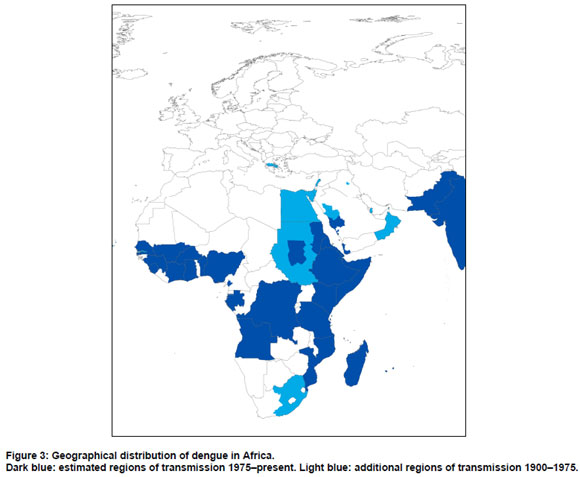
<body><![CDATA[<p><font face="Verdana, Arial, Helvetica, sans-serif" size="2"><b><i>South sub-Saharan    Africa</i></b></font></p>     <p><font face="Verdana, Arial, Helvetica, sans-serif" size="2">The first reported    dengue like outbreak of South Africa appeared in Natal 1901-1907 (10). An outbreak    frequently mentioned in the literature occurred in Durban from 1926 to 1927.    This outbreak was confirmed through serological testing (16,18,60). Although    Blackburn et al. argue dengue has not been reported in South Africa since 1926-1927,    an outbreak from 1940 to 1945 was identified by Gubler (10,61). </font></p>     <p><font face="Verdana, Arial, Helvetica, sans-serif" size="2">For the period    1975-1996, South Africa was the only named endemic country in the south sub-Saharan    African region. Blackburn et al. concluded that, although <i>Ae. aegypti</i>    is present in South Africa, only imported cases from India have been identified    since 1980 (61,62). No further reports on outbreaks for south sub-Saharan Africa    were identified.</font></p>     <p><font face="Verdana, Arial, Helvetica, sans-serif" size="2"><b>Asia-Pacific    region</b></font></p>     <p><font face="Verdana, Arial, Helvetica, sans-serif" size="2">According to the    overview of Van Rooyen and Rhodes, the endemic countries of Asia in 1948 were    India, Sri Lanka, Burma (Myanmar), Thailand, Malay Peninsula, French Indo-China    (Cambodia and Vietnam), Dutch East Indies (Indonesia), China, Formosa (Taiwan),    and Japan (20). </font></p>     <p><font face="Verdana, Arial, Helvetica, sans-serif" size="2">The following countries    experienced dengue activity from 1975 to 1996: Bangladesh, India, Indonesia,    Maldives, Myanmar, Sri Lanka, Thailand, Vietnam, Brunei, Cambodia, Lao Peoples    Democratic Republic, Malaysia, Singapore, Cook Islands, Fiji, French Polynesia,    Guam, Kiribati, Marshall Islands, Nauru, New Caledonia, Niue, Palau, Papua New    Guinea, Philippines, Samoa, Solomon Islands, Tokelau, Tonga, Tuvalu, Vanuatu,    and Wallis Futuna Islands (18). </font></p>     <p><font face="Verdana, Arial, Helvetica, sans-serif" size="2"><i><b>China</b></i></font></p>     <p><font face="Verdana, Arial, Helvetica, sans-serif" size="2">Three major outbreaks    are thought to have occurred in China before 1950. The first one includes an    outbreak in Taiwan in 1930, followed by outbreaks in Shanghai, the Fujian province    and the Guangdong province in 1940 (63). The third outbreak was in 1945 in the    city of Wuhan, Hubei province; it affected 80% of a population of one million    (64). In 1947 a suspected dengue outbreak occurred in Shanghai City and the    coastal areas of Jiangsu, Zhejiang and Fujian Provinces (63). According to Kuno,    <i>Ae. albopictus </i>was the transmitting vector (17). For all these areas,    records on epidemics before 1900 are available. In Taiwan pre-1930, epidemics    have occurred almost annually in the early period, the first one reported in    1870-1873 (10,16,17,19). Shanghai and the Fujian province were also affected    (19). Dengue resurfaced in 1904 in Shanghai. Frequent outbreaks for Hong Kong    were identified from 1876 to 1907 (10). Kuno lists two outbreaks for 1901 and    1902, which were most likely chikungunya (17,21). The earliest outbreak for    the Guangdong province identified was in 1901 in Guangzhou (18). </font></p>     <p><font face="Verdana, Arial, Helvetica, sans-serif" size="2">After the outbreaks    of 1930, 1940 and 1945, no epidemics were reported until 1978 (63,64). Since    the 1990s frequent outbreaks of dengue have occurred in Guangdong, Guangxi and    Hainan. The first outbreaks for 32 years were reported in 1978-1979 in Shiwan,    which is a town of Foshan City and in Zhongshan County, both located in the    Guangdong province. The vector responsible for transmission was <i>Ae. albopictus    </i>(63-65). In 1980 another outbreak occurred in the Guangdong province, affecting    one third of the province. Here both <i>Ae. albopictus</i> (north of the province)    and <i>Ae. aegypti</i> (in the south Hepu county) were the vectors. In 1982,    outbreaks in Wuhang, Hubei province and Shanghai have been reported (18). In    Hainan Island in 1979-1980 an outbreak affected over 400,000 individuals (63,65).    Besides Guangdong, Guangxi and Hainan, Taiwan has experienced outbreaks of dengue    since the 1980s. A major outbreak affected Kaohsiung in 2001-2002 (66,67). </font></p>     <p><font face="Verdana, Arial, Helvetica, sans-serif" size="2">In 2004 an outbreak    of dengue occurred in Ningbo, Zhejiang province, which was not considered an    endemic area. In total 83 cases were reported, and of these 68 were laboratory    confirmed. The authors suspect that dengue was introduced by a traveller who    returned from Thailand and the Ningbo area, which had a high density of <i>Ae.    albopictus</i> at that time (65). Liu et al. demonstrated the presence of dengue    in Dushan and Xingyi (68). Other areas that experience dengue epidemics are    Fujian and Yunnan provinces. In Fuzhou, Fujian province, an epidemic of dengue    occurred in 2004. Yunnan province had outbreaks from 1981 to 1982, transmitted    predominantly by <i>Ae. albopictus</i>. In 2008, another outbreak of dengue    occurred in this region (ProMED). Macao experienced an outbreak in 2001 where    <i>Ae. albopictus </i>served as primary vector (69). </font></p>     ]]></body>
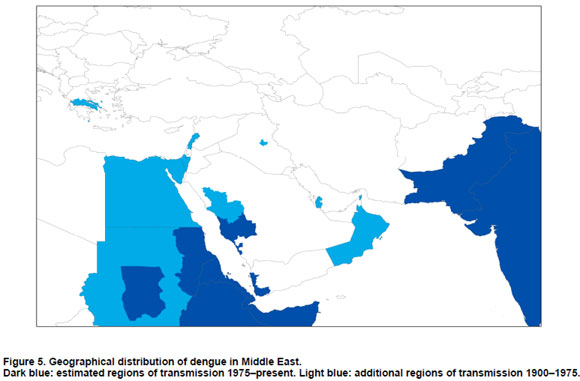
<body><![CDATA[<p><font face="Verdana, Arial, Helvetica, sans-serif" size="2"><i><b>Australia</b></i></font></p>     <p><font face="Verdana, Arial, Helvetica, sans-serif" size="2">Epidemics were    reported in the late 19<sup>th</sup> century in the states of Queensland, New    South Wales, Western Australia, and in the Northern Territory. The first occurrence    of dengue in Australia is reported to have occurred in 1873, from eight infected    travellers from Mauritius. In 1879 and 1885 the first local outbreaks of dengue    occurred in Queensland, in the towns of Townsville and Rockhampton respectively    (70). Besides frequent epidemics in Queensland, the disease was introduced for    the first time to New South Wales in 1886, and appeared again in 1898. These    may have been isolated imported cases rather than true local outbreaks. </font></p>     <p><font face="Verdana, Arial, Helvetica, sans-serif" size="2">Dengue epidemics    in the state of New South Wales were reported for the first time in 1905. In    1925-1926 there was a widespread outbreak from Newcastle (coast) to Tamworth    (inland) and Bourke (west) (16,70). The epidemic of 1942 is considered to have    been the last epidemic in New South Wales, which may have been facilitated by    the movement of army troops by steam train (70,71). In the Northern Territory    at least two outbreaks occurred in 1914 and in 1920 (70). In 1914 dengue was    identified in the Territory's capital, Darwin. From 1909 until 1927, dengue    cases were reported in the state of Western Australia. Outbreaks occurred nearly    annually in Broome, Wyndham, and Carnarvon and surrounding areas (17,70). </font></p>     <p>&nbsp;</p>     <p align="center"><img src="/img/revistas/tropika/2010nahead/a01fig4.jpg"></p>     <p>&nbsp;</p>      <p><font face="Verdana, Arial, Helvetica, sans-serif" size="2">After a large epidemic    in 1954 to 1955 that appeared in Townsville, north Queensland, dengue outbreaks    were absent for a period of 26 years (72). The outbreaks returned in North Queensland    in 1981-1982 (73). </font></p>     <p><font face="Verdana, Arial, Helvetica, sans-serif" size="2">Mackenzie et al.    provide an overview of dengue outbreaks in the period of 1990 to 1998 and argue    the epidemics have been limited to the north Queensland area, i.e. from the    Torres Strait south to Cairns, Townsville and Charters Towers (74). In 1992-1993    a dengue outbreak occurred in Townsville and Charter Towers; in 1996-1997 in    Torres Strait; 1997-1998 in Cairns (74-76). The most recent epidemic that occurred    in Cairns and Townsville, in 2008-2009 was much larger and more difficult to    control than previous outbreaks (77). </font></p>     <p><font face="Verdana, Arial, Helvetica, sans-serif" size="2"><b>Middle East</b></font></p>     <p><font face="Verdana, Arial, Helvetica, sans-serif" size="2">Dengue was endemic    in much of the Eastern Mediterranean including Lebanon and Palestine at the    end of the 19<sup>th</sup> century (18). At present, Turkey, Palestine, and    Syria and unspecified neighbouring countries are thought to be endemic (20).    From 1870 to 1873, dengue-like epidemics occurred in the Arabian peninsula in    Yemen (Aden), and Saudi Arabia (Mecca, Medina and Jeddah) (78). Israel, Turkey    (Smyrna and Istanbul), Palestine, and Syria were affected by a dengue outbreak    from 1889 to 1890 (10,18). This outbreak may have been related to the slave    trade (18). After this pandemic, dengue was recorded only in Lebanon, Israel    and Yemen. An outbreak was reported for Lebanon in 1907-1913 and in Beirut in    1945 (79). The 1907-1913 outbreak occurred also in Israel (Jerusalem). From    1920-1926 Yemen (Aden) experienced another outbreak (10). </font></p>     ]]></body>
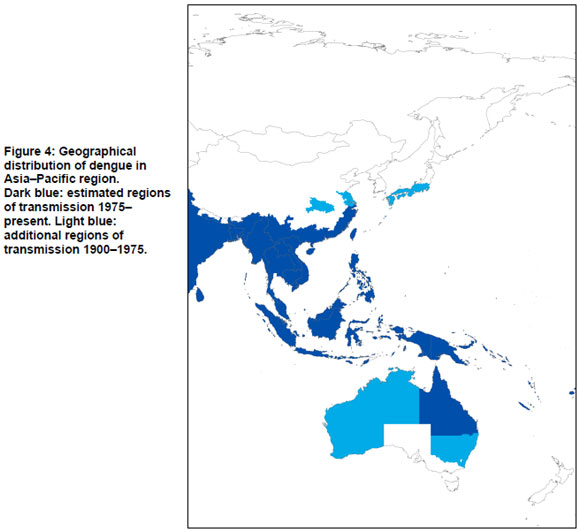
<body><![CDATA[<p>&nbsp;</p>     <p align="center"><img src="/img/revistas/tropika/2010nahead/a01fig5.jpg"></p>     <p>&nbsp;</p>     <p><font face="Verdana, Arial, Helvetica, sans-serif" size="2">Dengue was said    to be endemic in the 1960s in Qatar, Iraq and Oman (47). Saudi Arabia and Pakistan    were also considered endemic (18). The current situation in the Middle East    is discussed in the following sections with particular reference to Kuwait,    Pakistan, Saudi Arabia, and Yemen.</font></p>     <p><font face="Verdana, Arial, Helvetica, sans-serif" size="2"><b><i>Kuwait</i></b></font></p>     <p><font face="Verdana, Arial, Helvetica, sans-serif" size="2">Al Nakib et al.    observed dengue in Kuwait between 1980 and 1982, but the authors did not focus    on whether the infections concerned locally acquired or imported cases (80).    However, Pacsa et al. argue against local transmission of dengue infections    in Kuwait because of the absence of the <i>Ae. aegypti</i> mosquito and the    inability of the local vector, <i>Ae. caspius</i> to transmit dengue effectively    (81). The dengue cases that occurred in Kuwait had all arrived from dengue endemic    areas. In a follow-up study the authors tested 499 samples from residents from    Kuwait for dengue from 1997 to 1999. Participants that had not left the country    were all found to be negative for dengue (82). </font></p>     <p><font face="Verdana, Arial, Helvetica, sans-serif" size="2"><b><i>Pakistan</i></b></font></p>     <p><font face="Verdana, Arial, Helvetica, sans-serif" size="2">Serologically confirmed    cases of dengue were reported in Karachi in 1994 and another outbreak appeared    in this city in 2006 (83-86). Pakistan was considered non-endemic until 1993    but is now considered endemic (83). Since 2005 there have been outbreaks of    dengue DENV-3, leading Khan et al. to conclude that dengue is now hyperendemic    in Pakistan (87,88). Paul et al. interviewed 76 employees of a power plant in    Baluchistan in 1995, where an outbreak of a febrile illness had occurred, confirming    an outbreak of multiple serotypes (not further specified) in this largest province    of Pakistan (89). The vector responsible was most likely <i>Ae. aegypti</i>.    The authors argue that their results prove the presence of epidemic dengue in    southern Pakistan. </font></p>     <p><font face="Verdana, Arial, Helvetica, sans-serif" size="2"><b><i>Saudi Arabia</i></b></font></p>     <p><font face="Verdana, Arial, Helvetica, sans-serif" size="2"> In March 1994,    dengue was isolated for the first time since the outbreaks of the 19<sup>th</sup>    century in Jeddah, the Makkah province of Saudi Arabia (78,90,92). Zaki et al.    refer to four outbreaks between 1994 and 2006; 1994, 1997, 2004 and 2005-2006.    Recently in 2009 an outbreak was documented in Jeddah (ProMED) (90). </font></p>     ]]></body>
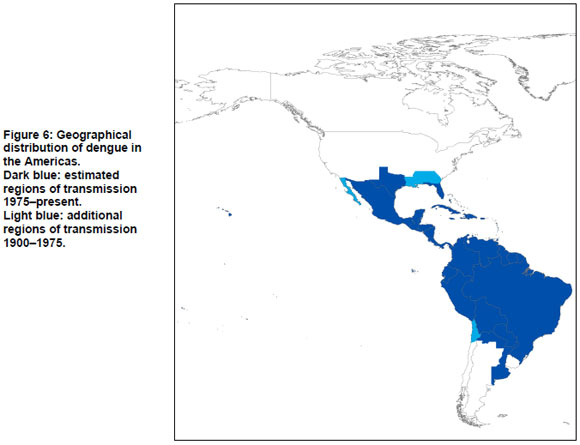
<body><![CDATA[<p><font face="Verdana, Arial, Helvetica, sans-serif" size="2">That three serotypes    of the dengue virus are established and circulating in the country might indicate    that dengue has become endemic in Saudi Arabia (90). Ayyub et al. concluded    that dengue is endemic in the region of Jeddah (93). </font></p>     <p><font face="Verdana, Arial, Helvetica, sans-serif" size="2"><b><i>Yemen</i></b></font></p>     <p><font face="Verdana, Arial, Helvetica, sans-serif" size="2">An epidemic of    dengue in was reported to have occurred in 1954, which affected 98% of the population    of Al Hudaydah (47). In 1984 a traveller returning from Yemen was serologically    confirmed to have had dengue (94). </font></p>     <p><font face="Verdana, Arial, Helvetica, sans-serif" size="2"><b>The Americas</b></font></p>     <p><font face="Verdana, Arial, Helvetica, sans-serif" size="2">Dengue is endemic    in much of South America, Central America and Mexico. The regions bordering    the current distribution of dengue are discussed in detail below.</font></p>     <p><font face="Verdana, Arial, Helvetica, sans-serif" size="2"><b><i>Argentina</i></b></font></p>     <p><font face="Verdana, Arial, Helvetica, sans-serif" size="2">In 1905, 1911 and    1916 dengue cases were reported in northern Argentina in Chaco, Corrientes,    Formosa, and Misiones provinces. In 1916 an epidemic occurred in Entre Rios    province without any haemorrhagic symptoms (18). Gubler&nbsp;&nbsp; reports an outbreak    here between 1914 and 1918 (10).</font></p>     <p><font face="Verdana, Arial, Helvetica, sans-serif" size="2">In 1963 dengue    transmission was interrupted in Argentina through the <i>Ae. aegypti</i> eradication    campaign, which was initiated in 1955 (95,96). In 1986, <i>Ae. aegypti</i> was    reported to have reinvaded north Argentina (95-97). Aviles et al. reported imported    cases of dengue from Bolivia, Paraguay and Brazil in the Salta Province but    also identified 19 indigenous cases of dengue in Oran, Tartagal, Guemes, and    Salvador Mazza in 1997 (96). Natiello et al. report an outbreak of 341 cases    in 1998, in the Salta Province (98). Another outbreak occurred 1999-2000 with    close to 500 cases in Misiones and Formosa, the north-eastern region on the    border with Paraguay (99). Between 1997 and 2001 indigenous cases appeared in    the Salta province, the Jujuy province and Formosa province (97). Natiello et    al. state that dengue has only recently been present in the northern provinces    of Argentina (98). </font></p>     <p><font face="Verdana, Arial, Helvetica, sans-serif" size="2">Imported cases    are often identified in Buenos Aires, mainly due to native Paraguayans living    in Buenos Aires visiting their home country (98,99). Natiello et al., who identified    dengue in Buenos Aires, concluded that no local transmission has occurred in    the area, and moreover, that the conditions in this city are not suitable for    optimal transmission (100). However, in 2007 the first case of dengue with no    travel history to endemic surrounding countries was identified. </font></p>     <p><font face="Verdana, Arial, Helvetica, sans-serif" size="2">Between 1998 and    2007, 4,719 cases of dengue were reported by Argentina, mainly in Salta, Formosa    and Misiones (95). </font></p>     ]]></body>
<body><![CDATA[<p><font face="Verdana, Arial, Helvetica, sans-serif" size="2"><b><i>Chile</i></b></font></p>     <p><font face="Verdana, Arial, Helvetica, sans-serif" size="2">Gubler&nbsp;&nbsp; reports    an outbreak in northern Chile between 1914 and 1918. In 2002 and 2007 there    were two localized outbreaks of dengue on Easter Island (10). Before the 2002    outbreak, dengue fever was diagnosed in 15 cases from continental Chile in 2000    and 2001; but no locally transmitted cases have occurred (95,101). </font></p>     <p><font face="Verdana, Arial, Helvetica, sans-serif" size="2"><b><i>Uruguay</i></b></font></p>     <p><font face="Verdana, Arial, Helvetica, sans-serif" size="2">Vezzani and Carbajo    argue that Uruguay has been the only South American country where locally transmitted    cases of dengue have been absent (95). No further reports or literature on indigenous    transmission or outbreaks in Uruguay were identified. </font></p>     <p><font face="Verdana, Arial, Helvetica, sans-serif" size="2"><b><i>United States    of America</i></b></font></p>     <p><font face="Verdana, Arial, Helvetica, sans-serif" size="2">The first documented    cases of dengue-like illness in the United States were reported by Rush and    concerned an outbreak in Philadelphia, Pennsylvania in 1780 (12,21,102-104).    From 1826 onwards, widespread outbreaks of dengue-like illness appeared in the    southern states, including Florida (Pensacola and other cities), Georgia (Savannah    and Augusta), Louisiana (New Orleans) and in Texas (Santa Cruz) (10,16,18,19).    In the northern and central states only sporadic cases were reported. Dengue    became more widespread in the southern states in 1850 with Alabama (Mobile),    Mississippi (Vicksburg and Woodville), Texas (Galveston, Houston and Brownsville)    and Missouri (St Louis affected) (10,19,60). </font></p>     <p><font face="Verdana, Arial, Helvetica, sans-serif" size="2">Alabama, Florida,    Georgia, Louisiana and Texas continued to experience dengue epidemics for several    decades. In Louisiana in 1945, an outbreak is thought to have been related to    war veterans who returned from the Pacific (18). An outbreak in Florida took    place in 1934-1935 in the Tampa and Miami areas (18,105). Georgia and Alabama    also experienced outbreaks in 1934-1936 (24). </font></p>     <p><font face="Verdana, Arial, Helvetica, sans-serif" size="2">Whereas most dengue    cases that have been reported in the United States since 1940 are imported,    local transmission of the dengue virus occurred in Texas in 1986 (in Brownsville,    Corpus Christi and Laredo) and 1995. Gratz and Knudsen report an outbreak in    1980, based on information of the Pan American Health Organization (PAHO) (18).    Between 1997 and 1998, 18 cases were diagnosed, all imported into Florida from    endemic areas (105). However, in 2009 indigenous dengue transmission occurred    in Key West, Florida (9). In August 2009 three cases were identified to have    acquired the disease locally, and by November, 91 cases tested positive for    dengue by the USA Centers for Disease Control and Prevention. In 2001, an epidemic    of dengue occurred in Hawaii after an absence of over 50 years (8). </font></p>     <p>&nbsp;</p>     <p align="center"><img src="/img/revistas/tropika/2010nahead/a01fig6.jpg"></p>     ]]></body>
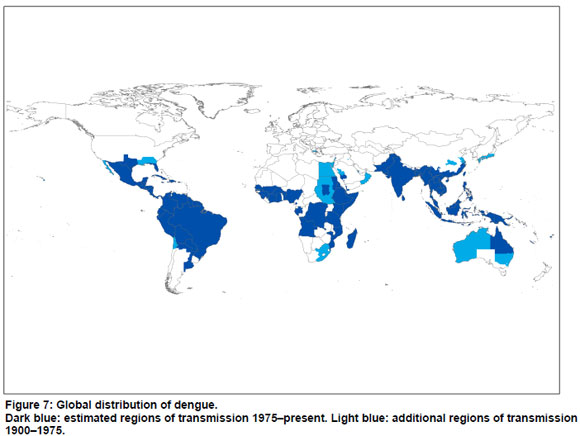
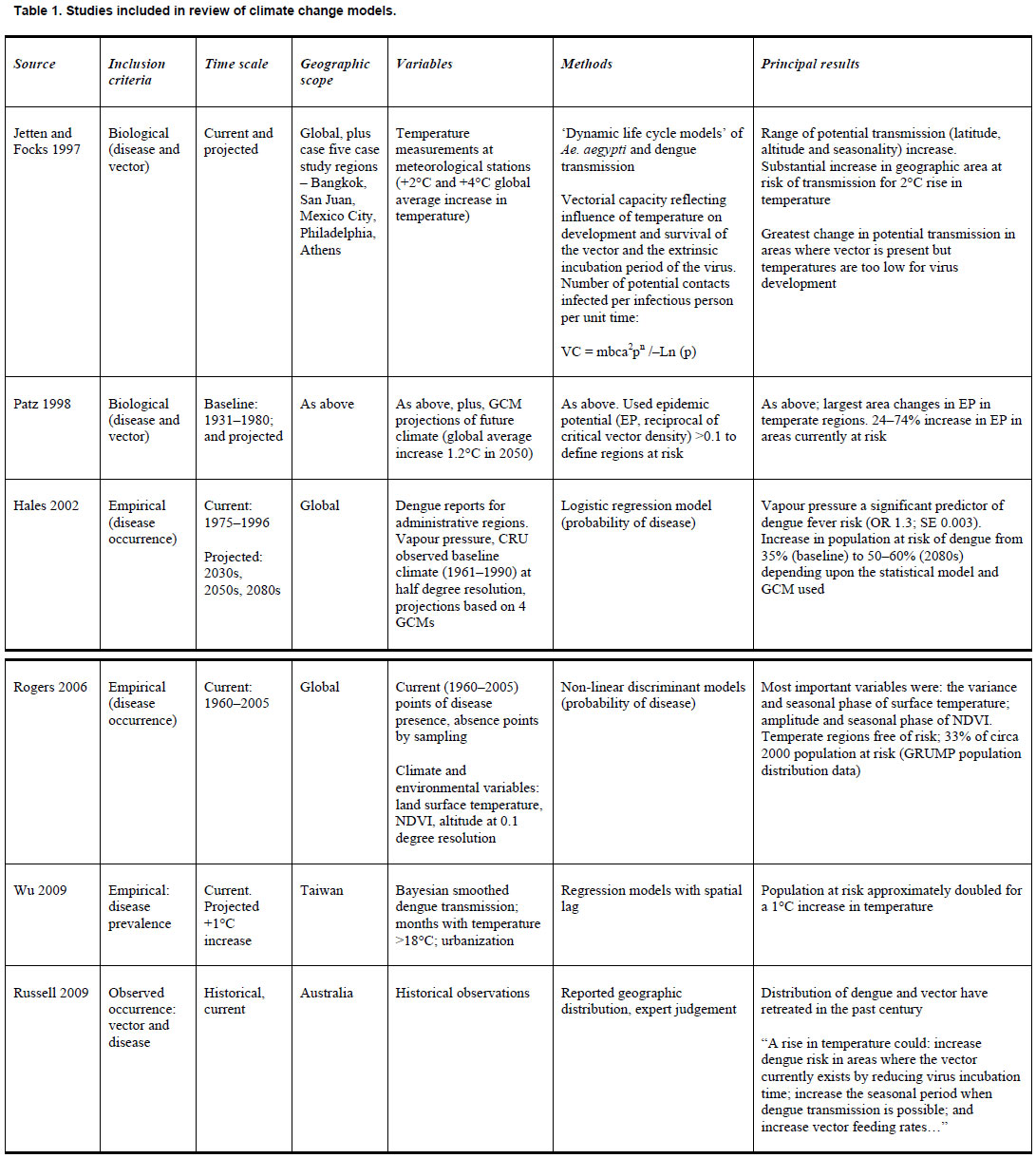
<body><![CDATA[<p>&nbsp;</p>      <p><font face="Verdana, Arial, Helvetica, sans-serif" size="2"><b>Summary: geographic    distribution of dengue</b></font></p>     <p><font face="Verdana, Arial, Helvetica, sans-serif" size="2">Estimated regions    of dengue transmission from 1900 to the present, and from 1975 to the present    are summarized in Figure 7, in which estimated regions of dengue transmission    for 1975-present are shown in dark blue; additional regions of dengue transmission    for 1900-1975 are shown in light blue. The map is based on the systematic review    in the present paper, and (for 1975-present), a recent map published by WHO    (3). Where there were differences between our findings and the WHO map, the    WHO map was assumed to be correct. </font></p>     <p>&nbsp;</p>     <p><font face="Verdana, Arial, Helvetica, sans-serif" size="3"><b>Review of climate    change models</b></font></p>     <p><font face="Verdana, Arial, Helvetica, sans-serif" size="2">The search of PubMed    yielded 45 articles and of Scopus 509 journal articles. Thirty-eight of the    554 articles from the combined searches were duplicates, leaving 516. One hundred    and seventy-one of these papers were on unrelated topics or did not consider    the relationships between the vector or the pathogen and environment (e.g. they    were about clinical presentation, vaccination and therapies, viral genetics,    larvicide development and mosquito control methods), leaving 345 papers. Six    papers met the eligibility criteria (see Figure 8). These six papers are summarized    in <a href="/img/revistas/tropika/2010nahead/a01tab1.jpg">Table 1</a>. Another 30 papers focused on    other variables relevant to climate change - e.g. interannual variability or    the urban landscape - but did not model the effects of climate change. </font></p>     <p><font face="Verdana, Arial, Helvetica, sans-serif" size="2">There are two broad    classes of vector-borne disease model: those based on theoretical considerations    (also known as mathematical or biological models) and those based on statistical    methods (also known as empirical models).</font></p>     <p><font face="Verdana, Arial, Helvetica, sans-serif" size="2">Jetten and Focks    modelled vectorial capacity (VC), defined as average number of potentially infective    contacts by a mosquito population per infectious person per year: </font></p>     <p align=center><font face="Verdana, Arial, Helvetica, sans-serif" size="2"><b>VC    = mbca<sup>2</sup>P<sup>n</sup> /-log<sup>e</sup> (P)</b></font></p>     <p><font face="Verdana, Arial, Helvetica, sans-serif" size="2">Here, <b>m</b>    is the number of female mosquitoes per person, <b>b</b> is the probability that    an infectious mosquito transmits dengue while biting a susceptible human, <b>c</b>    is the probability that a mosquito acquires a dengue infection while biting    a viraemic human, <b>a</b> is the number of bites per person per day, <b>n</b>    is the duration of the extrinsic incubation period (EIP), and <b>P</b> is the    survival rate of the mosquito (106). Setting VC=1, the epidemic potential (EP)    is the reciprocal of the critical vector density. </font></p>     ]]></body>
<body><![CDATA[<p>&nbsp;</p>     <p align="center"><img src="/img/revistas/tropika/2010nahead/a01fig7.jpg"></p>     <p>&nbsp;</p>     <p><font face="Verdana, Arial, Helvetica, sans-serif" size="2">Given a hypothetical    2-4°C increase in temperature, both the range of transmission (latitude and    altitude) and the length of transmission season were projected to increase,    and this was expected to reduce the average age of infection. A lower average    age of infection (caused by increased transmission risk) may lead to a greater    number of cases of severe dengue, as there is greater likelihood of multiple    infections over a lifetime with different serotypes. This would increase the    burden of the disease on individuals and increase the number of deaths from    dengue (106). </font></p>     <p><font face="Verdana, Arial, Helvetica, sans-serif" size="2">Patz et al. extended    this modelling by incorporating global climate model (GCM) projections of future    climate, rather than hypothetical temperature increases, to model the epidemic    potential (EP) of a number of regions (11). Baseline climate data for comparison    were from 1931 to 1980. EP was assumed to be independent of rainfall where artificial    containers exist. Temperature variability was not included, although it was    acknowledged that this may affect local breeding sites through evaporation.    There was an appreciable increase in EP with only very small increases in temperature,    up to a threshold of 40°C:</font></p>     <blockquote>       <p><font face="Verdana, Arial, Helvetica, sans-serif" size="2">&#34;Among the      three GCMs, the average projected temperature elevation was 1.16° C, expected      by the year 2050. All three GCMs projected a temperature-related increase      in potential seasonal transmission in five selected cities, as well as an      increase in global epidemic potential, with the largest area change occurring      in temperate regions. For regions already at risk, the aggregate epidemic      potential across the three scenarios rose on average between 31 and 47% (range,      24-74%).&#34; (11)</font></p> </blockquote>     <p><font face="Verdana, Arial, Helvetica, sans-serif" size="2">The authors concluded    that the model would be most accurate for regions bordering endemic regions,    where there are vulnerable people and vectors but transmission is currently    limited by temperature. </font></p>     <p><font face="Verdana, Arial, Helvetica, sans-serif" size="2">Hales et al. used    an empirical approach based on the reported distribution of dengue between 1975    and 1996 (107). The geographic limits of dengue fever transmission were modelled    using observed long-term average vapour pressure, a climate variable which depends    upon both rainfall and temperature. GCM projections of vapour pressure were    used to estimate climatic suitability for transmission in the 2030s, 2050s and    2080s. </font></p>     <blockquote>       ]]></body>
<body><![CDATA[<p><font face="Verdana, Arial, Helvetica, sans-serif" size="2">&#34;In 1990,      almost 30% of the world population, 1.5 billion people, lived in regions where      the estimated risk of dengue transmission was greater than 50%. With population      and climate change projections for 2085, we estimate that about 5-6 billion      people (50-60% of the projected global population) would be at risk of dengue      transmission, compared with 3.5 billion people, or 35% of the population,      if climate change did not happen.&#34; (107) </font></p> </blockquote>     <p><font face="Verdana, Arial, Helvetica, sans-serif" size="2">Rogers et al. fitted    non-linear discriminant models to the observed geographic distribution of dengue    (points of dengue presence 1960-2005) (103). The most important predictor variables    were the variance and seasonal phase of surface temperature, and the amplitude    and seasonal phase of the normalized difference vegetation index (NDVI). About    33% of the global population, in tropical and subtropical regions, was estimated    to be at risk, based on a modelled probability of dengue transmission of greater    than 50%.</font></p>     <p><font face="Verdana, Arial, Helvetica, sans-serif" size="2">Wu et al. used    regression models incorporating spatial lags to fit climate and environmental    data to smoothed rates of dengue notifications (1988-2002) within Taiwanese    townships (108). Months with temperature >18°C and urbanization were important    predictors. The estimated &#34;population at risk&#34; (the number of people    living in transmission risk zones) approximately doubled for each 1°C increase    in temperature.</font></p>     <p><font face="Verdana, Arial, Helvetica, sans-serif" size="2">Russell et al.    note that existing models based on the geographic distribution of dengue do    not account for earlier historical distributions of vector or disease and assert    that this overestimates areas at risk (109). In Australia for example, the area    where local transmission of dengue currently occurs is smaller than in the past:</font></p>     <blockquote>       <p><font face="Verdana, Arial, Helvetica, sans-serif" size="2">&#34;... Although      current vector distribution is restricted to Queensland, the area inhabited      by <i>A. aegypti</i> is larger than the disease-transmission areas, and is      not restricted by temperature (or vector-control programs); thus, it is unlikely      that rising temperatures alone will bring increased vector or virus distribution.&#34;      (109)</font></p> </blockquote>     <p><font face="Verdana, Arial, Helvetica, sans-serif" size="2">Russell et al.    concede that: &#34;A rise in temperature could… increase dengue risk in areas    where the vector currently exists by reducing virus incubation time&#34;. (109)</font></p>     <p><font face="Verdana, Arial, Helvetica, sans-serif" size="2"><b>Summary: modelling    studies</b></font></p>     <p><font face="Verdana, Arial, Helvetica, sans-serif" size="2">The findings of    theoretical and statistical models of dengue and climate are broadly consistent:    the transmission of dengue is highly sensitive to climate. Relatively small    increases in temperature (of the order of 1°C) can lead to substantial increases    in transmission potential. No studies have modelled the effect of climate trends    on dengue transmission over the past century. </font></p>     <p>&nbsp;</p>     ]]></body>
<body><![CDATA[<p><font face="Verdana, Arial, Helvetica, sans-serif" size="3"><b>Discussion</b></font></p>     <p><font face="Verdana, Arial, Helvetica, sans-serif" size="2">Dengue is endemic    in urban populations in tropical countries. Large epidemics of dengue have occurred    less frequently in subtropical regions, and rarely in cities in temperate regions.    </font></p>     <p><font face="Verdana, Arial, Helvetica, sans-serif" size="2">Although the exact    boundaries of current and historical transmission are impossible to establish    with certainty, we conclude that - despite increases in the geographic distribution    of dengue in recent decades - the current distribution of the disease is less    extensive than its historical limits. This geographic contraction has occurred    at the same time as increases in incidence in many countries. </font></p>     <p><font face="Verdana, Arial, Helvetica, sans-serif" size="2">Recently, local    transmission of dengue has been reported for the first time in several African    countries, Bhutan, Nepal and France (5-7). With the exception of the French    outbreak, which consisted of only two cases, it is difficult to be certain whether    these reports represent geographic spread of dengue, or the result of increased    awareness and reporting. On the other hand, dengue has returned after many decades    of absence in Hawaii and Florida, USA (8,9). </font></p>     <p><font face="Verdana, Arial, Helvetica, sans-serif" size="2">Areas of geographic    contraction of dengue, compared with historical limits, include the southern    states of North America, much of Australia, parts of southern Europe and Japan,    China and South Africa. Provision of piped water supplies and removal of water    storage tanks for domestic and other uses, other changes in housing conditions    (window screens and air conditioning) and targeted vector control measures have    plausibly contributed to this geographic contraction. Contraction of the geographic    distribution of dengue has occurred despite overall increases in temperature    over the past century. </font></p>     <p><font face="Verdana, Arial, Helvetica, sans-serif" size="2">Increases in poor    urban populations, greater human travel and trade worldwide, and breakdown in    public health measures may be primarily responsible for expansions in geographic    range and increased overall incidence of dengue in recent decades. </font></p>     <p><font face="Verdana, Arial, Helvetica, sans-serif" size="2">Has climate change    played a role in the resurgence of dengue? Surface temperatures have increased    by a global average of 0.75°C in the past century. Our best scientific understanding    is that temperature increases of this magnitude are associated with substantial    increases in dengue epidemic potential. Given that transmission also depends    on the interaction between numerous non-climatic local factors (e.g. breeding    sites, shelter, urban features, poverty, surveillance and control measures),    the impact of climate change cannot be quantified, based on current evidence.    On theoretical grounds, however, climate trends will have exacerbated    the effects of other factors at least in some areas.</font></p>     <p><font face="Verdana, Arial, Helvetica, sans-serif" size="2">Studies modelling    the potential effects of climate change on dengue project that there will be    increases in climatic suitability for transmission and an expansion of the geographic    regions at risk of dengue during this century. </font></p>     <p><font face="Verdana, Arial, Helvetica, sans-serif" size="2">The theoretical    models are particularly useful in defining the outer climatic limits of transmission    and the potential rate of transmission in the absence of limiting social and    other environmental factors. The empirical studies are useful in that they derive    from patterns of actual occurrence of transmission and thus include, in a crude    manner, the numerous human and smaller scale environmental factors that contribute    to dengue transmission. Such models may underestimate dengue potential in some    areas, while the theoretical models may overestimate potential in areas that    have, for example, effective control measures in place. Neither of these two    types of models account for the future distribution or effectiveness of factors    that limit transmission. </font></p>     <p><font face="Verdana, Arial, Helvetica, sans-serif" size="2">Whether or not    climate trends are indeed partly responsible for the recent resurgence of dengue,    models of the impact of climate change can indicate the future population at    risk of dengue, within the limitations of the modelling approach. The main limitation    is that the models project the <i>climatic suitability</i> for transmission.    They do not predict disease occurrence, which depends upon several limiting    or enhancing factors in addition to climate. These projections can only be considered    estimates of <i>areas suitable for transmission</i>, under the assumption that    today's relevant <i>non-climate</i> factors (e.g. housing quality and water    supplies, levels of poverty, public health, surveillance and control measures)    do not change over the coming century.</font></p>     ]]></body>
<body><![CDATA[<p><font face="Verdana, Arial, Helvetica, sans-serif" size="2">Mathematical models    of dengue do not account for the effect of non-climate factors. Empirical models    of spatial patterns of dengue <i>partly</i> account for the effect of non-climate    factors. This is because the geographic distribution of dengue on which these    empirical models are based is limited by the actual presence of all necessary    factors (vector, virus, susceptible human population, local physical and social    features). If vector, virus or human populations are absent from any regions    or countries that are climatically suitable for dengue, resulting models will    underestimate the geographic region that is climatically suitable. </font></p>     <p><font face="Verdana, Arial, Helvetica, sans-serif" size="2">Existing models    of dengue transmission provide limited, incomplete, but useful, projections    of disease risk. Spatial models could be improved by considering the historical    distribution of vectors and/or disease transmission, by incorporating data on    disease prevalence in addition to laboratory data on vector responses (breeding,    feeding, survival), and by considering local factors such as urbanization, population    density, poverty, mosquito control, water storage systems, travel and migration,    housing conditions and air-conditioning (109). Analytical studies incorporating    both climate and non-climate factors are now required, in order to assess the    significance of climate change as a driver of the emergence of dengue in the    past 50 years. As detailed geographic information on these factors is not available    for most countries or time periods, use of proxy variables such as gross domestic    product per capita may be helpful in improving models of dengue transmission.    </font></p>     <p><font face="Verdana, Arial, Helvetica, sans-serif" size="2">There are hints    that dengue may be returning to areas that have been free of the disease for    many decades. Dengue surveillance and control systems need to be strengthened,    especially in poor countries and on the fringes of current endemic regions.    Although climate change has not had a clear effect on the geographic distribution    of dengue in the past century, this does not imply there has been no effect,    or that the future impact of climate change on dengue can be ignored. </font></p>     <p><font face="Verdana, Arial, Helvetica, sans-serif" size="2">Historically, control    of dengue has been, at best, difficult to sustain. Since global climate change    is a progressive and potentially irreversible phenomenon, prudent policy requires    that we stabilize the global climate as soon as possible. Otherwise, control    of dengue will be harder to achieve, even under optimistic scenarios of future    development.</font></p>     <p>&nbsp;</p>     <p><font face="Verdana, Arial, Helvetica, sans-serif" size="3"><b>Summary box</b></font></p>     <p><font face="Verdana, Arial, Helvetica, sans-serif" size="2"> <i><b>What has    been learned from this review?</b></i></font></p> <font face="Verdana, Arial, Helvetica, sans-serif" size="2">  <ul>      <li>Geographic limits are difficult to establish with certainty, due to reliability issues with the    available data on historical outbreaks, as well as the poor reporting of dengue    epidemiology to date. The current distribution of dengue appears generally less    extensive than the historical limits of the disease.    <br>       <li>No studies have yet quantified the impact of climate change on the historical    distribution of dengue. This is an important research gap. Existing models project    increases in climatic suitability for transmission and an expansion of the geographic    regions at risk of dengue in the 21st century.</li>    ]]></body>
<body><![CDATA[</ul> </font> <font face="Verdana, Arial, Helvetica, sans-serif" size="2"><b><i>Implications    for public health practice</i></b></font> <font face="Verdana, Arial, Helvetica, sans-serif" size="2">  <ul>      <li>Reporting of dengue remains poor and adequate figures on dengue epidemiology are sparse. However,    they will be crucial for future predictions of dengue spread. For this reason    we emphasize the importance of improving the reporting system for the disease.    <br>       <li>Factors associated with urban poverty – such as poor housing quality and stored    domestic water, along with a minimal capacity for surveillance and control measures    – remain important promoters of dengue transmission within favourable climates.</li>    </ul>    </font>     <p><font face="Verdana, Arial, Helvetica, sans-serif" size="2"><b><i>Priority    research areas</i></b></font></p> <font face="Verdana, Arial, Helvetica, sans-serif" size="2">  <ul>      <li>Further understanding of the disappearance, or the emergence, of the disease in particular areas might    provide additional insight into the (potential) global distribution of dengue    with climate change.     <br>       <li>Improvement of existing spatial models of disease transmission by considering    the historical distribution of vectors and disease transmission, as well as    accounting for local factors (e.g. urbanization, population density, poverty,    mosquito control, water storage, travel and migration, housing conditions and    air-conditioning).</li>    </ul></font>     ]]></body>
<body><![CDATA[<p>&nbsp;</p>      <p><font face="Verdana, Arial, Helvetica, sans-serif" size="3"><b>References</b></font></p>     <!-- ref --><p align=left><font face="Verdana, Arial, Helvetica, sans-serif" size="2">1. WHO    (2008). Dengue and dengue haemorrhagic fever. Geneva, World Health Organization.    &nbsp;&nbsp;&nbsp;&nbsp;&nbsp;&nbsp;&nbsp;&nbsp;[&#160;<a href="javascript:void(0);" onclick="javascript: window.open('/scielo.php?script=sci_nlinks&ref=001008&pid=S2078-8606201000500000100001&lng=','','width=640,height=500,resizable=yes,scrollbars=1,menubar=yes,');">Links</a>&#160;]<!-- end-ref --></font></p>     <!-- ref --><p align=left><font face="Verdana, Arial, Helvetica, sans-serif" size="2">2. Halstead    S, Suaya J, Shepard D (2007). The burden of dengue infection. Lancet; 369:1411-1412.    &nbsp;&nbsp;&nbsp;&nbsp;&nbsp;&nbsp;&nbsp;&nbsp;[&#160;<a href="javascript:void(0);" onclick="javascript: window.open('/scielo.php?script=sci_nlinks&ref=001010&pid=S2078-8606201000500000100002&lng=','','width=640,height=500,resizable=yes,scrollbars=1,menubar=yes,');">Links</a>&#160;]<!-- end-ref --></font></p>     <!-- ref --><p align=left><font face="Verdana, Arial, Helvetica, sans-serif" size="2">3.WHO    (2009). Dengue: guidelines for diagnosis, treatment and control. Geneva, World    Health Organization.    &nbsp;&nbsp;&nbsp;&nbsp;&nbsp;&nbsp;&nbsp;&nbsp;[&#160;<a href="javascript:void(0);" onclick="javascript: window.open('/scielo.php?script=sci_nlinks&ref=001012&pid=S2078-8606201000500000100003&lng=','','width=640,height=500,resizable=yes,scrollbars=1,menubar=yes,');">Links</a>&#160;]<!-- end-ref --></font></p>     <!-- ref --><p align=left><font face="Verdana, Arial, Helvetica, sans-serif" size="2">4. Nathan    M, Dayal-Drager R, Guzman M (2009). In: Dengue: guidelines for diagnosis, treatment    and control. Geneva, World Health Organization.    &nbsp;&nbsp;&nbsp;&nbsp;&nbsp;&nbsp;&nbsp;&nbsp;[&#160;<a href="javascript:void(0);" onclick="javascript: window.open('/scielo.php?script=sci_nlinks&ref=001014&pid=S2078-8606201000500000100004&lng=','','width=640,height=500,resizable=yes,scrollbars=1,menubar=yes,');">Links</a>&#160;]<!-- end-ref --></font></p>     ]]></body>
<body><![CDATA[<!-- ref --><p align=left><font face="Verdana, Arial, Helvetica, sans-serif" size="2">5. Dorji    T, Yoon K, Holmes E (2009). Diversity and origin of dengue virus serotypes 1,    2, and 3, Bhutan. Emerg Infect Dis; 15:1630-1632.    &nbsp;&nbsp;&nbsp;&nbsp;&nbsp;&nbsp;&nbsp;&nbsp;[&#160;<a href="javascript:void(0);" onclick="javascript: window.open('/scielo.php?script=sci_nlinks&ref=001016&pid=S2078-8606201000500000100005&lng=','','width=640,height=500,resizable=yes,scrollbars=1,menubar=yes,');">Links</a>&#160;]<!-- end-ref --></font></p>     <!-- ref --><p align=left><font face="Verdana, Arial, Helvetica, sans-serif" size="2">6.Pandey    B, Morita K, Khanal S (2008). Dengue virus, Nepal. Emerg Infect Dis; 14:514-515.    &nbsp;&nbsp;&nbsp;&nbsp;&nbsp;&nbsp;&nbsp;&nbsp;[&#160;<a href="javascript:void(0);" onclick="javascript: window.open('/scielo.php?script=sci_nlinks&ref=001018&pid=S2078-8606201000500000100006&lng=','','width=640,height=500,resizable=yes,scrollbars=1,menubar=yes,');">Links</a>&#160;]<!-- end-ref --></font></p>     <!-- ref --><p align=left><font face="Verdana, Arial, Helvetica, sans-serif" size="2">7.La    Ruche G, Souarès Y, Armengaud A (2010). First two autochthonous dengue virus    infections in metropolitan France, September 2010. Eurosurveill; 15:19676.    &nbsp;&nbsp;&nbsp;&nbsp;&nbsp;&nbsp;&nbsp;&nbsp;[&#160;<a href="javascript:void(0);" onclick="javascript: window.open('/scielo.php?script=sci_nlinks&ref=001020&pid=S2078-8606201000500000100007&lng=','','width=640,height=500,resizable=yes,scrollbars=1,menubar=yes,');">Links</a>&#160;]<!-- end-ref --></font></p>     <!-- ref --><p align=left><font face="Verdana, Arial, Helvetica, sans-serif" size="2">8.Effler    P, Pang L, Kitsutani P et al. (2005). Dengue fever, Hawaii, 2001-2002. Emerg    Infect Dis; 11:742-749.    &nbsp;&nbsp;&nbsp;&nbsp;&nbsp;&nbsp;&nbsp;&nbsp;[&#160;<a href="javascript:void(0);" onclick="javascript: window.open('/scielo.php?script=sci_nlinks&ref=001022&pid=S2078-8606201000500000100008&lng=','','width=640,height=500,resizable=yes,scrollbars=1,menubar=yes,');">Links</a>&#160;]<!-- end-ref --> </font></p>     <!-- ref --><p align=left><font face="Verdana, Arial, Helvetica, sans-serif" size="2">9.Trout    A, Baracco G, Rodrigue M (2010). Locally Acquired Dengue, Key West, Florida    2009-2010. Morbidity and Mortality Weekly Report (MMWR); 59:577-581.    &nbsp;&nbsp;&nbsp;&nbsp;&nbsp;&nbsp;&nbsp;&nbsp;[&#160;<a href="javascript:void(0);" onclick="javascript: window.open('/scielo.php?script=sci_nlinks&ref=001024&pid=S2078-8606201000500000100009&lng=','','width=640,height=500,resizable=yes,scrollbars=1,menubar=yes,');">Links</a>&#160;]<!-- end-ref --></font></p>     ]]></body>
<body><![CDATA[<!-- ref --><p align=left><font face="Verdana, Arial, Helvetica, sans-serif" size="2">10.Gubler    D J (1997). In: Gubler DJ, Kuno G, eds. Dengue and Dengue Hemorrhagic fever.    Oxfordshire, CABI, Chapter 1.    &nbsp;&nbsp;&nbsp;&nbsp;&nbsp;&nbsp;&nbsp;&nbsp;[&#160;<a href="javascript:void(0);" onclick="javascript: window.open('/scielo.php?script=sci_nlinks&ref=001026&pid=S2078-8606201000500000100010&lng=','','width=640,height=500,resizable=yes,scrollbars=1,menubar=yes,');">Links</a>&#160;]<!-- end-ref --></font></p>     <!-- ref --><p align=left><font face="Verdana, Arial, Helvetica, sans-serif" size="2">11.Patz    J, Martens W, Focks D et al. (1998). Dengue fever epidemic potential as projected    by general circulation models of global climate change. Environ Health Perspect;    106:147-153.    &nbsp;&nbsp;&nbsp;&nbsp;&nbsp;&nbsp;&nbsp;&nbsp;[&#160;<a href="javascript:void(0);" onclick="javascript: window.open('/scielo.php?script=sci_nlinks&ref=001028&pid=S2078-8606201000500000100011&lng=','','width=640,height=500,resizable=yes,scrollbars=1,menubar=yes,');">Links</a>&#160;]<!-- end-ref --></font></p>     <!-- ref --><p align=left><font face="Verdana, Arial, Helvetica, sans-serif" size="2">12.Rigau-Perez    JG, Clark G, Gubler DJ et al. (1998). Dengue and dengue haemorrhagic fever.    Lancet; 352:971-977.    &nbsp;&nbsp;&nbsp;&nbsp;&nbsp;&nbsp;&nbsp;&nbsp;[&#160;<a href="javascript:void(0);" onclick="javascript: window.open('/scielo.php?script=sci_nlinks&ref=001030&pid=S2078-8606201000500000100012&lng=','','width=640,height=500,resizable=yes,scrollbars=1,menubar=yes,');">Links</a>&#160;]<!-- end-ref --></font></p>     <!-- ref --><p align=left><font face="Verdana, Arial, Helvetica, sans-serif" size="2">13.Pinheiro    F, Corber S (1997). Global situation of dengue and dengue haemorrhagic fever,    and its emergence in the Americas. World Health Stat Q; 50:161-169.    &nbsp;&nbsp;&nbsp;&nbsp;&nbsp;&nbsp;&nbsp;&nbsp;[&#160;<a href="javascript:void(0);" onclick="javascript: window.open('/scielo.php?script=sci_nlinks&ref=001032&pid=S2078-8606201000500000100013&lng=','','width=640,height=500,resizable=yes,scrollbars=1,menubar=yes,');">Links</a>&#160;]<!-- end-ref --></font></p>     <!-- ref --><p align=left><font face="Verdana, Arial, Helvetica, sans-serif" size="2">14.Kovats    R, Campbell-Lendrum DH, McMichel AJ et al. (2001). Early effects of climate    change: do they include changes in vector-borne disease? Philos Trans R Soc    Lond B Biol Sci; 356:1057-1068.    &nbsp;&nbsp;&nbsp;&nbsp;&nbsp;&nbsp;&nbsp;&nbsp;[&#160;<a href="javascript:void(0);" onclick="javascript: window.open('/scielo.php?script=sci_nlinks&ref=001034&pid=S2078-8606201000500000100014&lng=','','width=640,height=500,resizable=yes,scrollbars=1,menubar=yes,');">Links</a>&#160;]<!-- end-ref --></font></p>     ]]></body>
<body><![CDATA[<!-- ref --><p align=left><font face="Verdana, Arial, Helvetica, sans-serif" size="2">15.McMichael    A, Woodruff R, Hales S (2006). Climate change and human health: present and    future risks. Lancet; 367:859-869.    &nbsp;&nbsp;&nbsp;&nbsp;&nbsp;&nbsp;&nbsp;&nbsp;[&#160;<a href="javascript:void(0);" onclick="javascript: window.open('/scielo.php?script=sci_nlinks&ref=001036&pid=S2078-8606201000500000100015&lng=','','width=640,height=500,resizable=yes,scrollbars=1,menubar=yes,');">Links</a>&#160;]<!-- end-ref --></font></p>     <!-- ref --><p align=left><font face="Verdana, Arial, Helvetica, sans-serif" size="2">16.Kuno    G (2009). Emergence of the severe syndrome and mortality associated with dengue    and dengue-like illness: historical records (1890 to 1950) and their compatibility    with current hypotheses on the shift of disease manifestation. Clin Microbiol    Rev; 22:186-201.    &nbsp;&nbsp;&nbsp;&nbsp;&nbsp;&nbsp;&nbsp;&nbsp;[&#160;<a href="javascript:void(0);" onclick="javascript: window.open('/scielo.php?script=sci_nlinks&ref=001038&pid=S2078-8606201000500000100016&lng=','','width=640,height=500,resizable=yes,scrollbars=1,menubar=yes,');">Links</a>&#160;]<!-- end-ref --></font></p>     <!-- ref --><p align=left><font face="Verdana, Arial, Helvetica, sans-serif" size="2">17.Kuno    G (2007). Research on dengue and dengue-like illness in East Asia and the Western    Pacific during the first half of the 20th century. Rev Med Virol; 17:327-341.    &nbsp;&nbsp;&nbsp;&nbsp;&nbsp;&nbsp;&nbsp;&nbsp;[&#160;<a href="javascript:void(0);" onclick="javascript: window.open('/scielo.php?script=sci_nlinks&ref=001040&pid=S2078-8606201000500000100017&lng=','','width=640,height=500,resizable=yes,scrollbars=1,menubar=yes,');">Links</a>&#160;]<!-- end-ref --></font></p>     <!-- ref --><p align=left><font face="Verdana, Arial, Helvetica, sans-serif" size="2">18.Gratz    NG, Knudsen AB (1996). The rise and spread of dengue, dengue haemorrhagic fever    and its vectors: a historical overview. Geneva, World Health Organization.    &nbsp;&nbsp;&nbsp;&nbsp;&nbsp;&nbsp;&nbsp;&nbsp;[&#160;<a href="javascript:void(0);" onclick="javascript: window.open('/scielo.php?script=sci_nlinks&ref=001042&pid=S2078-8606201000500000100018&lng=','','width=640,height=500,resizable=yes,scrollbars=1,menubar=yes,');">Links</a>&#160;]<!-- end-ref --></font></p>     <!-- ref --><p align=left><font face="Verdana, Arial, Helvetica, sans-serif" size="2">19.Hirsch    A (1883). Geographical and Historical Pathology - Volume I: Acute Infectious    Diseases. The New Sydenham Society.    &nbsp;&nbsp;&nbsp;&nbsp;&nbsp;&nbsp;&nbsp;&nbsp;[&#160;<a href="javascript:void(0);" onclick="javascript: window.open('/scielo.php?script=sci_nlinks&ref=001044&pid=S2078-8606201000500000100019&lng=','','width=640,height=500,resizable=yes,scrollbars=1,menubar=yes,');">Links</a>&#160;]<!-- end-ref --></font></p>     ]]></body>
<body><![CDATA[<!-- ref --><p align=left><font face="Verdana, Arial, Helvetica, sans-serif" size="2">20.van    Rooyen C, Rhodes A (1948). Virus Diseases of Man, 2nd edn, Thomas Nelson and    Sons.    &nbsp;&nbsp;&nbsp;&nbsp;&nbsp;&nbsp;&nbsp;&nbsp;[&#160;<a href="javascript:void(0);" onclick="javascript: window.open('/scielo.php?script=sci_nlinks&ref=001046&pid=S2078-8606201000500000100020&lng=','','width=640,height=500,resizable=yes,scrollbars=1,menubar=yes,');">Links</a>&#160;]<!-- end-ref --></font></p>     <!-- ref --><p align=left><font face="Verdana, Arial, Helvetica, sans-serif" size="2">21.Carey    DE (1971). Chikungunya and dengue: a case of mistaken identity? J Hist Med Allied    Sci; 26:243-262.    &nbsp;&nbsp;&nbsp;&nbsp;&nbsp;&nbsp;&nbsp;&nbsp;[&#160;<a href="javascript:void(0);" onclick="javascript: window.open('/scielo.php?script=sci_nlinks&ref=001048&pid=S2078-8606201000500000100021&lng=','','width=640,height=500,resizable=yes,scrollbars=1,menubar=yes,');">Links</a>&#160;]<!-- end-ref --></font></p>     <!-- ref --><p align=left><font face="Verdana, Arial, Helvetica, sans-serif" size="2">22.Scott    HH (1943). The influence of the slave-trade in the spread of tropical disease.    Trans R Soc Trop Med Hyg; XXXVII:169-188.    &nbsp;&nbsp;&nbsp;&nbsp;&nbsp;&nbsp;&nbsp;&nbsp;[&#160;<a href="javascript:void(0);" onclick="javascript: window.open('/scielo.php?script=sci_nlinks&ref=001050&pid=S2078-8606201000500000100022&lng=','','width=640,height=500,resizable=yes,scrollbars=1,menubar=yes,');">Links</a>&#160;]<!-- end-ref --></font></p>     <!-- ref --><p align=left><font face="Verdana, Arial, Helvetica, sans-serif" size="2">23.Ulmann    E (1957). The geographical distribution of dengue up to 1957. World Atlas of    Epidemic Diseases, Part III. Falk-Verlag.    &nbsp;&nbsp;&nbsp;&nbsp;&nbsp;&nbsp;&nbsp;&nbsp;[&#160;<a href="javascript:void(0);" onclick="javascript: window.open('/scielo.php?script=sci_nlinks&ref=001052&pid=S2078-8606201000500000100023&lng=','','width=640,height=500,resizable=yes,scrollbars=1,menubar=yes,');">Links</a>&#160;]<!-- end-ref --></font></p>     <!-- ref --><p align=left><font face="Verdana, Arial, Helvetica, sans-serif" size="2">24.Gubler    DJ (1997). Epidemic Dengue/Dengue Haemorrhagic Fever: A Global Public Health    Problem in the 21st Century. Dengue Bulletin; 21:1-29.    &nbsp;&nbsp;&nbsp;&nbsp;&nbsp;&nbsp;&nbsp;&nbsp;[&#160;<a href="javascript:void(0);" onclick="javascript: window.open('/scielo.php?script=sci_nlinks&ref=001054&pid=S2078-8606201000500000100024&lng=','','width=640,height=500,resizable=yes,scrollbars=1,menubar=yes,');">Links</a>&#160;]<!-- end-ref --></font></p>     ]]></body>
<body><![CDATA[<!-- ref --><p align=left><font face="Verdana, Arial, Helvetica, sans-serif" size="2">25.WHO    (2009) Dengue in Africa: emergence of DENV-3, Côte d'Ivoire, 2008. Wkly Epidemiol    Rec; 84:85-88.    &nbsp;&nbsp;&nbsp;&nbsp;&nbsp;&nbsp;&nbsp;&nbsp;[&#160;<a href="javascript:void(0);" onclick="javascript: window.open('/scielo.php?script=sci_nlinks&ref=001056&pid=S2078-8606201000500000100025&lng=','','width=640,height=500,resizable=yes,scrollbars=1,menubar=yes,');">Links</a>&#160;]<!-- end-ref --></font></p>     <!-- ref --><p align=left><font face="Verdana, Arial, Helvetica, sans-serif" size="2">26.Rodier    GR, Gubler DJ, Cope SE et al. (1996). Epidemic dengue 2 in the city of Djibouti    1991-1992. Trans R Soc Trop Med Hyg; 90:237-240.    &nbsp;&nbsp;&nbsp;&nbsp;&nbsp;&nbsp;&nbsp;&nbsp;[&#160;<a href="javascript:void(0);" onclick="javascript: window.open('/scielo.php?script=sci_nlinks&ref=001058&pid=S2078-8606201000500000100026&lng=','','width=640,height=500,resizable=yes,scrollbars=1,menubar=yes,');">Links</a>&#160;]<!-- end-ref --></font></p>     <!-- ref --><p align=left><font face="Verdana, Arial, Helvetica, sans-serif" size="2">27.Rodier    GR, Parra JP, Kamil M et al. (1995). Recurrence and emergence of infectious    diseases in Djibouti city. Bull World Health Organ; 73:755-759.    &nbsp;&nbsp;&nbsp;&nbsp;&nbsp;&nbsp;&nbsp;&nbsp;[&#160;<a href="javascript:void(0);" onclick="javascript: window.open('/scielo.php?script=sci_nlinks&ref=001060&pid=S2078-8606201000500000100027&lng=','','width=640,height=500,resizable=yes,scrollbars=1,menubar=yes,');">Links</a>&#160;]<!-- end-ref --></font></p>     <!-- ref --><p align=left><font face="Verdana, Arial, Helvetica, sans-serif" size="2">28.Robinson    MC (1956). An epidemic of a dengue-like fever in the southern province of Tanganyika.    Cent Afr J Med; 2:394-396.    &nbsp;&nbsp;&nbsp;&nbsp;&nbsp;&nbsp;&nbsp;&nbsp;[&#160;<a href="javascript:void(0);" onclick="javascript: window.open('/scielo.php?script=sci_nlinks&ref=001062&pid=S2078-8606201000500000100028&lng=','','width=640,height=500,resizable=yes,scrollbars=1,menubar=yes,');">Links</a>&#160;]<!-- end-ref --></font></p>     <!-- ref --><p align=left><font face="Verdana, Arial, Helvetica, sans-serif" size="2">29.McCarthy    DD, Bagster Wilson D (1948). Dengue in the East African command incidence in    relation to Aëdes prevalence and some clinical features. Trans R Soc Trop Med    Hyg; 42:83-88.    &nbsp;&nbsp;&nbsp;&nbsp;&nbsp;&nbsp;&nbsp;&nbsp;[&#160;<a href="javascript:void(0);" onclick="javascript: window.open('/scielo.php?script=sci_nlinks&ref=001064&pid=S2078-8606201000500000100029&lng=','','width=640,height=500,resizable=yes,scrollbars=1,menubar=yes,');">Links</a>&#160;]<!-- end-ref --></font></p>     ]]></body>
<body><![CDATA[<!-- ref --><p align=left><font face="Verdana, Arial, Helvetica, sans-serif" size="2">30.Julvez    J, Ragavoodoo C, Gopaul AR et al. (1998). [Human diseases transmitted by Culicidae    in southwest Indian Ocean islands]. Bull Soc Pathol Exot; 91:99-103.    &nbsp;&nbsp;&nbsp;&nbsp;&nbsp;&nbsp;&nbsp;&nbsp;[&#160;<a href="javascript:void(0);" onclick="javascript: window.open('/scielo.php?script=sci_nlinks&ref=001066&pid=S2078-8606201000500000100030&lng=','','width=640,height=500,resizable=yes,scrollbars=1,menubar=yes,');">Links</a>&#160;]<!-- end-ref --></font></p>     <!-- ref --><p align=left><font face="Verdana, Arial, Helvetica, sans-serif" size="2">31.Boisier    P, Morvan JM, Laventure S et al. (1994). [Dengue 1 epidemic in the Grand Comoro    Island (Federal Islamic Republic of the Comores). March-May 1993]. Ann Soc Belg    Med Trop; 74:217-229.    &nbsp;&nbsp;&nbsp;&nbsp;&nbsp;&nbsp;&nbsp;&nbsp;[&#160;<a href="javascript:void(0);" onclick="javascript: window.open('/scielo.php?script=sci_nlinks&ref=001068&pid=S2078-8606201000500000100031&lng=','','width=640,height=500,resizable=yes,scrollbars=1,menubar=yes,');">Links</a>&#160;]<!-- end-ref --></font></p>     <!-- ref --><p align=left><font face="Verdana, Arial, Helvetica, sans-serif" size="2">32.Morvan    JM, Boisier P, Laventure S et al. (1994). An outbreak of type 1 dengue fever    on Grande Comore island. S Afr Med J; 84:298.    &nbsp;&nbsp;&nbsp;&nbsp;&nbsp;&nbsp;&nbsp;&nbsp;[&#160;<a href="javascript:void(0);" onclick="javascript: window.open('/scielo.php?script=sci_nlinks&ref=001070&pid=S2078-8606201000500000100032&lng=','','width=640,height=500,resizable=yes,scrollbars=1,menubar=yes,');">Links</a>&#160;]<!-- end-ref --></font></p>     <!-- ref --><p align=left><font face="Verdana, Arial, Helvetica, sans-serif" size="2">33.Johnson    BK, Ocheng D, Gichogo A et al. (1982). Epidemic dengue fever caused by dengue    type 2 virus in Kenya: preliminary results of human virological and serological    studies. East Afr Med J; 59:781-784.    &nbsp;&nbsp;&nbsp;&nbsp;&nbsp;&nbsp;&nbsp;&nbsp;[&#160;<a href="javascript:void(0);" onclick="javascript: window.open('/scielo.php?script=sci_nlinks&ref=001072&pid=S2078-8606201000500000100033&lng=','','width=640,height=500,resizable=yes,scrollbars=1,menubar=yes,');">Links</a>&#160;]<!-- end-ref --></font></p>     <!-- ref --><p align=left><font face="Verdana, Arial, Helvetica, sans-serif" size="2">34.Sang    RC (2007). Dengue in Africa. TropIKA.net. Available online only: <a href="http://www.tropika.net/svc/review/061001-Dengue_in_Africa" target="_blank">http://www.tropika.net/svc/review/061001-Dengue_in_Africa</a>.    &nbsp;&nbsp;&nbsp;&nbsp;&nbsp;&nbsp;&nbsp;&nbsp;[&#160;<a href="javascript:void(0);" onclick="javascript: window.open('/scielo.php?script=sci_nlinks&ref=001074&pid=S2078-8606201000500000100034&lng=','','width=640,height=500,resizable=yes,scrollbars=1,menubar=yes,');">Links</a>&#160;]<!-- end-ref --></font></p>     ]]></body>
<body><![CDATA[<!-- ref --><p align=left><font face="Verdana, Arial, Helvetica, sans-serif" size="2">35.Johnson    BK, Musoke S, Ocheng D et al. (1982). Dengue-2 virus in Kenya. Lancet; 2:208-209.    &nbsp;&nbsp;&nbsp;&nbsp;&nbsp;&nbsp;&nbsp;&nbsp;[&#160;<a href="javascript:void(0);" onclick="javascript: window.open('/scielo.php?script=sci_nlinks&ref=001076&pid=S2078-8606201000500000100035&lng=','','width=640,height=500,resizable=yes,scrollbars=1,menubar=yes,');">Links</a>&#160;]<!-- end-ref --></font></p>     <!-- ref --><p align=left><font face="Verdana, Arial, Helvetica, sans-serif" size="2">36.Kanesa-thasan    N, Chang GJ, Smoak BL et al. (1998). Molecular and epidemiologic analysis of    dengue virus isolates from Somalia. Emerg Infect Dis; 4:299-303.    &nbsp;&nbsp;&nbsp;&nbsp;&nbsp;&nbsp;&nbsp;&nbsp;[&#160;<a href="javascript:void(0);" onclick="javascript: window.open('/scielo.php?script=sci_nlinks&ref=001078&pid=S2078-8606201000500000100036&lng=','','width=640,height=500,resizable=yes,scrollbars=1,menubar=yes,');">Links</a>&#160;]<!-- end-ref --></font></p>     <!-- ref --><p align=left><font face="Verdana, Arial, Helvetica, sans-serif" size="2">37.Saleh    AS, Hassan A, Scott RM et al. (1985). Dengue in north-east Africa. Lancet; 2:211-212.    &nbsp;&nbsp;&nbsp;&nbsp;&nbsp;&nbsp;&nbsp;&nbsp;[&#160;<a href="javascript:void(0);" onclick="javascript: window.open('/scielo.php?script=sci_nlinks&ref=001080&pid=S2078-8606201000500000100037&lng=','','width=640,height=500,resizable=yes,scrollbars=1,menubar=yes,');">Links</a>&#160;]<!-- end-ref --></font></p>     <!-- ref --><p align=left><font face="Verdana, Arial, Helvetica, sans-serif" size="2">38.Botros    BA, Watts DM, Soliman AK et al. (1989). Serological evidence of dengue fever    among refugees, Hargeysa, Somalia. J Med Virol; 29:79-81.    &nbsp;&nbsp;&nbsp;&nbsp;&nbsp;&nbsp;&nbsp;&nbsp;[&#160;<a href="javascript:void(0);" onclick="javascript: window.open('/scielo.php?script=sci_nlinks&ref=001082&pid=S2078-8606201000500000100038&lng=','','width=640,height=500,resizable=yes,scrollbars=1,menubar=yes,');">Links</a>&#160;]<!-- end-ref --></font></p>     <!-- ref --><p align=left><font face="Verdana, Arial, Helvetica, sans-serif" size="2">39.Metselaar    D, Grainger CR, Oei KG et al. (1980). An outbreak of type 2 dengue fever in    the Seychelles, probably transmitted by Aedes albopictus (Skuse). Bull World    Health Organ; 58:937-943.    &nbsp;&nbsp;&nbsp;&nbsp;&nbsp;&nbsp;&nbsp;&nbsp;[&#160;<a href="javascript:void(0);" onclick="javascript: window.open('/scielo.php?script=sci_nlinks&ref=001084&pid=S2078-8606201000500000100039&lng=','','width=640,height=500,resizable=yes,scrollbars=1,menubar=yes,');">Links</a>&#160;]<!-- end-ref --></font></p>     ]]></body>
<body><![CDATA[<!-- ref --><p align=left><font face="Verdana, Arial, Helvetica, sans-serif" size="2">40.Coulanges    P, Clercy Y, Jousset FX et al. (1979). [Dengue at Reunion: isolation of a strain    at the Pasteur Institute of Madagascar]. Bull Soc Pathol Exot Filiales; 72:205-209.    &nbsp;&nbsp;&nbsp;&nbsp;&nbsp;&nbsp;&nbsp;&nbsp;[&#160;<a href="javascript:void(0);" onclick="javascript: window.open('/scielo.php?script=sci_nlinks&ref=001086&pid=S2078-8606201000500000100040&lng=','','width=640,height=500,resizable=yes,scrollbars=1,menubar=yes,');">Links</a>&#160;]<!-- end-ref --></font></p>     <!-- ref --><p align=left><font face="Verdana, Arial, Helvetica, sans-serif" size="2">41.Kles    V, Michault A, Rodhain F et al. (1994). [A serological survey regarding Flaviviridae    infections on the island of Reunion (1971-1989)]. Bull Soc Pathol Exot; 87:71-76.    &nbsp;&nbsp;&nbsp;&nbsp;&nbsp;&nbsp;&nbsp;&nbsp;[&#160;<a href="javascript:void(0);" onclick="javascript: window.open('/scielo.php?script=sci_nlinks&ref=001088&pid=S2078-8606201000500000100041&lng=','','width=640,height=500,resizable=yes,scrollbars=1,menubar=yes,');">Links</a>&#160;]<!-- end-ref --></font></p>     <!-- ref --><p align=left><font face="Verdana, Arial, Helvetica, sans-serif" size="2">42.Ramchurn    SK, Moheeput K, Goorah SS (2009). An analysis of a short-lived outbreak of dengue    fever in Mauritius. Euro Surveill; 14:19314.    &nbsp;&nbsp;&nbsp;&nbsp;&nbsp;&nbsp;&nbsp;&nbsp;[&#160;<a href="javascript:void(0);" onclick="javascript: window.open('/scielo.php?script=sci_nlinks&ref=001090&pid=S2078-8606201000500000100042&lng=','','width=640,height=500,resizable=yes,scrollbars=1,menubar=yes,');">Links</a>&#160;]<!-- end-ref --></font></p>     <!-- ref --><p align=left><font face="Verdana, Arial, Helvetica, sans-serif" size="2">43.Gubler    DJ, Sather GE, Kuno G et al. (1986). Dengue 3 virus transmission in Africa.    Am J Trop Med Hyg; 35:1280-1284.    &nbsp;&nbsp;&nbsp;&nbsp;&nbsp;&nbsp;&nbsp;&nbsp;[&#160;<a href="javascript:void(0);" onclick="javascript: window.open('/scielo.php?script=sci_nlinks&ref=001092&pid=S2078-8606201000500000100043&lng=','','width=640,height=500,resizable=yes,scrollbars=1,menubar=yes,');">Links</a>&#160;]<!-- end-ref --></font></p>     <!-- ref --><p align=left><font face="Verdana, Arial, Helvetica, sans-serif" size="2">44.Messer    WB, Gubler DJ, Harris E et al. (2003). Emergence and global spread of a dengue    serotype 3, subtype III virus. Emerg Infect Dis; 9:800-809.    &nbsp;&nbsp;&nbsp;&nbsp;&nbsp;&nbsp;&nbsp;&nbsp;[&#160;<a href="javascript:void(0);" onclick="javascript: window.open('/scielo.php?script=sci_nlinks&ref=001094&pid=S2078-8606201000500000100044&lng=','','width=640,height=500,resizable=yes,scrollbars=1,menubar=yes,');">Links</a>&#160;]<!-- end-ref --></font></p>     ]]></body>
<body><![CDATA[<!-- ref --><p align=left><font face="Verdana, Arial, Helvetica, sans-serif" size="2">45.Ross    RW (1956). The Newala epidemic. III. The virus: isolation, pathogenic properties    and relationship to the epidemic. J Hyg (Lond); 54:177-191.    &nbsp;&nbsp;&nbsp;&nbsp;&nbsp;&nbsp;&nbsp;&nbsp;[&#160;<a href="javascript:void(0);" onclick="javascript: window.open('/scielo.php?script=sci_nlinks&ref=001096&pid=S2078-8606201000500000100045&lng=','','width=640,height=500,resizable=yes,scrollbars=1,menubar=yes,');">Links</a>&#160;]<!-- end-ref --></font></p>     <!-- ref --><p align=left><font face="Verdana, Arial, Helvetica, sans-serif" size="2">46.Mason    PJ, Haddow AJ (1957). An epidemic of virus disease in Southern Province, Tanganyika    Territory, in 1952-53; an additional note on chikungunya virus isolations and    serum antibodies. Trans R Soc Trop Med Hyg; 51:238-240.    &nbsp;&nbsp;&nbsp;&nbsp;&nbsp;&nbsp;&nbsp;&nbsp;[&#160;<a href="javascript:void(0);" onclick="javascript: window.open('/scielo.php?script=sci_nlinks&ref=001098&pid=S2078-8606201000500000100046&lng=','','width=640,height=500,resizable=yes,scrollbars=1,menubar=yes,');">Links</a>&#160;]<!-- end-ref --></font></p>     <!-- ref --><p align=left><font face="Verdana, Arial, Helvetica, sans-serif" size="2">47.NAS    (1962). In: Tropical Health: A Report on a Study of Needs and Resources. Washington    DC, National Academy of Sciences; National Reseaharch Council. 107-108.    &nbsp;&nbsp;&nbsp;&nbsp;&nbsp;&nbsp;&nbsp;&nbsp;[&#160;<a href="javascript:void(0);" onclick="javascript: window.open('/scielo.php?script=sci_nlinks&ref=001100&pid=S2078-8606201000500000100047&lng=','','width=640,height=500,resizable=yes,scrollbars=1,menubar=yes,');">Links</a>&#160;]<!-- end-ref --> </font></p>     <!-- ref --><p align=left><font face="Verdana, Arial, Helvetica, sans-serif" size="2">48.Leroy    EM, Nkoghe D, Ollomo B et al. (2009). Concurrent chikungunya and dengue virus    infections during simultaneous outbreaks, Gabon, 2007. Emerg Infect Dis; 15:591-593.    &nbsp;&nbsp;&nbsp;&nbsp;&nbsp;&nbsp;&nbsp;&nbsp;[&#160;<a href="javascript:void(0);" onclick="javascript: window.open('/scielo.php?script=sci_nlinks&ref=001102&pid=S2078-8606201000500000100048&lng=','','width=640,height=500,resizable=yes,scrollbars=1,menubar=yes,');">Links</a>&#160;]<!-- end-ref --></font></p>     <!-- ref --><p align=left><font face="Verdana, Arial, Helvetica, sans-serif" size="2">49.Paupy    C, Ollomo B, Kamgan B et al. (2009). Comparative Role of Aedes albopictus and    Aedes aegypti in the Emergence of Dengue and chikungunya in Central Africa.    Vector Borne Zoonotic Dis; 10:259-266.    &nbsp;&nbsp;&nbsp;&nbsp;&nbsp;&nbsp;&nbsp;&nbsp;[&#160;<a href="javascript:void(0);" onclick="javascript: window.open('/scielo.php?script=sci_nlinks&ref=001104&pid=S2078-8606201000500000100049&lng=','','width=640,height=500,resizable=yes,scrollbars=1,menubar=yes,');">Links</a>&#160;]<!-- end-ref --></font></p>     ]]></body>
<body><![CDATA[<!-- ref --><p align=left><font face="Verdana, Arial, Helvetica, sans-serif" size="2">50.WHO    (2009). Dengue fever, Cape Verde. Wkly Epidemiol Rec; 84:469.    &nbsp;&nbsp;&nbsp;&nbsp;&nbsp;&nbsp;&nbsp;&nbsp;[&#160;<a href="javascript:void(0);" onclick="javascript: window.open('/scielo.php?script=sci_nlinks&ref=001106&pid=S2078-8606201000500000100050&lng=','','width=640,height=500,resizable=yes,scrollbars=1,menubar=yes,');">Links</a>&#160;]<!-- end-ref --></font></p>     <!-- ref --><p align=left><font face="Verdana, Arial, Helvetica, sans-serif" size="2">51.Fagbami    A (1977). Epidemiological investigations on arbovirus infections at Igbo-Ora,    Nigeria. Trop Geogr Med; 29:187-191.    &nbsp;&nbsp;&nbsp;&nbsp;&nbsp;&nbsp;&nbsp;&nbsp;[&#160;<a href="javascript:void(0);" onclick="javascript: window.open('/scielo.php?script=sci_nlinks&ref=001108&pid=S2078-8606201000500000100051&lng=','','width=640,height=500,resizable=yes,scrollbars=1,menubar=yes,');">Links</a>&#160;]<!-- end-ref --></font></p>     <!-- ref --><p align=left><font face="Verdana, Arial, Helvetica, sans-serif" size="2">52.Fagbami    AH, Fabiyi A (1976). Epidemiology of dengue infections in Nigeria: virus isolations    and clinical observations, 1972-1975. J Trop Med Hyg; 79:226-228.    &nbsp;&nbsp;&nbsp;&nbsp;&nbsp;&nbsp;&nbsp;&nbsp;[&#160;<a href="javascript:void(0);" onclick="javascript: window.open('/scielo.php?script=sci_nlinks&ref=001110&pid=S2078-8606201000500000100052&lng=','','width=640,height=500,resizable=yes,scrollbars=1,menubar=yes,');">Links</a>&#160;]<!-- end-ref --></font></p>     <!-- ref --><p align=left><font face="Verdana, Arial, Helvetica, sans-serif" size="2">53.Fagbami    AH, Monath TP, Fabiyi A (1977). Dengue virus infections in Nigeria: a survey    for antibodies in monkeys and humans. Trans R Soc Trop Med Hyg; 71:60-65.    &nbsp;&nbsp;&nbsp;&nbsp;&nbsp;&nbsp;&nbsp;&nbsp;[&#160;<a href="javascript:void(0);" onclick="javascript: window.open('/scielo.php?script=sci_nlinks&ref=001112&pid=S2078-8606201000500000100053&lng=','','width=640,height=500,resizable=yes,scrollbars=1,menubar=yes,');">Links</a>&#160;]<!-- end-ref --></font></p>     <!-- ref --><p align=left><font face="Verdana, Arial, Helvetica, sans-serif" size="2">54.Adekolu-John    EO, Fagbami AH (1983). Arthropod-borne virus antibodies in sera of residents    of Kainji Lake Basin, Nigeria 1980. Trans R Soc Trop Med Hyg; 77:149-151.    &nbsp;&nbsp;&nbsp;&nbsp;&nbsp;&nbsp;&nbsp;&nbsp;[&#160;<a href="javascript:void(0);" onclick="javascript: window.open('/scielo.php?script=sci_nlinks&ref=001114&pid=S2078-8606201000500000100054&lng=','','width=640,height=500,resizable=yes,scrollbars=1,menubar=yes,');">Links</a>&#160;]<!-- end-ref --></font></p>     ]]></body>
<body><![CDATA[<!-- ref --><p align=left><font face="Verdana, Arial, Helvetica, sans-serif" size="2">55.Moore    DL, Causey OR, Carey DE et al. (1975). Arthropod-borne viral infections of man    in Nigeria, 1964-1970. Ann Trop Med Parasitol; 69:49-64.    &nbsp;&nbsp;&nbsp;&nbsp;&nbsp;&nbsp;&nbsp;&nbsp;[&#160;<a href="javascript:void(0);" onclick="javascript: window.open('/scielo.php?script=sci_nlinks&ref=001116&pid=S2078-8606201000500000100055&lng=','','width=640,height=500,resizable=yes,scrollbars=1,menubar=yes,');">Links</a>&#160;]<!-- end-ref --></font></p>     <!-- ref --><p align=left><font face="Verdana, Arial, Helvetica, sans-serif" size="2">56.Zeller    HG (1998). [Dengue, arbovirus and migrations in the Indian Ocean]. Bull Soc    Pathol Exot; 91:56-60.    &nbsp;&nbsp;&nbsp;&nbsp;&nbsp;&nbsp;&nbsp;&nbsp;[&#160;<a href="javascript:void(0);" onclick="javascript: window.open('/scielo.php?script=sci_nlinks&ref=001118&pid=S2078-8606201000500000100056&lng=','','width=640,height=500,resizable=yes,scrollbars=1,menubar=yes,');">Links</a>&#160;]<!-- end-ref --></font></p>     <!-- ref --><p align=left><font face="Verdana, Arial, Helvetica, sans-serif" size="2">57.Zeller    HG, Traore-Lamizana M, Monlun E et al. (1992). Dengue-2 virus isolation from    humans during an epizootic in southeastern Senegal in November, 1990. Res Virol;    143:101-102.    &nbsp;&nbsp;&nbsp;&nbsp;&nbsp;&nbsp;&nbsp;&nbsp;[&#160;<a href="javascript:void(0);" onclick="javascript: window.open('/scielo.php?script=sci_nlinks&ref=001120&pid=S2078-8606201000500000100057&lng=','','width=640,height=500,resizable=yes,scrollbars=1,menubar=yes,');">Links</a>&#160;]<!-- end-ref --></font></p>     <!-- ref --><p align=left><font face="Verdana, Arial, Helvetica, sans-serif" size="2">58.Gonzalez    J, Du Saussay C, Gautun JC et al. (1985). [Dengue in Burkina Faso (ex-Upper    Volta): seasonal epidemics in the urban area of Ouagadougou]. Bull Soc Pathol    Exot Filiales; 78:7-14.    &nbsp;&nbsp;&nbsp;&nbsp;&nbsp;&nbsp;&nbsp;&nbsp;[&#160;<a href="javascript:void(0);" onclick="javascript: window.open('/scielo.php?script=sci_nlinks&ref=001122&pid=S2078-8606201000500000100058&lng=','','width=640,height=500,resizable=yes,scrollbars=1,menubar=yes,');">Links</a>&#160;]<!-- end-ref --></font></p>     <!-- ref --><p align=left><font face="Verdana, Arial, Helvetica, sans-serif" size="2">59.Eisenhut    M, Schwarz TF, Hegenscheid B (1999). Seroprevalence of dengue, chikungunya and    Sindbis virus infections in German aid workers. Infection; 27:82-85.    &nbsp;&nbsp;&nbsp;&nbsp;&nbsp;&nbsp;&nbsp;&nbsp;[&#160;<a href="javascript:void(0);" onclick="javascript: window.open('/scielo.php?script=sci_nlinks&ref=001124&pid=S2078-8606201000500000100059&lng=','','width=640,height=500,resizable=yes,scrollbars=1,menubar=yes,');">Links</a>&#160;]<!-- end-ref --></font></p>     ]]></body>
<body><![CDATA[<!-- ref --><p align=left><font face="Verdana, Arial, Helvetica, sans-serif" size="2">60.Schlesinger    RW (1977). Dengue viruses. Virol Monogr; 1-132.    &nbsp;&nbsp;&nbsp;&nbsp;&nbsp;&nbsp;&nbsp;&nbsp;[&#160;<a href="javascript:void(0);" onclick="javascript: window.open('/scielo.php?script=sci_nlinks&ref=001126&pid=S2078-8606201000500000100060&lng=','','width=640,height=500,resizable=yes,scrollbars=1,menubar=yes,');">Links</a>&#160;]<!-- end-ref --></font></p>     <!-- ref --><p align=left><font face="Verdana, Arial, Helvetica, sans-serif" size="2">61.Blackburn    NK, Meenehan G, Aldridge N (1987). The status of dengue fever virus in South    Africa - serological studies and diagnosis of a case of dengue fever. Trans    R Soc Trop Med Hyg; 81:690-692.    &nbsp;&nbsp;&nbsp;&nbsp;&nbsp;&nbsp;&nbsp;&nbsp;[&#160;<a href="javascript:void(0);" onclick="javascript: window.open('/scielo.php?script=sci_nlinks&ref=001128&pid=S2078-8606201000500000100061&lng=','','width=640,height=500,resizable=yes,scrollbars=1,menubar=yes,');">Links</a>&#160;]<!-- end-ref --></font></p>     <!-- ref --><p align=left><font face="Verdana, Arial, Helvetica, sans-serif" size="2">62.Jupp    PG, Kemp A (1996). What is the potential for future outbreaks of chikungunya,    dengue and yellow fever in southern Africa? S Afr Med J; 86:35-37.    &nbsp;&nbsp;&nbsp;&nbsp;&nbsp;&nbsp;&nbsp;&nbsp;[&#160;<a href="javascript:void(0);" onclick="javascript: window.open('/scielo.php?script=sci_nlinks&ref=001130&pid=S2078-8606201000500000100062&lng=','','width=640,height=500,resizable=yes,scrollbars=1,menubar=yes,');">Links</a>&#160;]<!-- end-ref --></font></p>     <!-- ref --><p align=left><font face="Verdana, Arial, Helvetica, sans-serif" size="2">63.QiuFX,    Gubler DJ, Liu JC et al. (1993). Dengue in China: a clinical review. Bull World    Health Organ; 71:349-359.    &nbsp;&nbsp;&nbsp;&nbsp;&nbsp;&nbsp;&nbsp;&nbsp;[&#160;<a href="javascript:void(0);" onclick="javascript: window.open('/scielo.php?script=sci_nlinks&ref=001132&pid=S2078-8606201000500000100063&lng=','','width=640,height=500,resizable=yes,scrollbars=1,menubar=yes,');">Links</a>&#160;]<!-- end-ref --></font></p>     <!-- ref --><p align=left><font face="Verdana, Arial, Helvetica, sans-serif" size="2">64.Fan    WF, Yu SR, Cosgriff TM (1989). The reemergence of dengue in China. Rev Infect    Dis; 11(Suppl 4):S847-853.    &nbsp;&nbsp;&nbsp;&nbsp;&nbsp;&nbsp;&nbsp;&nbsp;[&#160;<a href="javascript:void(0);" onclick="javascript: window.open('/scielo.php?script=sci_nlinks&ref=001134&pid=S2078-8606201000500000100064&lng=','','width=640,height=500,resizable=yes,scrollbars=1,menubar=yes,');">Links</a>&#160;]<!-- end-ref --></font></p>     ]]></body>
<body><![CDATA[<!-- ref --><p align=left><font face="Verdana, Arial, Helvetica, sans-serif" size="2">65.Xu    G, Dong H, Sh N et al. (2007). An outbreak of dengue virus serotype 1 infection    in Cixi, Ningbo, People's Republic of China, 2004, associated with a traveler    from Thailand and high density of Aedes albopictus. Am J Trop Med Hyg; 76:1182-1188.    &nbsp;&nbsp;&nbsp;&nbsp;&nbsp;&nbsp;&nbsp;&nbsp;[&#160;<a href="javascript:void(0);" onclick="javascript: window.open('/scielo.php?script=sci_nlinks&ref=001136&pid=S2078-8606201000500000100065&lng=','','width=640,height=500,resizable=yes,scrollbars=1,menubar=yes,');">Links</a>&#160;]<!-- end-ref --></font></p>     <!-- ref --><p align=left><font face="Verdana, Arial, Helvetica, sans-serif" size="2">66.Tung    YC, Lin KH, Chiang HC et al. (2008). Molecular epidemiology of dengue virus    serotype 2 in the Taiwan 2002 outbreak with envelope gene and nonstructural    protein 1 gene analysis. Kaohsiung J Med Sci; 24:398-407.    &nbsp;&nbsp;&nbsp;&nbsp;&nbsp;&nbsp;&nbsp;&nbsp;[&#160;<a href="javascript:void(0);" onclick="javascript: window.open('/scielo.php?script=sci_nlinks&ref=001138&pid=S2078-8606201000500000100066&lng=','','width=640,height=500,resizable=yes,scrollbars=1,menubar=yes,');">Links</a>&#160;]<!-- end-ref --></font></p>     <!-- ref --><p align=left><font face="Verdana, Arial, Helvetica, sans-serif" size="2">67.Chen    H, Lin SR, Liu HF et al. (2008). Evolution of dengue virus type 2 during two    consecutive outbreaks with an increase in severity in southern Taiwan in 2001-2002.    Am J Trop Med Hyg; 79:495-505.    &nbsp;&nbsp;&nbsp;&nbsp;&nbsp;&nbsp;&nbsp;&nbsp;[&#160;<a href="javascript:void(0);" onclick="javascript: window.open('/scielo.php?script=sci_nlinks&ref=001140&pid=S2078-8606201000500000100067&lng=','','width=640,height=500,resizable=yes,scrollbars=1,menubar=yes,');">Links</a>&#160;]<!-- end-ref --></font></p>     <!-- ref --><p align=left><font face="Verdana, Arial, Helvetica, sans-serif" size="2">68.Liu    W, Zuo L, Zhou Y (2006). The distribution of DEN infected people in Dushan and    Xingyi area of Yunnan-Guizhou Plateau, China. Cell Mol Immunol; 3:473-476.    &nbsp;&nbsp;&nbsp;&nbsp;&nbsp;&nbsp;&nbsp;&nbsp;[&#160;<a href="javascript:void(0);" onclick="javascript: window.open('/scielo.php?script=sci_nlinks&ref=001142&pid=S2078-8606201000500000100068&lng=','','width=640,height=500,resizable=yes,scrollbars=1,menubar=yes,');">Links</a>&#160;]<!-- end-ref --></font></p>     <!-- ref --><p align=left><font face="Verdana, Arial, Helvetica, sans-serif" size="2">69.Almeida    AP, Baptista SS, Sousa CA et al. (2005). Bioecology and vectorial capacity of    Aedes albopictus (Diptera: Culicidae) in Macao, China, in relation to dengue    virus transmission. J Med Entomol; 42:419-428.    &nbsp;&nbsp;&nbsp;&nbsp;&nbsp;&nbsp;&nbsp;&nbsp;[&#160;<a href="javascript:void(0);" onclick="javascript: window.open('/scielo.php?script=sci_nlinks&ref=001144&pid=S2078-8606201000500000100069&lng=','','width=640,height=500,resizable=yes,scrollbars=1,menubar=yes,');">Links</a>&#160;]<!-- end-ref --></font></p>     ]]></body>
<body><![CDATA[<!-- ref --><p align=left><font face="Verdana, Arial, Helvetica, sans-serif" size="2"><b>70.</b>Lumley    GF, Taylor FJ (1943). Dengue. Service Publication Number 3. Sydney, Australian    Medical Publishing Company Limited.    &nbsp;&nbsp;&nbsp;&nbsp;&nbsp;&nbsp;&nbsp;&nbsp;[&#160;<a href="javascript:void(0);" onclick="javascript: window.open('/scielo.php?script=sci_nlinks&ref=001146&pid=S2078-8606201000500000100070&lng=','','width=640,height=500,resizable=yes,scrollbars=1,menubar=yes,');">Links</a>&#160;]<!-- end-ref --> </font></p>     <!-- ref --><p align=left><font face="Verdana, Arial, Helvetica, sans-serif" size="2">71.Hueston    L (2004). The increase in presentations of dengue fever in New South Wales.    NSW Public Health Bull; 15:204-207.    &nbsp;&nbsp;&nbsp;&nbsp;&nbsp;&nbsp;&nbsp;&nbsp;[&#160;<a href="javascript:void(0);" onclick="javascript: window.open('/scielo.php?script=sci_nlinks&ref=001148&pid=S2078-8606201000500000100071&lng=','','width=640,height=500,resizable=yes,scrollbars=1,menubar=yes,');">Links</a>&#160;]<!-- end-ref --></font></p>     <!-- ref --><p align=left><font face="Verdana, Arial, Helvetica, sans-serif" size="2">72.Doherty    RL, Westaway EG, Whitehead RH (1967). Further studies of the aetiology of an    epidemic of dengue in Queensland, 1954-1955. Med J Aust; 2:1078-1080.    &nbsp;&nbsp;&nbsp;&nbsp;&nbsp;&nbsp;&nbsp;&nbsp;[&#160;<a href="javascript:void(0);" onclick="javascript: window.open('/scielo.php?script=sci_nlinks&ref=001150&pid=S2078-8606201000500000100072&lng=','','width=640,height=500,resizable=yes,scrollbars=1,menubar=yes,');">Links</a>&#160;]<!-- end-ref --></font></p>     <!-- ref --><p align=left><font face="Verdana, Arial, Helvetica, sans-serif" size="2">73.Kay    BH, Barker-Hudson P, Stallman ND et al. (1984). Dengue fever. Reappearance in    northern Queensland after 26 years. Med J Aust; 140:264-268.    &nbsp;&nbsp;&nbsp;&nbsp;&nbsp;&nbsp;&nbsp;&nbsp;[&#160;<a href="javascript:void(0);" onclick="javascript: window.open('/scielo.php?script=sci_nlinks&ref=001152&pid=S2078-8606201000500000100073&lng=','','width=640,height=500,resizable=yes,scrollbars=1,menubar=yes,');">Links</a>&#160;]<!-- end-ref --></font></p>     <!-- ref --><p align=left><font face="Verdana, Arial, Helvetica, sans-serif" size="2">74.Mackenzie    JS, Broom AK, Hall RA et al. (1998). Arboviruses in the Australian region, 1990    to 1998. Commun Dis Intell; 22:93-100.    &nbsp;&nbsp;&nbsp;&nbsp;&nbsp;&nbsp;&nbsp;&nbsp;[&#160;<a href="javascript:void(0);" onclick="javascript: window.open('/scielo.php?script=sci_nlinks&ref=001154&pid=S2078-8606201000500000100074&lng=','','width=640,height=500,resizable=yes,scrollbars=1,menubar=yes,');">Links</a>&#160;]<!-- end-ref --></font></p>     ]]></body>
<body><![CDATA[<!-- ref --><p align=left><font face="Verdana, Arial, Helvetica, sans-serif" size="2">75.Mackenzie    JS, la Brooy JT, Hueston L et al. (1996). Dengue in Australia. J Med Microbiol;    45:159-161.    &nbsp;&nbsp;&nbsp;&nbsp;&nbsp;&nbsp;&nbsp;&nbsp;[&#160;<a href="javascript:void(0);" onclick="javascript: window.open('/scielo.php?script=sci_nlinks&ref=001156&pid=S2078-8606201000500000100075&lng=','','width=640,height=500,resizable=yes,scrollbars=1,menubar=yes,');">Links</a>&#160;]<!-- end-ref --></font></p>     <!-- ref --><p align=left><font face="Verdana, Arial, Helvetica, sans-serif" size="2">76.Hills    S, Piispanen J, Foley P et al. (2000). Public health implications of dengue    in personnel returning from East Timor. Commun Dis Intell; 24:365-368.    &nbsp;&nbsp;&nbsp;&nbsp;&nbsp;&nbsp;&nbsp;&nbsp;[&#160;<a href="javascript:void(0);" onclick="javascript: window.open('/scielo.php?script=sci_nlinks&ref=001158&pid=S2078-8606201000500000100076&lng=','','width=640,height=500,resizable=yes,scrollbars=1,menubar=yes,');">Links</a>&#160;]<!-- end-ref --></font></p>     <!-- ref --><p align=left><font face="Verdana, Arial, Helvetica, sans-serif" size="2">77.McCredie    J (2009). Dengue fever epidemic hits northern Australia. BMJ 338, b967.    &nbsp;&nbsp;&nbsp;&nbsp;&nbsp;&nbsp;&nbsp;&nbsp;[&#160;<a href="javascript:void(0);" onclick="javascript: window.open('/scielo.php?script=sci_nlinks&ref=001160&pid=S2078-8606201000500000100077&lng=','','width=640,height=500,resizable=yes,scrollbars=1,menubar=yes,');">Links</a>&#160;]<!-- end-ref --></font></p>     <!-- ref --><p align=left><font face="Verdana, Arial, Helvetica, sans-serif" size="2">78.Fakeeh    M,  Zaki AM (2001). Virologic and serologic surveillance for dengue fever in    Jeddah, Saudi Arabia, 1994-1999. Am J Trop Med Hyg; 65:764-767.    &nbsp;&nbsp;&nbsp;&nbsp;&nbsp;&nbsp;&nbsp;&nbsp;[&#160;<a href="javascript:void(0);" onclick="javascript: window.open('/scielo.php?script=sci_nlinks&ref=001162&pid=S2078-8606201000500000100078&lng=','','width=640,height=500,resizable=yes,scrollbars=1,menubar=yes,');">Links</a>&#160;]<!-- end-ref --></font></p>     <!-- ref --><p align=left><font face="Verdana, Arial, Helvetica, sans-serif" size="2">79.Kuno    G (2009). Emergence of the severe syndrome and mortality associated with dengue    and dengue-like illness: historical records (1890 to 1950) and their compatibility    with current hypotheses on the shift of disease manifestation. Clin Microbiol    Rev; 22:186-201.    &nbsp;&nbsp;&nbsp;&nbsp;&nbsp;&nbsp;&nbsp;&nbsp;[&#160;<a href="javascript:void(0);" onclick="javascript: window.open('/scielo.php?script=sci_nlinks&ref=001164&pid=S2078-8606201000500000100079&lng=','','width=640,height=500,resizable=yes,scrollbars=1,menubar=yes,');">Links</a>&#160;]<!-- end-ref --></font></p>     ]]></body>
<body><![CDATA[<!-- ref --><p align=left><font face="Verdana, Arial, Helvetica, sans-serif" size="2">80.Al-Nakib    W, Lloyd G, El-Mekk A et al. (1984). Preliminary report on arbovirus-antibody    prevalence among patients in Kuwait: evidence of Congo/Crimean virus infection.    Trans R Soc Trop Med Hyg; 78:474-476.    &nbsp;&nbsp;&nbsp;&nbsp;&nbsp;&nbsp;&nbsp;&nbsp;[&#160;<a href="javascript:void(0);" onclick="javascript: window.open('/scielo.php?script=sci_nlinks&ref=001166&pid=S2078-8606201000500000100080&lng=','','width=640,height=500,resizable=yes,scrollbars=1,menubar=yes,');">Links</a>&#160;]<!-- end-ref --></font></p>     <!-- ref --><p align=left><font face="Verdana, Arial, Helvetica, sans-serif" size="2">81.Pacsa    AS, Mustafa AS, Chaturvedi UC et al. (2002). Study of Dengue Virus Infection    in Kuwait. Dengue Bulletin; 25:113-117.    &nbsp;&nbsp;&nbsp;&nbsp;&nbsp;&nbsp;&nbsp;&nbsp;[&#160;<a href="javascript:void(0);" onclick="javascript: window.open('/scielo.php?script=sci_nlinks&ref=001168&pid=S2078-8606201000500000100081&lng=','','width=640,height=500,resizable=yes,scrollbars=1,menubar=yes,');">Links</a>&#160;]<!-- end-ref --></font></p>     <!-- ref --><p align=left><font face="Verdana, Arial, Helvetica, sans-serif" size="2">82.Pacsa    AS, Chaturvedi UC, Mustafa AS (2003). Seroprevalence of three emerging arboviral    infections in Kuwaiti nationals. East Mediterr Health J; 9:266-273.    &nbsp;&nbsp;&nbsp;&nbsp;&nbsp;&nbsp;&nbsp;&nbsp;[&#160;<a href="javascript:void(0);" onclick="javascript: window.open('/scielo.php?script=sci_nlinks&ref=001170&pid=S2078-8606201000500000100082&lng=','','width=640,height=500,resizable=yes,scrollbars=1,menubar=yes,');">Links</a>&#160;]<!-- end-ref --></font></p>     <!-- ref --><p align=left><font face="Verdana, Arial, Helvetica, sans-serif" size="2">83.Chan    YC, Salahuddin NI, Khan J et al. (1995). Dengue haemorrhagic fever outbreak    in Karachi, Pakistan, 1994. Trans R Soc Trop Med Hyg; 89:619-620.    &nbsp;&nbsp;&nbsp;&nbsp;&nbsp;&nbsp;&nbsp;&nbsp;[&#160;<a href="javascript:void(0);" onclick="javascript: window.open('/scielo.php?script=sci_nlinks&ref=001172&pid=S2078-8606201000500000100083&lng=','','width=640,height=500,resizable=yes,scrollbars=1,menubar=yes,');">Links</a>&#160;]<!-- end-ref --></font></p>     <!-- ref --><p align=left><font face="Verdana, Arial, Helvetica, sans-serif" size="2">84.Khan    E, Siddiqui J, Shakoor S et al. (2007). Dengue outbreak in Karachi, Pakistan,    2006: experience at a tertiary care center. Trans R Soc Trop Med Hyg; 101:1114-1119.    &nbsp;&nbsp;&nbsp;&nbsp;&nbsp;&nbsp;&nbsp;&nbsp;[&#160;<a href="javascript:void(0);" onclick="javascript: window.open('/scielo.php?script=sci_nlinks&ref=001174&pid=S2078-8606201000500000100084&lng=','','width=640,height=500,resizable=yes,scrollbars=1,menubar=yes,');">Links</a>&#160;]<!-- end-ref --></font></p>     ]]></body>
<body><![CDATA[<!-- ref --><p align=left><font face="Verdana, Arial, Helvetica, sans-serif" size="2">85.Riaz    MM, Mumtaz K, Khan MS et al. (2009). Outbreak of dengue fever in Karachi 2006:    a clinical perspective. J Pak Med Assoc; 59:339-344.    &nbsp;&nbsp;&nbsp;&nbsp;&nbsp;&nbsp;&nbsp;&nbsp;[&#160;<a href="javascript:void(0);" onclick="javascript: window.open('/scielo.php?script=sci_nlinks&ref=001176&pid=S2078-8606201000500000100085&lng=','','width=640,height=500,resizable=yes,scrollbars=1,menubar=yes,');">Links</a>&#160;]<!-- end-ref --></font></p>     <!-- ref --><p align=left><font face="Verdana, Arial, Helvetica, sans-serif" size="2">86.Ahmed    S, Arif F, Yahya Y et al. (2008). Dengue fever outbreak in Karachi 2006 - a    study of profile and outcome of children under 15 years of age. J Pak Med Assoc;    58:4-8.    &nbsp;&nbsp;&nbsp;&nbsp;&nbsp;&nbsp;&nbsp;&nbsp;[&#160;<a href="javascript:void(0);" onclick="javascript: window.open('/scielo.php?script=sci_nlinks&ref=001178&pid=S2078-8606201000500000100086&lng=','','width=640,height=500,resizable=yes,scrollbars=1,menubar=yes,');">Links</a>&#160;]<!-- end-ref --></font></p>     <!-- ref --><p align=left><font face="Verdana, Arial, Helvetica, sans-serif" size="2">87.Naeem-Ullah    U, Akram W (2009). Dengue knowledge, attitudes and practices in Multan, Pakistan:    an urban area at the verge of dengue infestation. Public Health; 123:452-453.    &nbsp;&nbsp;&nbsp;&nbsp;&nbsp;&nbsp;&nbsp;&nbsp;[&#160;<a href="javascript:void(0);" onclick="javascript: window.open('/scielo.php?script=sci_nlinks&ref=001180&pid=S2078-8606201000500000100087&lng=','','width=640,height=500,resizable=yes,scrollbars=1,menubar=yes,');">Links</a>&#160;]<!-- end-ref --></font></p>     <!-- ref --><p align=left><font face="Verdana, Arial, Helvetica, sans-serif" size="2">88.Khan    E, Hasan R, Mehraj V et al. (2008). Co-circulations of two genotypes of dengue    virus in 2006 out-break of dengue hemorrhagic fever in Karachi, Pakistan. J    Clin Virol; 43:176-179.    &nbsp;&nbsp;&nbsp;&nbsp;&nbsp;&nbsp;&nbsp;&nbsp;[&#160;<a href="javascript:void(0);" onclick="javascript: window.open('/scielo.php?script=sci_nlinks&ref=001182&pid=S2078-8606201000500000100088&lng=','','width=640,height=500,resizable=yes,scrollbars=1,menubar=yes,');">Links</a>&#160;]<!-- end-ref --></font></p>     <!-- ref --><p align=left><font face="Verdana, Arial, Helvetica, sans-serif" size="2">89.Paul    RE, Patel AY, Mirza S et al. (1998). Expansion of epidemic dengue viral infections    to Pakistan. Int J Infect Dis; 2:197-201.    &nbsp;&nbsp;&nbsp;&nbsp;&nbsp;&nbsp;&nbsp;&nbsp;[&#160;<a href="javascript:void(0);" onclick="javascript: window.open('/scielo.php?script=sci_nlinks&ref=001184&pid=S2078-8606201000500000100089&lng=','','width=640,height=500,resizable=yes,scrollbars=1,menubar=yes,');">Links</a>&#160;]<!-- end-ref --></font></p>     ]]></body>
<body><![CDATA[<!-- ref --><p align=left><font face="Verdana, Arial, Helvetica, sans-serif" size="2">90.Zaki    A, Perera D, Jahan SS et al. (2008). Phylogeny of dengue viruses circulating    in Jeddah, Saudi Arabia: 1994 to 2006. Trop Med Int Health; 13:584-592.    &nbsp;&nbsp;&nbsp;&nbsp;&nbsp;&nbsp;&nbsp;&nbsp;[&#160;<a href="javascript:void(0);" onclick="javascript: window.open('/scielo.php?script=sci_nlinks&ref=001186&pid=S2078-8606201000500000100090&lng=','','width=640,height=500,resizable=yes,scrollbars=1,menubar=yes,');">Links</a>&#160;]<!-- end-ref --></font></p>     <!-- ref --><p align=left><font face="Verdana, Arial, Helvetica, sans-serif" size="2">91.WHO    (1995). Dengue and dengue haemorrhagic fever. Wkly Epidemiol Rec; 70:237-238.    &nbsp;&nbsp;&nbsp;&nbsp;&nbsp;&nbsp;&nbsp;&nbsp;[&#160;<a href="javascript:void(0);" onclick="javascript: window.open('/scielo.php?script=sci_nlinks&ref=001188&pid=S2078-8606201000500000100091&lng=','','width=640,height=500,resizable=yes,scrollbars=1,menubar=yes,');">Links</a>&#160;]<!-- end-ref --></font></p>     <!-- ref --><p align=left><font face="Verdana, Arial, Helvetica, sans-serif" size="2">92.Khan    NA, Azhar EI, El-Fiky S et al. (2008). Clinical profile and outcome of hospitalized    patients during first outbreak of dengue in Makkah, Saudi Arabia. Acta Trop;    105:39-44.    &nbsp;&nbsp;&nbsp;&nbsp;&nbsp;&nbsp;&nbsp;&nbsp;[&#160;<a href="javascript:void(0);" onclick="javascript: window.open('/scielo.php?script=sci_nlinks&ref=001190&pid=S2078-8606201000500000100092&lng=','','width=640,height=500,resizable=yes,scrollbars=1,menubar=yes,');">Links</a>&#160;]<!-- end-ref --></font></p>     <!-- ref --><p align=left><font face="Verdana, Arial, Helvetica, sans-serif" size="2">93.Ayyub    M, Khazindar AM, Lubbad EH et al. (2006). Characteristics of dengue fever in    a large public hospital, Jeddah, Saudi Arabia. J Ayub Med Coll Abbottabad; 18:9-13.    &nbsp;&nbsp;&nbsp;&nbsp;&nbsp;&nbsp;&nbsp;&nbsp;[&#160;<a href="javascript:void(0);" onclick="javascript: window.open('/scielo.php?script=sci_nlinks&ref=001192&pid=S2078-8606201000500000100093&lng=','','width=640,height=500,resizable=yes,scrollbars=1,menubar=yes,');">Links</a>&#160;]<!-- end-ref --></font></p>     <!-- ref --><p align=left><font face="Verdana, Arial, Helvetica, sans-serif" size="2">94.Jimenez-Lucho    VE, Fisher EJ, Saravolatz LD (1984). Dengue with hemorrhagic manifestations:    an imported case from the Middle East. Am J Trop Med Hyg; 33:650-653.    &nbsp;&nbsp;&nbsp;&nbsp;&nbsp;&nbsp;&nbsp;&nbsp;[&#160;<a href="javascript:void(0);" onclick="javascript: window.open('/scielo.php?script=sci_nlinks&ref=001194&pid=S2078-8606201000500000100094&lng=','','width=640,height=500,resizable=yes,scrollbars=1,menubar=yes,');">Links</a>&#160;]<!-- end-ref --></font></p>     ]]></body>
<body><![CDATA[<!-- ref --><p align=left><font face="Verdana, Arial, Helvetica, sans-serif" size="2">95.Vezzani    D, Carbajo AE (2008). Aedes aegypti, Aedes albopictus, and dengue in Argentina:    current knowledge and future directions. Mem Inst Oswaldo Cruz; 103:66-74.    &nbsp;&nbsp;&nbsp;&nbsp;&nbsp;&nbsp;&nbsp;&nbsp;[&#160;<a href="javascript:void(0);" onclick="javascript: window.open('/scielo.php?script=sci_nlinks&ref=001196&pid=S2078-8606201000500000100095&lng=','','width=640,height=500,resizable=yes,scrollbars=1,menubar=yes,');">Links</a>&#160;]<!-- end-ref --></font></p>     <!-- ref --><p align=left><font face="Verdana, Arial, Helvetica, sans-serif" size="2">96.Aviles    G, Rangeon G, Vorndam V et al. (1999). Dengue reemergence in Argentina. Emerg    Infect Dis; 5:575-578.    &nbsp;&nbsp;&nbsp;&nbsp;&nbsp;&nbsp;&nbsp;&nbsp;[&#160;<a href="javascript:void(0);" onclick="javascript: window.open('/scielo.php?script=sci_nlinks&ref=001198&pid=S2078-8606201000500000100096&lng=','','width=640,height=500,resizable=yes,scrollbars=1,menubar=yes,');">Links</a>&#160;]<!-- end-ref --></font></p>     <!-- ref --><p align=left><font face="Verdana, Arial, Helvetica, sans-serif" size="2">97.Aviles    G, Paz MV, Rangeon G et al. (2003). Laboratory surveillance of dengue in Argentina,    1995-2001. Emerg Infect Dis; 9:738-742.    &nbsp;&nbsp;&nbsp;&nbsp;&nbsp;&nbsp;&nbsp;&nbsp;[&#160;<a href="javascript:void(0);" onclick="javascript: window.open('/scielo.php?script=sci_nlinks&ref=001200&pid=S2078-8606201000500000100097&lng=','','width=640,height=500,resizable=yes,scrollbars=1,menubar=yes,');">Links</a>&#160;]<!-- end-ref --></font></p>     <!-- ref --><p align=left><font face="Verdana, Arial, Helvetica, sans-serif" size="2">98.Natiello    M, Ritacco V, Morales MA et al. (2008). Indigenous dengue fever, Buenos Aires,    Argentina. Emerg Infect Dis; 14:1498-1499.    &nbsp;&nbsp;&nbsp;&nbsp;&nbsp;&nbsp;&nbsp;&nbsp;[&#160;<a href="javascript:void(0);" onclick="javascript: window.open('/scielo.php?script=sci_nlinks&ref=001202&pid=S2078-8606201000500000100098&lng=','','width=640,height=500,resizable=yes,scrollbars=1,menubar=yes,');">Links</a>&#160;]<!-- end-ref --></font></p>     <!-- ref --><p align=left><font face="Verdana, Arial, Helvetica, sans-serif" size="2">99.Barrero    PR, Mistchenko AS (2004). Complete genome sequencing of dengue virus type 1    isolated in Buenos Aires, Argentina. Virus Res; 101:135-145.    &nbsp;&nbsp;&nbsp;&nbsp;&nbsp;&nbsp;&nbsp;&nbsp;[&#160;<a href="javascript:void(0);" onclick="javascript: window.open('/scielo.php?script=sci_nlinks&ref=001204&pid=S2078-8606201000500000100099&lng=','','width=640,height=500,resizable=yes,scrollbars=1,menubar=yes,');">Links</a>&#160;]<!-- end-ref --></font></p>     ]]></body>
<body><![CDATA[<!-- ref --><p align=left><font face="Verdana, Arial, Helvetica, sans-serif" size="2">100.Barrero    PR, Mistchenko AS (2008). Genetic analysis of dengue virus type 3 isolated in    Buenos Aires, Argentina. Virus Res; 135:83-88.    &nbsp;&nbsp;&nbsp;&nbsp;&nbsp;&nbsp;&nbsp;&nbsp;[&#160;<a href="javascript:void(0);" onclick="javascript: window.open('/scielo.php?script=sci_nlinks&ref=001206&pid=S2078-8606201000500000100100&lng=','','width=640,height=500,resizable=yes,scrollbars=1,menubar=yes,');">Links</a>&#160;]<!-- end-ref --></font></p>     <!-- ref --><p align=left><font face="Verdana, Arial, Helvetica, sans-serif" size="2">101.Perret    C, Abarca K, Ovalle J et al. (2003). Dengue-1 virus isolation during first dengue    fever outbreak on Easter Island, Chile. Emerg Infect Dis; 9:1465-1467.    &nbsp;&nbsp;&nbsp;&nbsp;&nbsp;&nbsp;&nbsp;&nbsp;[&#160;<a href="javascript:void(0);" onclick="javascript: window.open('/scielo.php?script=sci_nlinks&ref=001208&pid=S2078-8606201000500000100101&lng=','','width=640,height=500,resizable=yes,scrollbars=1,menubar=yes,');">Links</a>&#160;]<!-- end-ref --></font></p>     <!-- ref --><p align=left><font face="Verdana, Arial, Helvetica, sans-serif" size="2">102.Hirsch    A (1883). Acute Infective Diseases. Vol. 1 (The New Sydenham Society, 1883).    &nbsp;&nbsp;&nbsp;&nbsp;&nbsp;&nbsp;&nbsp;&nbsp;[&#160;<a href="javascript:void(0);" onclick="javascript: window.open('/scielo.php?script=sci_nlinks&ref=001210&pid=S2078-8606201000500000100102&lng=','','width=640,height=500,resizable=yes,scrollbars=1,menubar=yes,');">Links</a>&#160;]<!-- end-ref --></font></p>     <!-- ref --><p align=left><font face="Verdana, Arial, Helvetica, sans-serif" size="2">103.Rogers    DJ, Wilson AJ, Hay SI et al. (2006). The global distribution of yellow fever    and dengue. Adv Parasitol; 62:181-220.    &nbsp;&nbsp;&nbsp;&nbsp;&nbsp;&nbsp;&nbsp;&nbsp;[&#160;<a href="javascript:void(0);" onclick="javascript: window.open('/scielo.php?script=sci_nlinks&ref=001212&pid=S2078-8606201000500000100103&lng=','','width=640,height=500,resizable=yes,scrollbars=1,menubar=yes,');">Links</a>&#160;]<!-- end-ref --></font></p>     <!-- ref --><p align=left><font face="Verdana, Arial, Helvetica, sans-serif" size="2">104.Halstead    SB (1997). In Dengue and Dengue Hemorrhagic Fever (Gubler DJ, Kuno G, eds)     p478. CAB International.    &nbsp;&nbsp;&nbsp;&nbsp;&nbsp;&nbsp;&nbsp;&nbsp;[&#160;<a href="javascript:void(0);" onclick="javascript: window.open('/scielo.php?script=sci_nlinks&ref=001214&pid=S2078-8606201000500000100104&lng=','','width=640,height=500,resizable=yes,scrollbars=1,menubar=yes,');">Links</a>&#160;]<!-- end-ref --></font></p>     ]]></body>
<body><![CDATA[<!-- ref --><p align=left><font face="Verdana, Arial, Helvetica, sans-serif" size="2">105.Gill    J, Stark LM, Clark GG (2000). Dengue surveillance in Florida, 1997-98. Emerg    Infect Dis; 6:30-35.    &nbsp;&nbsp;&nbsp;&nbsp;&nbsp;&nbsp;&nbsp;&nbsp;[&#160;<a href="javascript:void(0);" onclick="javascript: window.open('/scielo.php?script=sci_nlinks&ref=001216&pid=S2078-8606201000500000100105&lng=','','width=640,height=500,resizable=yes,scrollbars=1,menubar=yes,');">Links</a>&#160;]<!-- end-ref --></font></p>     <!-- ref --><p align=left><font face="Verdana, Arial, Helvetica, sans-serif" size="2">106.Jetten    TH, Focks DA (1997). Potential Changes in the Distribution of Dengue Transmission    under Climate Warming. Am J Trop Med Hyg; 57:285-297.    &nbsp;&nbsp;&nbsp;&nbsp;&nbsp;&nbsp;&nbsp;&nbsp;[&#160;<a href="javascript:void(0);" onclick="javascript: window.open('/scielo.php?script=sci_nlinks&ref=001218&pid=S2078-8606201000500000100106&lng=','','width=640,height=500,resizable=yes,scrollbars=1,menubar=yes,');">Links</a>&#160;]<!-- end-ref --></font></p>     <!-- ref --><p align=left><font face="Verdana, Arial, Helvetica, sans-serif" size="2">107.Hales    S, de Wet N, Maindonald J et al. (2002). Potential effect of population and    climate changes on global distribution of dengue fever: an empirical model.    Lancet; 360:830-834.    &nbsp;&nbsp;&nbsp;&nbsp;&nbsp;&nbsp;&nbsp;&nbsp;[&#160;<a href="javascript:void(0);" onclick="javascript: window.open('/scielo.php?script=sci_nlinks&ref=001220&pid=S2078-8606201000500000100107&lng=','','width=640,height=500,resizable=yes,scrollbars=1,menubar=yes,');">Links</a>&#160;]<!-- end-ref --></font></p>     <!-- ref --><p align=left><font face="Verdana, Arial, Helvetica, sans-serif" size="2">108.Wu    P, Lay J, Guo H et al. (2009). Higher temperature and urbanization affect the    spatial patterns of dengue fever transmission in subtropical Taiwan. Sci Total    Environ; 407:2224-2233.    &nbsp;&nbsp;&nbsp;&nbsp;&nbsp;&nbsp;&nbsp;&nbsp;[&#160;<a href="javascript:void(0);" onclick="javascript: window.open('/scielo.php?script=sci_nlinks&ref=001222&pid=S2078-8606201000500000100108&lng=','','width=640,height=500,resizable=yes,scrollbars=1,menubar=yes,');">Links</a>&#160;]<!-- end-ref --></font></p>     <!-- ref --><p align=left><font face="Verdana, Arial, Helvetica, sans-serif" size="2">109.Russell    R, Currie B, Lindsay M et al. (2009). Dengue and climate change in Australia:    predictions for the future should incorporate knowledge from the past. Med J    Aust; 190:265-268.    &nbsp;&nbsp;&nbsp;&nbsp;&nbsp;&nbsp;&nbsp;&nbsp;[&#160;<a href="javascript:void(0);" onclick="javascript: window.open('/scielo.php?script=sci_nlinks&ref=001224&pid=S2078-8606201000500000100109&lng=','','width=640,height=500,resizable=yes,scrollbars=1,menubar=yes,');">Links</a>&#160;]<!-- end-ref --></font></p>     ]]></body>
<body><![CDATA[<p>&nbsp;</p>     <p>&nbsp;</p>     <p><a name="cor"></a> <a href="#topo"><img src="/img/revistas/tropika/2010nahead/seta.jpg" width="15" height="17" border="0"></a><font face="Verdana, Arial, Helvetica, sans-serif" size="2"><b>Corresponding    author</b>: Simon Hales <a href="mailto:simon.hales@otago.ac.nz">simon.hales@otago.ac.nz</a></font>     <p><font face="Verdana, Arial, Helvetica, sans-serif" size="2">Database search:    December 2009 </font></p>      ]]></body>
<back>
<ref-list>
<ref id="B1">
<label>1</label><nlm-citation citation-type="book">
<collab>WHO</collab>
<source><![CDATA[Dengue and dengue haemorrhagic fever]]></source>
<year>2008</year>
<publisher-loc><![CDATA[Geneva ]]></publisher-loc>
<publisher-name><![CDATA[World Health Organization]]></publisher-name>
</nlm-citation>
</ref>
<ref id="B2">
<label>2</label><nlm-citation citation-type="journal">
<person-group person-group-type="author">
<name>
<surname><![CDATA[Halstead]]></surname>
<given-names><![CDATA[S]]></given-names>
</name>
<name>
<surname><![CDATA[Suaya]]></surname>
<given-names><![CDATA[J]]></given-names>
</name>
<name>
<surname><![CDATA[Shepard]]></surname>
<given-names><![CDATA[D]]></given-names>
</name>
</person-group>
<article-title xml:lang="en"><![CDATA[The burden of dengue infection]]></article-title>
<source><![CDATA[Lancet]]></source>
<year>2007</year>
<volume>369</volume>
<page-range>1411-1412</page-range></nlm-citation>
</ref>
<ref id="B3">
<label>3</label><nlm-citation citation-type="book">
<collab>WHO</collab>
<source><![CDATA[Dengue: guidelines for diagnosis, treatment and control]]></source>
<year>2009</year>
<publisher-loc><![CDATA[Geneva ]]></publisher-loc>
<publisher-name><![CDATA[World Health Organization]]></publisher-name>
</nlm-citation>
</ref>
<ref id="B4">
<label>4</label><nlm-citation citation-type="book">
<person-group person-group-type="author">
<name>
<surname><![CDATA[Nathan]]></surname>
<given-names><![CDATA[M]]></given-names>
</name>
<name>
<surname><![CDATA[Dayal-Drager]]></surname>
<given-names><![CDATA[R]]></given-names>
</name>
<name>
<surname><![CDATA[Guzman]]></surname>
<given-names><![CDATA[M]]></given-names>
</name>
</person-group>
<source><![CDATA[Dengue: guidelines for diagnosis, treatment and control]]></source>
<year>2009</year>
<publisher-loc><![CDATA[Geneva ]]></publisher-loc>
<publisher-name><![CDATA[World Health Organization]]></publisher-name>
</nlm-citation>
</ref>
<ref id="B5">
<label>5</label><nlm-citation citation-type="journal">
<person-group person-group-type="author">
<name>
<surname><![CDATA[Dorji]]></surname>
<given-names><![CDATA[T]]></given-names>
</name>
<name>
<surname><![CDATA[Yoon]]></surname>
<given-names><![CDATA[K]]></given-names>
</name>
<name>
<surname><![CDATA[Holmes]]></surname>
<given-names><![CDATA[E]]></given-names>
</name>
</person-group>
<article-title xml:lang="en"><![CDATA[Diversity and origin of dengue virus serotypes 1, 2, and 3, Bhutan]]></article-title>
<source><![CDATA[Emerg Infect Dis]]></source>
<year>2009</year>
<volume>15</volume>
<page-range>1630-1632</page-range></nlm-citation>
</ref>
<ref id="B6">
<label>6</label><nlm-citation citation-type="journal">
<person-group person-group-type="author">
<name>
<surname><![CDATA[Pandey]]></surname>
<given-names><![CDATA[B]]></given-names>
</name>
<name>
<surname><![CDATA[Morita]]></surname>
<given-names><![CDATA[K]]></given-names>
</name>
<name>
<surname><![CDATA[Khanal]]></surname>
<given-names><![CDATA[S]]></given-names>
</name>
</person-group>
<article-title xml:lang="en"><![CDATA[Dengue virus, Nepal]]></article-title>
<source><![CDATA[Emerg Infect Dis]]></source>
<year>2008</year>
<volume>14</volume>
<page-range>514-515</page-range></nlm-citation>
</ref>
<ref id="B7">
<label>7</label><nlm-citation citation-type="journal">
<person-group person-group-type="author">
<name>
<surname><![CDATA[La Ruche]]></surname>
<given-names><![CDATA[G]]></given-names>
</name>
<name>
<surname><![CDATA[Souarès]]></surname>
<given-names><![CDATA[Y]]></given-names>
</name>
<name>
<surname><![CDATA[Armengaud]]></surname>
<given-names><![CDATA[A]]></given-names>
</name>
</person-group>
<article-title xml:lang="en"><![CDATA[First two autochthonous dengue virus infections in metropolitan France, September 2010]]></article-title>
<source><![CDATA[Eurosurveill]]></source>
<year>2010</year>
<volume>15</volume>
</nlm-citation>
</ref>
<ref id="B8">
<label>8</label><nlm-citation citation-type="journal">
<person-group person-group-type="author">
<name>
<surname><![CDATA[Effler]]></surname>
<given-names><![CDATA[P]]></given-names>
</name>
<name>
<surname><![CDATA[Pang]]></surname>
<given-names><![CDATA[L]]></given-names>
</name>
<name>
<surname><![CDATA[Kitsutani]]></surname>
<given-names><![CDATA[P]]></given-names>
</name>
</person-group>
<article-title xml:lang="en"><![CDATA[Dengue fever, Hawaii, 2001-2002]]></article-title>
<source><![CDATA[Emerg Infect Dis]]></source>
<year>2005</year>
<volume>11</volume>
<page-range>742-749</page-range></nlm-citation>
</ref>
<ref id="B9">
<label>9</label><nlm-citation citation-type="journal">
<person-group person-group-type="author">
<name>
<surname><![CDATA[Trout]]></surname>
<given-names><![CDATA[A]]></given-names>
</name>
<name>
<surname><![CDATA[Baracco]]></surname>
<given-names><![CDATA[G]]></given-names>
</name>
<name>
<surname><![CDATA[Rodrigue]]></surname>
<given-names><![CDATA[M]]></given-names>
</name>
</person-group>
<article-title xml:lang="en"><![CDATA[Locally Acquired Dengue, Key West, Florida 2009-2010]]></article-title>
<source><![CDATA[Morbidity and Mortality Weekly Report (MMWR)]]></source>
<year>2010</year>
<volume>59</volume>
<page-range>577-581</page-range></nlm-citation>
</ref>
<ref id="B10">
<label>10</label><nlm-citation citation-type="book">
<person-group person-group-type="author">
<name>
<surname><![CDATA[Gubler]]></surname>
<given-names><![CDATA[D J]]></given-names>
</name>
</person-group>
<person-group person-group-type="editor">
<name>
<surname><![CDATA[Gubler]]></surname>
<given-names><![CDATA[DJ]]></given-names>
</name>
<name>
<surname><![CDATA[Kuno]]></surname>
<given-names><![CDATA[G]]></given-names>
</name>
</person-group>
<source><![CDATA[Dengue and Dengue Hemorrhagic fever]]></source>
<year>1997</year>
<publisher-loc><![CDATA[Oxfordshire ]]></publisher-loc>
<publisher-name><![CDATA[CABI]]></publisher-name>
</nlm-citation>
</ref>
<ref id="B11">
<label>11</label><nlm-citation citation-type="journal">
<person-group person-group-type="author">
<name>
<surname><![CDATA[Patz]]></surname>
<given-names><![CDATA[J]]></given-names>
</name>
<name>
<surname><![CDATA[Martens]]></surname>
<given-names><![CDATA[W]]></given-names>
</name>
<name>
<surname><![CDATA[Focks]]></surname>
<given-names><![CDATA[D]]></given-names>
</name>
</person-group>
<article-title xml:lang="en"><![CDATA[Dengue fever epidemic potential as projected by general circulation models of global climate change]]></article-title>
<source><![CDATA[Environ Health Perspect]]></source>
<year>1998</year>
<volume>106</volume>
<page-range>147-153</page-range></nlm-citation>
</ref>
<ref id="B12">
<label>12</label><nlm-citation citation-type="journal">
<person-group person-group-type="author">
<name>
<surname><![CDATA[Rigau-Perez]]></surname>
<given-names><![CDATA[JG]]></given-names>
</name>
<name>
<surname><![CDATA[Clark]]></surname>
<given-names><![CDATA[G]]></given-names>
</name>
<name>
<surname><![CDATA[Gubler]]></surname>
<given-names><![CDATA[DJ]]></given-names>
</name>
</person-group>
<article-title xml:lang="en"><![CDATA[Dengue and dengue haemorrhagic fever]]></article-title>
<source><![CDATA[Lancet]]></source>
<year>1998</year>
<volume>352</volume>
<page-range>971-977</page-range></nlm-citation>
</ref>
<ref id="B13">
<label>13</label><nlm-citation citation-type="journal">
<person-group person-group-type="author">
<name>
<surname><![CDATA[Pinheiro]]></surname>
<given-names><![CDATA[F]]></given-names>
</name>
<name>
<surname><![CDATA[Corber]]></surname>
<given-names><![CDATA[S]]></given-names>
</name>
</person-group>
<article-title xml:lang="en"><![CDATA[Global situation of dengue and dengue haemorrhagic fever, and its emergence in the Americas]]></article-title>
<source><![CDATA[World Health Stat Q]]></source>
<year>1997</year>
<volume>50</volume>
<page-range>161-169</page-range></nlm-citation>
</ref>
<ref id="B14">
<label>14</label><nlm-citation citation-type="journal">
<person-group person-group-type="author">
<name>
<surname><![CDATA[Kovats]]></surname>
<given-names><![CDATA[R]]></given-names>
</name>
<name>
<surname><![CDATA[Campbell-Lendrum]]></surname>
<given-names><![CDATA[DH]]></given-names>
</name>
<name>
<surname><![CDATA[McMichel]]></surname>
<given-names><![CDATA[AJ]]></given-names>
</name>
</person-group>
<article-title xml:lang="en"><![CDATA[Early effects of climate change: do they include changes in vector-borne disease?]]></article-title>
<source><![CDATA[Philos Trans R Soc Lond B Biol Sci]]></source>
<year>2001</year>
<volume>356</volume>
<page-range>1057-1068</page-range></nlm-citation>
</ref>
<ref id="B15">
<label>15</label><nlm-citation citation-type="journal">
<person-group person-group-type="author">
<name>
<surname><![CDATA[McMichael]]></surname>
<given-names><![CDATA[A]]></given-names>
</name>
<name>
<surname><![CDATA[Woodruff]]></surname>
<given-names><![CDATA[R]]></given-names>
</name>
<name>
<surname><![CDATA[Hales]]></surname>
<given-names><![CDATA[S]]></given-names>
</name>
</person-group>
<article-title xml:lang="en"><![CDATA[Climate change and human health: present and future risks]]></article-title>
<source><![CDATA[Lancet]]></source>
<year>2006</year>
<volume>367</volume>
<page-range>859-869</page-range></nlm-citation>
</ref>
<ref id="B16">
<label>16</label><nlm-citation citation-type="journal">
<person-group person-group-type="author">
<name>
<surname><![CDATA[Kuno]]></surname>
<given-names><![CDATA[G]]></given-names>
</name>
</person-group>
<article-title xml:lang="en"><![CDATA[Emergence of the severe syndrome and mortality associated with dengue and dengue-like illness: historical records (1890 to 1950) and their compatibility with current hypotheses on the shift of disease manifestation]]></article-title>
<source><![CDATA[Clin Microbiol Rev]]></source>
<year>2009</year>
<volume>22</volume>
<page-range>186-201</page-range></nlm-citation>
</ref>
<ref id="B17">
<label>17</label><nlm-citation citation-type="journal">
<person-group person-group-type="author">
<name>
<surname><![CDATA[Kuno]]></surname>
<given-names><![CDATA[G]]></given-names>
</name>
</person-group>
<article-title xml:lang="en"><![CDATA[Research on dengue and dengue-like illness in East Asia and the Western Pacific during the first half of the 20th century]]></article-title>
<source><![CDATA[Rev Med Virol]]></source>
<year>2007</year>
<volume>17</volume>
<page-range>327-341</page-range></nlm-citation>
</ref>
<ref id="B18">
<label>18</label><nlm-citation citation-type="book">
<person-group person-group-type="author">
<name>
<surname><![CDATA[Gratz]]></surname>
<given-names><![CDATA[NG]]></given-names>
</name>
<name>
<surname><![CDATA[Knudsen]]></surname>
<given-names><![CDATA[AB]]></given-names>
</name>
</person-group>
<source><![CDATA[The rise and spread of dengue, dengue haemorrhagic fever and its vectors: a historical overview]]></source>
<year>1996</year>
<publisher-loc><![CDATA[Geneva ]]></publisher-loc>
<publisher-name><![CDATA[World Health Organization]]></publisher-name>
</nlm-citation>
</ref>
<ref id="B19">
<label>19</label><nlm-citation citation-type="book">
<person-group person-group-type="author">
<name>
<surname><![CDATA[Hirsch]]></surname>
<given-names><![CDATA[A]]></given-names>
</name>
</person-group>
<source><![CDATA[Geographical and Historical Pathology: Volume I: Acute Infectious Diseases]]></source>
<year>1883</year>
<publisher-name><![CDATA[The New Sydenham Society]]></publisher-name>
</nlm-citation>
</ref>
<ref id="B20">
<label>20</label><nlm-citation citation-type="book">
<person-group person-group-type="author">
<name>
<surname><![CDATA[van Rooyen]]></surname>
<given-names><![CDATA[C]]></given-names>
</name>
<name>
<surname><![CDATA[Rhodes]]></surname>
<given-names><![CDATA[A]]></given-names>
</name>
</person-group>
<source><![CDATA[Virus Diseases of Man]]></source>
<year>1948</year>
<edition>2</edition>
<publisher-name><![CDATA[Thomas Nelson and Sons]]></publisher-name>
</nlm-citation>
</ref>
<ref id="B21">
<label>21</label><nlm-citation citation-type="journal">
<person-group person-group-type="author">
<name>
<surname><![CDATA[Carey]]></surname>
<given-names><![CDATA[DE]]></given-names>
</name>
</person-group>
<article-title xml:lang="en"><![CDATA[Chikungunya and dengue: a case of mistaken identity?]]></article-title>
<source><![CDATA[J Hist Med Allied Sci]]></source>
<year>1971</year>
<volume>26</volume>
<page-range>243-262</page-range></nlm-citation>
</ref>
<ref id="B22">
<label>22</label><nlm-citation citation-type="journal">
<person-group person-group-type="author">
<name>
<surname><![CDATA[Scott]]></surname>
<given-names><![CDATA[HH]]></given-names>
</name>
</person-group>
<article-title xml:lang="en"><![CDATA[The influence of the slave-trade in the spread of tropical disease]]></article-title>
<source><![CDATA[Trans R Soc Trop Med Hyg]]></source>
<year>1943</year>
<volume>XXXVII</volume>
<page-range>169-188</page-range></nlm-citation>
</ref>
<ref id="B23">
<label>23</label><nlm-citation citation-type="book">
<person-group person-group-type="author">
<name>
<surname><![CDATA[Ulmann]]></surname>
<given-names><![CDATA[E]]></given-names>
</name>
</person-group>
<source><![CDATA[The geographical distribution of dengue up to 1957: World Atlas of Epidemic Diseases, Part III]]></source>
<year>1957</year>
<publisher-name><![CDATA[Falk-Verlag]]></publisher-name>
</nlm-citation>
</ref>
<ref id="B24">
<label>24</label><nlm-citation citation-type="journal">
<person-group person-group-type="author">
<name>
<surname><![CDATA[Gubler]]></surname>
<given-names><![CDATA[DJ]]></given-names>
</name>
</person-group>
<article-title xml:lang="en"><![CDATA[Epidemic Dengue/Dengue Haemorrhagic Fever: A Global Public Health Problem in the 21st Century]]></article-title>
<source><![CDATA[Dengue Bulletin]]></source>
<year>1997</year>
<volume>21</volume>
<page-range>1-29</page-range></nlm-citation>
</ref>
<ref id="B25">
<label>25</label><nlm-citation citation-type="journal">
<collab>WHO</collab>
<article-title xml:lang="en"><![CDATA[Dengue in Africa: emergence of DENV-3, Côte d'Ivoire, 2008]]></article-title>
<source><![CDATA[Wkly Epidemiol Rec]]></source>
<year>2009</year>
<volume>84</volume>
<page-range>85-88</page-range></nlm-citation>
</ref>
<ref id="B26">
<label>26</label><nlm-citation citation-type="journal">
<person-group person-group-type="author">
<name>
<surname><![CDATA[Rodier]]></surname>
<given-names><![CDATA[GR]]></given-names>
</name>
<name>
<surname><![CDATA[Gubler]]></surname>
<given-names><![CDATA[DJ]]></given-names>
</name>
<name>
<surname><![CDATA[Cope]]></surname>
<given-names><![CDATA[SE]]></given-names>
</name>
</person-group>
<article-title xml:lang="en"><![CDATA[Epidemic dengue 2 in the city of Djibouti 1991-1992]]></article-title>
<source><![CDATA[Trans R Soc Trop Med Hyg]]></source>
<year>1996</year>
<volume>90</volume>
<page-range>237-240</page-range></nlm-citation>
</ref>
<ref id="B27">
<label>27</label><nlm-citation citation-type="journal">
<person-group person-group-type="author">
<name>
<surname><![CDATA[Rodier]]></surname>
<given-names><![CDATA[GR]]></given-names>
</name>
<name>
<surname><![CDATA[Parra]]></surname>
<given-names><![CDATA[JP]]></given-names>
</name>
<name>
<surname><![CDATA[Kamil]]></surname>
<given-names><![CDATA[M]]></given-names>
</name>
</person-group>
<article-title xml:lang="en"><![CDATA[Recurrence and emergence of infectious diseases in Djibouti city]]></article-title>
<source><![CDATA[Bull World Health Organ]]></source>
<year>1995</year>
<volume>73</volume>
<page-range>755-759</page-range></nlm-citation>
</ref>
<ref id="B28">
<label>28</label><nlm-citation citation-type="journal">
<person-group person-group-type="author">
<name>
<surname><![CDATA[Robinson]]></surname>
<given-names><![CDATA[MC]]></given-names>
</name>
</person-group>
<article-title xml:lang="en"><![CDATA[An epidemic of a dengue-like fever in the southern province of Tanganyika]]></article-title>
<source><![CDATA[Cent Afr J Med]]></source>
<year>1956</year>
<volume>2</volume>
<page-range>394-396</page-range></nlm-citation>
</ref>
<ref id="B29">
<label>29</label><nlm-citation citation-type="journal">
<person-group person-group-type="author">
<name>
<surname><![CDATA[McCarthy]]></surname>
<given-names><![CDATA[DD]]></given-names>
</name>
<name>
<surname><![CDATA[Bagster Wilson]]></surname>
<given-names><![CDATA[D]]></given-names>
</name>
</person-group>
<article-title xml:lang="en"><![CDATA[Dengue in the East African command incidence in relation to Aëdes prevalence and some clinical features]]></article-title>
<source><![CDATA[Trans R Soc Trop Med Hyg]]></source>
<year>1948</year>
<volume>42</volume>
<page-range>83-88</page-range></nlm-citation>
</ref>
<ref id="B30">
<label>30</label><nlm-citation citation-type="journal">
<person-group person-group-type="author">
<name>
<surname><![CDATA[Julvez]]></surname>
<given-names><![CDATA[J]]></given-names>
</name>
<name>
<surname><![CDATA[Ragavoodoo]]></surname>
<given-names><![CDATA[C]]></given-names>
</name>
<name>
<surname><![CDATA[Gopaul]]></surname>
<given-names><![CDATA[AR]]></given-names>
</name>
</person-group>
<article-title xml:lang="en"><![CDATA[Human diseases transmitted by Culicidae in southwest Indian Ocean islands]]></article-title>
<source><![CDATA[Bull Soc Pathol Exot]]></source>
<year>1998</year>
<volume>91</volume>
<page-range>99-103</page-range></nlm-citation>
</ref>
<ref id="B31">
<label>31</label><nlm-citation citation-type="journal">
<person-group person-group-type="author">
<name>
<surname><![CDATA[Boisier]]></surname>
<given-names><![CDATA[P]]></given-names>
</name>
<name>
<surname><![CDATA[Morvan]]></surname>
<given-names><![CDATA[JM]]></given-names>
</name>
<name>
<surname><![CDATA[Laventure]]></surname>
<given-names><![CDATA[S]]></given-names>
</name>
</person-group>
<article-title xml:lang="en"><![CDATA[Dengue 1 epidemic in the Grand Comoro Island (Federal Islamic Republic of the Comores). March-May 1993]]></article-title>
<source><![CDATA[Ann Soc Belg Med Trop]]></source>
<year>1994</year>
<volume>74</volume>
<page-range>217-229</page-range></nlm-citation>
</ref>
<ref id="B32">
<label>32</label><nlm-citation citation-type="journal">
<person-group person-group-type="author">
<name>
<surname><![CDATA[Morvan]]></surname>
<given-names><![CDATA[JM]]></given-names>
</name>
<name>
<surname><![CDATA[Boisier]]></surname>
<given-names><![CDATA[P]]></given-names>
</name>
<name>
<surname><![CDATA[Laventure]]></surname>
<given-names><![CDATA[S]]></given-names>
</name>
</person-group>
<article-title xml:lang="en"><![CDATA[An outbreak of type 1 dengue fever on Grande Comore island]]></article-title>
<source><![CDATA[S Afr Med J]]></source>
<year>1994</year>
<volume>84</volume>
<page-range>298</page-range></nlm-citation>
</ref>
<ref id="B33">
<label>33</label><nlm-citation citation-type="journal">
<person-group person-group-type="author">
<name>
<surname><![CDATA[Johnson]]></surname>
<given-names><![CDATA[BK]]></given-names>
</name>
<name>
<surname><![CDATA[Ocheng]]></surname>
<given-names><![CDATA[D]]></given-names>
</name>
<name>
<surname><![CDATA[Gichogo]]></surname>
<given-names><![CDATA[A]]></given-names>
</name>
</person-group>
<article-title xml:lang="en"><![CDATA[Epidemic dengue fever caused by dengue type 2 virus in Kenya: preliminary results of human virological and serological studies]]></article-title>
<source><![CDATA[East Afr Med J]]></source>
<year>1982</year>
<volume>59</volume>
<page-range>781-784</page-range></nlm-citation>
</ref>
<ref id="B34">
<label>34</label><nlm-citation citation-type="">
<person-group person-group-type="author">
<name>
<surname><![CDATA[Sang]]></surname>
<given-names><![CDATA[RC]]></given-names>
</name>
</person-group>
<source><![CDATA[Dengue in Africa]]></source>
<year>2007</year>
</nlm-citation>
</ref>
<ref id="B35">
<label>35</label><nlm-citation citation-type="journal">
<person-group person-group-type="author">
<name>
<surname><![CDATA[Johnson]]></surname>
<given-names><![CDATA[BK]]></given-names>
</name>
<name>
<surname><![CDATA[Musoke]]></surname>
<given-names><![CDATA[S]]></given-names>
</name>
<name>
<surname><![CDATA[Ocheng]]></surname>
<given-names><![CDATA[D]]></given-names>
</name>
</person-group>
<article-title xml:lang="en"><![CDATA[Dengue-2 virus in Kenya]]></article-title>
<source><![CDATA[Lancet]]></source>
<year>1982</year>
<volume>2</volume>
<page-range>208-209</page-range></nlm-citation>
</ref>
<ref id="B36">
<label>36</label><nlm-citation citation-type="journal">
<person-group person-group-type="author">
<name>
<surname><![CDATA[Kanesa-thasan]]></surname>
<given-names><![CDATA[N]]></given-names>
</name>
<name>
<surname><![CDATA[Chang]]></surname>
<given-names><![CDATA[GJ]]></given-names>
</name>
<name>
<surname><![CDATA[Smoak]]></surname>
<given-names><![CDATA[BL]]></given-names>
</name>
</person-group>
<article-title xml:lang="en"><![CDATA[Molecular and epidemiologic analysis of dengue virus isolates from Somalia]]></article-title>
<source><![CDATA[Emerg Infect Dis]]></source>
<year>1998</year>
<volume>4</volume>
<page-range>299-303</page-range></nlm-citation>
</ref>
<ref id="B37">
<label>37</label><nlm-citation citation-type="journal">
<person-group person-group-type="author">
<name>
<surname><![CDATA[Saleh]]></surname>
<given-names><![CDATA[AS]]></given-names>
</name>
<name>
<surname><![CDATA[Hassan]]></surname>
<given-names><![CDATA[A]]></given-names>
</name>
<name>
<surname><![CDATA[Scott]]></surname>
<given-names><![CDATA[RM]]></given-names>
</name>
</person-group>
<article-title xml:lang="en"><![CDATA[Dengue in north-east Africa]]></article-title>
<source><![CDATA[Lancet]]></source>
<year>1985</year>
<volume>2</volume>
<page-range>211-212</page-range></nlm-citation>
</ref>
<ref id="B38">
<label>38</label><nlm-citation citation-type="journal">
<person-group person-group-type="author">
<name>
<surname><![CDATA[Botros]]></surname>
<given-names><![CDATA[BA]]></given-names>
</name>
<name>
<surname><![CDATA[Watts]]></surname>
<given-names><![CDATA[DM]]></given-names>
</name>
<name>
<surname><![CDATA[Soliman]]></surname>
<given-names><![CDATA[AK]]></given-names>
</name>
</person-group>
<article-title xml:lang="en"><![CDATA[Serological evidence of dengue fever among refugees, Hargeysa, Somalia]]></article-title>
<source><![CDATA[J Med Virol]]></source>
<year>1989</year>
<volume>29</volume>
<page-range>79-81</page-range></nlm-citation>
</ref>
<ref id="B39">
<label>39</label><nlm-citation citation-type="journal">
<person-group person-group-type="author">
<name>
<surname><![CDATA[Metselaar]]></surname>
<given-names><![CDATA[D]]></given-names>
</name>
<name>
<surname><![CDATA[Grainger]]></surname>
<given-names><![CDATA[CR]]></given-names>
</name>
<name>
<surname><![CDATA[Oei]]></surname>
<given-names><![CDATA[KG]]></given-names>
</name>
</person-group>
<article-title xml:lang="en"><![CDATA[An outbreak of type 2 dengue fever in the Seychelles, probably transmitted by Aedes albopictus (Skuse)]]></article-title>
<source><![CDATA[Bull World Health Organ]]></source>
<year>1980</year>
<volume>58</volume>
<page-range>937-943</page-range></nlm-citation>
</ref>
<ref id="B40">
<label>40</label><nlm-citation citation-type="journal">
<person-group person-group-type="author">
<name>
<surname><![CDATA[Coulanges]]></surname>
<given-names><![CDATA[P]]></given-names>
</name>
<name>
<surname><![CDATA[Clercy]]></surname>
<given-names><![CDATA[Y]]></given-names>
</name>
<name>
<surname><![CDATA[Jousset]]></surname>
<given-names><![CDATA[FX]]></given-names>
</name>
</person-group>
<article-title xml:lang="en"><![CDATA[Dengue at Reunion: isolation of a strain at the Pasteur Institute of Madagascar]]></article-title>
<source><![CDATA[Bull Soc Pathol Exot Filiales]]></source>
<year>1979</year>
<volume>72</volume>
<page-range>205-209</page-range></nlm-citation>
</ref>
<ref id="B41">
<label>41</label><nlm-citation citation-type="journal">
<person-group person-group-type="author">
<name>
<surname><![CDATA[Kles]]></surname>
<given-names><![CDATA[V]]></given-names>
</name>
<name>
<surname><![CDATA[Michault]]></surname>
<given-names><![CDATA[A]]></given-names>
</name>
<name>
<surname><![CDATA[Rodhain]]></surname>
<given-names><![CDATA[F]]></given-names>
</name>
</person-group>
<article-title xml:lang="en"><![CDATA[A serological survey regarding Flaviviridae infections on the island of Reunion (1971-1989)]]></article-title>
<source><![CDATA[Bull Soc Pathol Exot]]></source>
<year>1994</year>
<volume>87</volume>
<page-range>71-76</page-range></nlm-citation>
</ref>
<ref id="B42">
<label>42</label><nlm-citation citation-type="journal">
<person-group person-group-type="author">
<name>
<surname><![CDATA[Ramchurn]]></surname>
<given-names><![CDATA[SK]]></given-names>
</name>
<name>
<surname><![CDATA[Moheeput]]></surname>
<given-names><![CDATA[K]]></given-names>
</name>
<name>
<surname><![CDATA[Goorah]]></surname>
<given-names><![CDATA[SS]]></given-names>
</name>
</person-group>
<article-title xml:lang="en"><![CDATA[An analysis of a short-lived outbreak of dengue fever in Mauritius]]></article-title>
<source><![CDATA[Euro Surveill]]></source>
<year>2009</year>
<volume>14</volume>
<page-range>19314</page-range></nlm-citation>
</ref>
<ref id="B43">
<label>43</label><nlm-citation citation-type="journal">
<person-group person-group-type="author">
<name>
<surname><![CDATA[Gubler]]></surname>
<given-names><![CDATA[DJ]]></given-names>
</name>
<name>
<surname><![CDATA[Sather]]></surname>
<given-names><![CDATA[GE]]></given-names>
</name>
<name>
<surname><![CDATA[Kuno]]></surname>
<given-names><![CDATA[G]]></given-names>
</name>
</person-group>
<article-title xml:lang="en"><![CDATA[Dengue 3 virus transmission in Africa]]></article-title>
<source><![CDATA[Am J Trop Med Hyg]]></source>
<year>1986</year>
<volume>35</volume>
<page-range>1280-1284</page-range></nlm-citation>
</ref>
<ref id="B44">
<label>44</label><nlm-citation citation-type="journal">
<person-group person-group-type="author">
<name>
<surname><![CDATA[Messer]]></surname>
<given-names><![CDATA[WB]]></given-names>
</name>
<name>
<surname><![CDATA[Gubler]]></surname>
<given-names><![CDATA[DJ]]></given-names>
</name>
<name>
<surname><![CDATA[Harris]]></surname>
<given-names><![CDATA[E]]></given-names>
</name>
</person-group>
<article-title xml:lang="en"><![CDATA[Emergence and global spread of a dengue serotype 3, subtype III virus]]></article-title>
<source><![CDATA[Emerg Infect Dis]]></source>
<year>2003</year>
<volume>9</volume>
<page-range>800-809</page-range></nlm-citation>
</ref>
<ref id="B45">
<label>45</label><nlm-citation citation-type="journal">
<person-group person-group-type="author">
<name>
<surname><![CDATA[Ross]]></surname>
<given-names><![CDATA[RW]]></given-names>
</name>
</person-group>
<article-title xml:lang="en"><![CDATA[The Newala epidemic. III: The virus: isolation, pathogenic properties and relationship to the epidemic]]></article-title>
<source><![CDATA[J Hyg (Lond)]]></source>
<year>1956</year>
<volume>54</volume>
<page-range>177-191</page-range></nlm-citation>
</ref>
<ref id="B46">
<label>46</label><nlm-citation citation-type="journal">
<person-group person-group-type="author">
<name>
<surname><![CDATA[Mason]]></surname>
<given-names><![CDATA[PJ]]></given-names>
</name>
<name>
<surname><![CDATA[Haddow]]></surname>
<given-names><![CDATA[AJ]]></given-names>
</name>
</person-group>
<article-title xml:lang="en"><![CDATA[An epidemic of virus disease in Southern Province, Tanganyika Territory, in 1952-53: an additional note on chikungunya virus isolations and serum antibodies]]></article-title>
<source><![CDATA[Trans R Soc Trop Med Hyg]]></source>
<year>1957</year>
<volume>51</volume>
<page-range>238-240</page-range></nlm-citation>
</ref>
<ref id="B47">
<label>47</label><nlm-citation citation-type="book">
<collab>NAS</collab>
<source><![CDATA[Tropical Health: A Report on a Study of Needs and Resources]]></source>
<year>1962</year>
<page-range>107-108</page-range><publisher-loc><![CDATA[Washington^eDC DC]]></publisher-loc>
<publisher-name><![CDATA[National Academy of Sciences; National Reseaharch Council]]></publisher-name>
</nlm-citation>
</ref>
<ref id="B48">
<label>48</label><nlm-citation citation-type="journal">
<person-group person-group-type="author">
<name>
<surname><![CDATA[Leroy]]></surname>
<given-names><![CDATA[EM]]></given-names>
</name>
<name>
<surname><![CDATA[Nkoghe]]></surname>
<given-names><![CDATA[D]]></given-names>
</name>
<name>
<surname><![CDATA[Ollomo]]></surname>
<given-names><![CDATA[B]]></given-names>
</name>
</person-group>
<article-title xml:lang="en"><![CDATA[Concurrent chikungunya and dengue virus infections during simultaneous outbreaks, Gabon, 2007]]></article-title>
<source><![CDATA[Emerg Infect Dis]]></source>
<year>2009</year>
<volume>15</volume>
<page-range>591-593</page-range></nlm-citation>
</ref>
<ref id="B49">
<label>49</label><nlm-citation citation-type="journal">
<person-group person-group-type="author">
<name>
<surname><![CDATA[Paupy]]></surname>
<given-names><![CDATA[C]]></given-names>
</name>
<name>
<surname><![CDATA[Ollomo]]></surname>
<given-names><![CDATA[B]]></given-names>
</name>
<name>
<surname><![CDATA[Kamgan]]></surname>
<given-names><![CDATA[B]]></given-names>
</name>
</person-group>
<article-title xml:lang="en"><![CDATA[Comparative Role of Aedes albopictus and Aedes aegypti in the Emergence of Dengue and chikungunya in Central Africa]]></article-title>
<source><![CDATA[Vector Borne Zoonotic Dis]]></source>
<year>2009</year>
<volume>10</volume>
<page-range>259-266</page-range></nlm-citation>
</ref>
<ref id="B50">
<label>50</label><nlm-citation citation-type="journal">
<collab>WHO</collab>
<article-title xml:lang="en"><![CDATA[Dengue fever, Cape Verde]]></article-title>
<source><![CDATA[Wkly Epidemiol Rec]]></source>
<year>2009</year>
<volume>84</volume>
<page-range>469</page-range></nlm-citation>
</ref>
<ref id="B51">
<label>51</label><nlm-citation citation-type="journal">
<person-group person-group-type="author">
<name>
<surname><![CDATA[Fagbami]]></surname>
<given-names><![CDATA[A]]></given-names>
</name>
</person-group>
<article-title xml:lang="en"><![CDATA[Epidemiological investigations on arbovirus infections at Igbo-Ora, Nigeria]]></article-title>
<source><![CDATA[Trop Geogr Med]]></source>
<year>1977</year>
<volume>29</volume>
<page-range>187-191</page-range></nlm-citation>
</ref>
<ref id="B52">
<label>52</label><nlm-citation citation-type="journal">
<person-group person-group-type="author">
<name>
<surname><![CDATA[Fagbami]]></surname>
<given-names><![CDATA[AH]]></given-names>
</name>
<name>
<surname><![CDATA[Fabiyi]]></surname>
<given-names><![CDATA[A]]></given-names>
</name>
</person-group>
<article-title xml:lang="en"><![CDATA[Epidemiology of dengue infections in Nigeria: virus isolations and clinical observations, 1972-1975]]></article-title>
<source><![CDATA[J Trop Med Hyg]]></source>
<year>1976</year>
<volume>79</volume>
<page-range>226-228</page-range></nlm-citation>
</ref>
<ref id="B53">
<label>53</label><nlm-citation citation-type="journal">
<person-group person-group-type="author">
<name>
<surname><![CDATA[Fagbami]]></surname>
<given-names><![CDATA[AH]]></given-names>
</name>
<name>
<surname><![CDATA[Monath]]></surname>
<given-names><![CDATA[TP]]></given-names>
</name>
<name>
<surname><![CDATA[Fabiyi]]></surname>
<given-names><![CDATA[A]]></given-names>
</name>
</person-group>
<article-title xml:lang="en"><![CDATA[Dengue virus infections in Nigeria: a survey for antibodies in monkeys and humans]]></article-title>
<source><![CDATA[Trans R Soc Trop Med Hyg]]></source>
<year>1977</year>
<volume>71</volume>
<page-range>60-65</page-range></nlm-citation>
</ref>
<ref id="B54">
<label>54</label><nlm-citation citation-type="journal">
<person-group person-group-type="author">
<name>
<surname><![CDATA[Adekolu-John]]></surname>
<given-names><![CDATA[EO]]></given-names>
</name>
<name>
<surname><![CDATA[Fagbami]]></surname>
<given-names><![CDATA[AH]]></given-names>
</name>
</person-group>
<article-title xml:lang="en"><![CDATA[Arthropod-borne virus antibodies in sera of residents of Kainji Lake Basin, Nigeria 1980]]></article-title>
<source><![CDATA[Trans R Soc Trop Med Hyg]]></source>
<year>1983</year>
<volume>77</volume>
<page-range>149-151</page-range></nlm-citation>
</ref>
<ref id="B55">
<label>55</label><nlm-citation citation-type="journal">
<person-group person-group-type="author">
<name>
<surname><![CDATA[Moore]]></surname>
<given-names><![CDATA[DL]]></given-names>
</name>
<name>
<surname><![CDATA[Causey]]></surname>
<given-names><![CDATA[OR]]></given-names>
</name>
<name>
<surname><![CDATA[Carey]]></surname>
<given-names><![CDATA[DE]]></given-names>
</name>
</person-group>
<article-title xml:lang="en"><![CDATA[Arthropod-borne viral infections of man in Nigeria, 1964-1970]]></article-title>
<source><![CDATA[Ann Trop Med Parasitol]]></source>
<year>1975</year>
<volume>69</volume>
<page-range>49-64</page-range></nlm-citation>
</ref>
<ref id="B56">
<label>56</label><nlm-citation citation-type="journal">
<person-group person-group-type="author">
<name>
<surname><![CDATA[Zeller]]></surname>
<given-names><![CDATA[HG]]></given-names>
</name>
</person-group>
<article-title xml:lang="en"><![CDATA[Dengue, arbovirus and migrations in the Indian Ocean]]></article-title>
<source><![CDATA[Bull Soc Pathol Exot]]></source>
<year>1998</year>
<volume>91</volume>
<page-range>56-60</page-range></nlm-citation>
</ref>
<ref id="B57">
<label>57</label><nlm-citation citation-type="journal">
<person-group person-group-type="author">
<name>
<surname><![CDATA[Zeller]]></surname>
<given-names><![CDATA[HG]]></given-names>
</name>
<name>
<surname><![CDATA[Traore-Lamizana]]></surname>
<given-names><![CDATA[M]]></given-names>
</name>
<name>
<surname><![CDATA[Monlun]]></surname>
<given-names><![CDATA[E]]></given-names>
</name>
</person-group>
<article-title xml:lang="en"><![CDATA[Dengue-2 virus isolation from humans during an epizootic in southeastern Senegal in November, 1990]]></article-title>
<source><![CDATA[Res Virol]]></source>
<year>1992</year>
<volume>143</volume>
<page-range>101-102</page-range></nlm-citation>
</ref>
<ref id="B58">
<label>58</label><nlm-citation citation-type="journal">
<person-group person-group-type="author">
<name>
<surname><![CDATA[Gonzalez]]></surname>
<given-names><![CDATA[J]]></given-names>
</name>
<name>
<surname><![CDATA[Du Saussay]]></surname>
<given-names><![CDATA[C]]></given-names>
</name>
<name>
<surname><![CDATA[Gautun]]></surname>
<given-names><![CDATA[JC]]></given-names>
</name>
</person-group>
<article-title xml:lang="en"><![CDATA[Dengue in Burkina Faso (ex-Upper Volta): seasonal epidemics in the urban area of Ouagadougou]]></article-title>
<source><![CDATA[Bull Soc Pathol Exot Filiales]]></source>
<year>1985</year>
<volume>78</volume>
<page-range>7-14</page-range></nlm-citation>
</ref>
<ref id="B59">
<label>59</label><nlm-citation citation-type="journal">
<person-group person-group-type="author">
<name>
<surname><![CDATA[Eisenhut]]></surname>
<given-names><![CDATA[M]]></given-names>
</name>
<name>
<surname><![CDATA[Schwarz]]></surname>
<given-names><![CDATA[TF]]></given-names>
</name>
<name>
<surname><![CDATA[Hegenscheid]]></surname>
<given-names><![CDATA[B]]></given-names>
</name>
</person-group>
<article-title xml:lang="en"><![CDATA[Seroprevalence of dengue, chikungunya and Sindbis virus infections in German aid workers]]></article-title>
<source><![CDATA[Infection]]></source>
<year>1999</year>
<volume>27</volume>
<page-range>82-85</page-range></nlm-citation>
</ref>
<ref id="B60">
<label>60</label><nlm-citation citation-type="journal">
<person-group person-group-type="author">
<name>
<surname><![CDATA[Schlesinger]]></surname>
<given-names><![CDATA[RW]]></given-names>
</name>
</person-group>
<article-title xml:lang="en"><![CDATA[Dengue viruses]]></article-title>
<source><![CDATA[Virol Monogr]]></source>
<year>1977</year>
<page-range>1-132</page-range></nlm-citation>
</ref>
<ref id="B61">
<label>61</label><nlm-citation citation-type="journal">
<person-group person-group-type="author">
<name>
<surname><![CDATA[Blackburn]]></surname>
<given-names><![CDATA[NK]]></given-names>
</name>
<name>
<surname><![CDATA[Meenehan]]></surname>
<given-names><![CDATA[G]]></given-names>
</name>
<name>
<surname><![CDATA[Aldridge]]></surname>
<given-names><![CDATA[N]]></given-names>
</name>
</person-group>
<article-title xml:lang="en"><![CDATA[The status of dengue fever virus in South Africa: serological studies and diagnosis of a case of dengue fever]]></article-title>
<source><![CDATA[Trans R Soc Trop Med Hyg]]></source>
<year>1987</year>
<volume>81</volume>
<page-range>690-692</page-range></nlm-citation>
</ref>
<ref id="B62">
<label>62</label><nlm-citation citation-type="journal">
<person-group person-group-type="author">
<name>
<surname><![CDATA[Jupp]]></surname>
<given-names><![CDATA[PG]]></given-names>
</name>
<name>
<surname><![CDATA[Kemp]]></surname>
<given-names><![CDATA[A]]></given-names>
</name>
</person-group>
<article-title xml:lang="en"><![CDATA[What is the potential for future outbreaks of chikungunya, dengue and yellow fever in southern Africa?]]></article-title>
<source><![CDATA[S Afr Med J]]></source>
<year>1996</year>
<volume>86</volume>
<page-range>35-37</page-range></nlm-citation>
</ref>
<ref id="B63">
<label>63</label><nlm-citation citation-type="journal">
<person-group person-group-type="author">
<name>
<surname><![CDATA[Qiu]]></surname>
<given-names><![CDATA[FX]]></given-names>
</name>
<name>
<surname><![CDATA[Gubler]]></surname>
<given-names><![CDATA[DJ]]></given-names>
</name>
<name>
<surname><![CDATA[Liu]]></surname>
<given-names><![CDATA[JC]]></given-names>
</name>
</person-group>
<article-title xml:lang="en"><![CDATA[Dengue in China: a clinical review]]></article-title>
<source><![CDATA[Bull World Health Organ]]></source>
<year>1993</year>
<volume>71</volume>
<page-range>349-359</page-range></nlm-citation>
</ref>
<ref id="B64">
<label>64</label><nlm-citation citation-type="journal">
<person-group person-group-type="author">
<name>
<surname><![CDATA[Fan]]></surname>
<given-names><![CDATA[WF]]></given-names>
</name>
<name>
<surname><![CDATA[Yu]]></surname>
<given-names><![CDATA[SR]]></given-names>
</name>
<name>
<surname><![CDATA[Cosgriff]]></surname>
<given-names><![CDATA[TM]]></given-names>
</name>
</person-group>
<article-title xml:lang="en"><![CDATA[The reemergence of dengue in China]]></article-title>
<source><![CDATA[Rev Infect Dis]]></source>
<year>1989</year>
<volume>11</volume>
<numero>^s4</numero>
<issue>^s4</issue>
<supplement>4</supplement>
<page-range>S847-853</page-range></nlm-citation>
</ref>
<ref id="B65">
<label>65</label><nlm-citation citation-type="journal">
<person-group person-group-type="author">
<name>
<surname><![CDATA[Xu]]></surname>
<given-names><![CDATA[G]]></given-names>
</name>
<name>
<surname><![CDATA[Dong]]></surname>
<given-names><![CDATA[H]]></given-names>
</name>
<name>
<surname><![CDATA[Sh]]></surname>
<given-names><![CDATA[N]]></given-names>
</name>
</person-group>
<article-title xml:lang="en"><![CDATA[An outbreak of dengue virus serotype 1 infection in Cixi, Ningbo, People's Republic of China, 2004, associated with a traveler from Thailand and high density of Aedes albopictus]]></article-title>
<source><![CDATA[Am J Trop Med Hyg]]></source>
<year>2007</year>
<volume>76</volume>
<page-range>1182-1188</page-range></nlm-citation>
</ref>
<ref id="B66">
<label>66</label><nlm-citation citation-type="journal">
<person-group person-group-type="author">
<name>
<surname><![CDATA[Tung]]></surname>
<given-names><![CDATA[YC]]></given-names>
</name>
<name>
<surname><![CDATA[Lin]]></surname>
<given-names><![CDATA[KH]]></given-names>
</name>
<name>
<surname><![CDATA[Chiang]]></surname>
<given-names><![CDATA[HC]]></given-names>
</name>
</person-group>
<article-title xml:lang="en"><![CDATA[Molecular epidemiology of dengue virus serotype 2 in the Taiwan 2002 outbreak with envelope gene and nonstructural protein 1 gene analysis]]></article-title>
<source><![CDATA[Kaohsiung J Med Sci]]></source>
<year>2008</year>
<volume>24</volume>
<page-range>398-407</page-range></nlm-citation>
</ref>
<ref id="B67">
<label>67</label><nlm-citation citation-type="journal">
<person-group person-group-type="author">
<name>
<surname><![CDATA[Chen]]></surname>
<given-names><![CDATA[H]]></given-names>
</name>
<name>
<surname><![CDATA[Lin]]></surname>
<given-names><![CDATA[SR]]></given-names>
</name>
<name>
<surname><![CDATA[Liu]]></surname>
<given-names><![CDATA[HF]]></given-names>
</name>
</person-group>
<article-title xml:lang="en"><![CDATA[Evolution of dengue virus type 2 during two consecutive outbreaks with an increase in severity in southern Taiwan in 2001-2002]]></article-title>
<source><![CDATA[Am J Trop Med Hyg]]></source>
<year></year>
<volume>79</volume>
<page-range>495-505</page-range></nlm-citation>
</ref>
<ref id="B68">
<label>68</label><nlm-citation citation-type="journal">
<person-group person-group-type="author">
<name>
<surname><![CDATA[Liu]]></surname>
<given-names><![CDATA[W]]></given-names>
</name>
<name>
<surname><![CDATA[Zuo]]></surname>
<given-names><![CDATA[L]]></given-names>
</name>
<name>
<surname><![CDATA[Zhou]]></surname>
<given-names><![CDATA[Y]]></given-names>
</name>
</person-group>
<article-title xml:lang="en"><![CDATA[The distribution of DEN infected people in Dushan and Xingyi area of Yunnan-Guizhou Plateau, China]]></article-title>
<source><![CDATA[Cell Mol Immunol]]></source>
<year>2006</year>
<volume>3</volume>
<page-range>473-476</page-range></nlm-citation>
</ref>
<ref id="B69">
<label>69</label><nlm-citation citation-type="journal">
<person-group person-group-type="author">
<name>
<surname><![CDATA[Almeida]]></surname>
<given-names><![CDATA[AP]]></given-names>
</name>
<name>
<surname><![CDATA[Baptista]]></surname>
<given-names><![CDATA[SS]]></given-names>
</name>
<name>
<surname><![CDATA[Sousa]]></surname>
<given-names><![CDATA[CA]]></given-names>
</name>
</person-group>
<article-title xml:lang="en"><![CDATA[Bioecology and vectorial capacity of Aedes albopictus (Diptera: Culicidae) in Macao, China, in relation to dengue virus transmission]]></article-title>
<source><![CDATA[J Med Entomol]]></source>
<year>2005</year>
<volume>42</volume>
<page-range>419-428</page-range></nlm-citation>
</ref>
<ref id="B70">
<label>70</label><nlm-citation citation-type="book">
<person-group person-group-type="author">
<name>
<surname><![CDATA[Lumley]]></surname>
<given-names><![CDATA[GF]]></given-names>
</name>
<name>
<surname><![CDATA[Taylor]]></surname>
<given-names><![CDATA[FJ]]></given-names>
</name>
</person-group>
<source><![CDATA[Dengue]]></source>
<year>1943</year>
<volume>3</volume>
<publisher-name><![CDATA[Sydney, Australian Medical Publishing Company Limited]]></publisher-name>
</nlm-citation>
</ref>
<ref id="B71">
<label>71</label><nlm-citation citation-type="journal">
<person-group person-group-type="author">
<name>
<surname><![CDATA[Hueston]]></surname>
<given-names><![CDATA[L]]></given-names>
</name>
</person-group>
<article-title xml:lang="en"><![CDATA[The increase in presentations of dengue fever in New South Wales]]></article-title>
<source><![CDATA[NSW Public Health Bull]]></source>
<year>2004</year>
<volume>15</volume>
<page-range>204-207</page-range></nlm-citation>
</ref>
<ref id="B72">
<label>72</label><nlm-citation citation-type="journal">
<person-group person-group-type="author">
<name>
<surname><![CDATA[Doherty]]></surname>
<given-names><![CDATA[RL]]></given-names>
</name>
<name>
<surname><![CDATA[Westaway]]></surname>
<given-names><![CDATA[EG]]></given-names>
</name>
<name>
<surname><![CDATA[Whitehead]]></surname>
<given-names><![CDATA[RH]]></given-names>
</name>
</person-group>
<article-title xml:lang="en"><![CDATA[Further studies of the aetiology of an epidemic of dengue in Queensland, 1954-1955]]></article-title>
<source><![CDATA[Med J Aust]]></source>
<year>1967</year>
<volume>2</volume>
<page-range>1078-1080</page-range></nlm-citation>
</ref>
<ref id="B73">
<label>73</label><nlm-citation citation-type="journal">
<person-group person-group-type="author">
<name>
<surname><![CDATA[Kay]]></surname>
<given-names><![CDATA[BH]]></given-names>
</name>
<name>
<surname><![CDATA[Barker-Hudson]]></surname>
<given-names><![CDATA[P]]></given-names>
</name>
<name>
<surname><![CDATA[Stallman]]></surname>
<given-names><![CDATA[ND]]></given-names>
</name>
</person-group>
<article-title xml:lang="en"><![CDATA[Dengue fever: Reappearance in northern Queensland after 26 years]]></article-title>
<source><![CDATA[Med J Aust]]></source>
<year>1984</year>
<volume>140</volume>
<page-range>264-268</page-range></nlm-citation>
</ref>
<ref id="B74">
<label>74</label><nlm-citation citation-type="journal">
<person-group person-group-type="author">
<name>
<surname><![CDATA[Mackenzie]]></surname>
<given-names><![CDATA[JS]]></given-names>
</name>
<name>
<surname><![CDATA[Broom]]></surname>
<given-names><![CDATA[AK]]></given-names>
</name>
<name>
<surname><![CDATA[Hall]]></surname>
<given-names><![CDATA[RA]]></given-names>
</name>
</person-group>
<article-title xml:lang="en"><![CDATA[Arboviruses in the Australian region, 1990 to 1998]]></article-title>
<source><![CDATA[Commun Dis Intell]]></source>
<year>1998</year>
<volume>22</volume>
<page-range>93-100</page-range></nlm-citation>
</ref>
<ref id="B75">
<label>75</label><nlm-citation citation-type="journal">
<person-group person-group-type="author">
<name>
<surname><![CDATA[Mackenzie]]></surname>
<given-names><![CDATA[JS]]></given-names>
</name>
<name>
<surname><![CDATA[la Brooy]]></surname>
<given-names><![CDATA[JT]]></given-names>
</name>
<name>
<surname><![CDATA[Hueston]]></surname>
<given-names><![CDATA[L]]></given-names>
</name>
</person-group>
<article-title xml:lang="en"><![CDATA[Dengue in Australia]]></article-title>
<source><![CDATA[J Med Microbiol]]></source>
<year>1996</year>
<volume>45</volume>
<page-range>159-161</page-range></nlm-citation>
</ref>
<ref id="B76">
<label>76</label><nlm-citation citation-type="journal">
<person-group person-group-type="author">
<name>
<surname><![CDATA[Hills]]></surname>
<given-names><![CDATA[S]]></given-names>
</name>
<name>
<surname><![CDATA[Piispanen]]></surname>
<given-names><![CDATA[J]]></given-names>
</name>
<name>
<surname><![CDATA[Foley]]></surname>
<given-names><![CDATA[P]]></given-names>
</name>
</person-group>
<article-title xml:lang="en"><![CDATA[Public health implications of dengue in personnel returning from East Timor]]></article-title>
<source><![CDATA[Commun Dis Intell]]></source>
<year>2000</year>
<volume>24</volume>
<page-range>365-368</page-range></nlm-citation>
</ref>
<ref id="B77">
<label>77</label><nlm-citation citation-type="journal">
<person-group person-group-type="author">
<name>
<surname><![CDATA[McCredie]]></surname>
<given-names><![CDATA[J]]></given-names>
</name>
</person-group>
<article-title xml:lang="en"><![CDATA[Dengue fever epidemic hits northern Australia]]></article-title>
<source><![CDATA[BMJ]]></source>
<year>2009</year>
<volume>338</volume>
<page-range>b967</page-range></nlm-citation>
</ref>
<ref id="B78">
<label>78</label><nlm-citation citation-type="journal">
<person-group person-group-type="author">
<name>
<surname><![CDATA[Fakeeh]]></surname>
<given-names><![CDATA[M]]></given-names>
</name>
<name>
<surname><![CDATA[Zaki]]></surname>
<given-names><![CDATA[AM]]></given-names>
</name>
</person-group>
<article-title xml:lang="en"><![CDATA[Virologic and serologic surveillance for dengue fever in Jeddah, Saudi Arabia, 1994-1999]]></article-title>
<source><![CDATA[Am J Trop Med Hyg]]></source>
<year>2001</year>
<volume>65</volume>
<page-range>764-767</page-range></nlm-citation>
</ref>
<ref id="B79">
<label>79</label><nlm-citation citation-type="journal">
<person-group person-group-type="author">
<name>
<surname><![CDATA[Kuno]]></surname>
<given-names><![CDATA[G]]></given-names>
</name>
</person-group>
<article-title xml:lang="en"><![CDATA[Emergence of the severe syndrome and mortality associated with dengue and dengue-like illness: historical records (1890 to 1950) and their compatibility with current hypotheses on the shift of disease manifestation]]></article-title>
<source><![CDATA[Clin Microbiol Rev]]></source>
<year>2009</year>
<volume>22</volume>
<page-range>186-201</page-range></nlm-citation>
</ref>
<ref id="B80">
<label>80</label><nlm-citation citation-type="journal">
<person-group person-group-type="author">
<name>
<surname><![CDATA[Nakib]]></surname>
<given-names><![CDATA[W]]></given-names>
</name>
<name>
<surname><![CDATA[Lloyd]]></surname>
<given-names><![CDATA[G]]></given-names>
</name>
<name>
<surname><![CDATA[Mekk]]></surname>
<given-names><![CDATA[A]]></given-names>
</name>
</person-group>
<article-title xml:lang="en"><![CDATA[Preliminary report on arbovirus-antibody prevalence among patients in Kuwait: evidence of Congo/Crimean virus infection]]></article-title>
<source><![CDATA[Trans R Soc Trop Med Hyg]]></source>
<year>1984</year>
<volume>78</volume>
<page-range>474-476</page-range></nlm-citation>
</ref>
<ref id="B81">
<label>81</label><nlm-citation citation-type="">
<person-group person-group-type="author">
<name>
<surname><![CDATA[Pacsa]]></surname>
<given-names><![CDATA[AS]]></given-names>
</name>
<name>
<surname><![CDATA[Mustafa]]></surname>
<given-names><![CDATA[AS]]></given-names>
</name>
<name>
<surname><![CDATA[Chaturvedi]]></surname>
<given-names><![CDATA[UC]]></given-names>
</name>
</person-group>
<article-title xml:lang="en"><![CDATA[Study of Dengue Virus Infection in Kuwait]]></article-title>
<source><![CDATA[]]></source>
<year>2002</year>
<volume>25</volume>
<page-range>113-117</page-range></nlm-citation>
</ref>
<ref id="B82">
<label>82</label><nlm-citation citation-type="journal">
<person-group person-group-type="author">
<name>
<surname><![CDATA[Pacsa]]></surname>
<given-names><![CDATA[AS]]></given-names>
</name>
<name>
<surname><![CDATA[Chaturvedi]]></surname>
<given-names><![CDATA[UC]]></given-names>
</name>
<name>
<surname><![CDATA[Mustafa]]></surname>
<given-names><![CDATA[AS]]></given-names>
</name>
</person-group>
<article-title xml:lang="en"><![CDATA[Seroprevalence of three emerging arboviral infections in Kuwaiti nationals]]></article-title>
<source><![CDATA[East Mediterr Health J]]></source>
<year>2003</year>
<volume>9</volume>
<page-range>266-273</page-range></nlm-citation>
</ref>
<ref id="B83">
<label>83</label><nlm-citation citation-type="journal">
<person-group person-group-type="author">
<name>
<surname><![CDATA[Chan]]></surname>
<given-names><![CDATA[YC]]></given-names>
</name>
<name>
<surname><![CDATA[Salahuddin]]></surname>
<given-names><![CDATA[NI]]></given-names>
</name>
<name>
<surname><![CDATA[Khan]]></surname>
<given-names><![CDATA[J]]></given-names>
</name>
</person-group>
<article-title xml:lang="en"><![CDATA[Dengue haemorrhagic fever outbreak in Karachi, Pakistan, 1994]]></article-title>
<source><![CDATA[Trans R Soc Trop Med Hyg]]></source>
<year>1995</year>
<volume>89</volume>
<page-range>619-620</page-range></nlm-citation>
</ref>
<ref id="B84">
<label>84</label><nlm-citation citation-type="journal">
<person-group person-group-type="author">
<name>
<surname><![CDATA[Khan]]></surname>
<given-names><![CDATA[E]]></given-names>
</name>
<name>
<surname><![CDATA[Siddiqui]]></surname>
<given-names><![CDATA[J]]></given-names>
</name>
<name>
<surname><![CDATA[Shakoor]]></surname>
<given-names><![CDATA[S]]></given-names>
</name>
</person-group>
<article-title xml:lang="en"><![CDATA[Dengue outbreak in Karachi, Pakistan, 2006: experience at a tertiary care center]]></article-title>
<source><![CDATA[Trans R Soc Trop Med Hyg]]></source>
<year>2007</year>
<volume>101</volume>
<page-range>1114-1119</page-range></nlm-citation>
</ref>
<ref id="B85">
<label>85</label><nlm-citation citation-type="journal">
<person-group person-group-type="author">
<name>
<surname><![CDATA[Riaz]]></surname>
<given-names><![CDATA[MM]]></given-names>
</name>
<name>
<surname><![CDATA[Mumtaz]]></surname>
<given-names><![CDATA[K]]></given-names>
</name>
<name>
<surname><![CDATA[Khan]]></surname>
<given-names><![CDATA[MS]]></given-names>
</name>
</person-group>
<article-title xml:lang="en"><![CDATA[Outbreak of dengue fever in Karachi 2006: a clinical perspective]]></article-title>
<source><![CDATA[J Pak Med Assoc]]></source>
<year>2009</year>
<volume>59</volume>
<page-range>339-344</page-range></nlm-citation>
</ref>
<ref id="B86">
<label>86</label><nlm-citation citation-type="journal">
<person-group person-group-type="author">
<name>
<surname><![CDATA[Ahmed]]></surname>
<given-names><![CDATA[S]]></given-names>
</name>
<name>
<surname><![CDATA[Arif]]></surname>
<given-names><![CDATA[F]]></given-names>
</name>
<name>
<surname><![CDATA[Yahya]]></surname>
<given-names><![CDATA[Y]]></given-names>
</name>
</person-group>
<article-title xml:lang="en"><![CDATA[Dengue fever outbreak in Karachi 2006: a study of profile and outcome of children under 15 years of age]]></article-title>
<source><![CDATA[J Pak Med Assoc]]></source>
<year>2008</year>
<volume>58</volume>
<page-range>4-8</page-range></nlm-citation>
</ref>
<ref id="B87">
<label>87</label><nlm-citation citation-type="journal">
<person-group person-group-type="author">
<name>
<surname><![CDATA[Naeem-Ullah]]></surname>
<given-names><![CDATA[U]]></given-names>
</name>
<name>
<surname><![CDATA[Akram]]></surname>
<given-names><![CDATA[W]]></given-names>
</name>
</person-group>
<article-title xml:lang="en"><![CDATA[Dengue knowledge, attitudes and practices in Multan, Pakistan: an urban area at the verge of dengue infestation]]></article-title>
<source><![CDATA[Public Health]]></source>
<year>2009</year>
<volume>123</volume>
<page-range>452-453</page-range></nlm-citation>
</ref>
<ref id="B88">
<label>88</label><nlm-citation citation-type="journal">
<person-group person-group-type="author">
<name>
<surname><![CDATA[Khan]]></surname>
<given-names><![CDATA[E]]></given-names>
</name>
<name>
<surname><![CDATA[Hasan]]></surname>
<given-names><![CDATA[R]]></given-names>
</name>
<name>
<surname><![CDATA[Mehraj]]></surname>
<given-names><![CDATA[V]]></given-names>
</name>
</person-group>
<article-title xml:lang="en"><![CDATA[Co-circulations of two genotypes of dengue virus in 2006 out-break of dengue hemorrhagic fever in Karachi, Pakistan]]></article-title>
<source><![CDATA[J Clin Virol]]></source>
<year>2008</year>
<volume>43</volume>
<page-range>176-179</page-range></nlm-citation>
</ref>
<ref id="B89">
<label>89</label><nlm-citation citation-type="journal">
<person-group person-group-type="author">
<name>
<surname><![CDATA[Paul]]></surname>
<given-names><![CDATA[RE]]></given-names>
</name>
<name>
<surname><![CDATA[Patel]]></surname>
<given-names><![CDATA[AY]]></given-names>
</name>
<name>
<surname><![CDATA[Mirza]]></surname>
<given-names><![CDATA[S]]></given-names>
</name>
</person-group>
<article-title xml:lang="en"><![CDATA[Expansion of epidemic dengue viral infections to Pakistan]]></article-title>
<source><![CDATA[Int J Infect Dis]]></source>
<year>1998</year>
<volume>2</volume>
<page-range>197-201</page-range></nlm-citation>
</ref>
<ref id="B90">
<label>90</label><nlm-citation citation-type="journal">
<person-group person-group-type="author">
<name>
<surname><![CDATA[Zaki]]></surname>
<given-names><![CDATA[A]]></given-names>
</name>
<name>
<surname><![CDATA[Perera]]></surname>
<given-names><![CDATA[D]]></given-names>
</name>
<name>
<surname><![CDATA[Jahan]]></surname>
<given-names><![CDATA[SS]]></given-names>
</name>
</person-group>
<article-title xml:lang="en"><![CDATA[Phylogeny of dengue viruses circulating in Jeddah, Saudi Arabia: 1994 to 2006]]></article-title>
<source><![CDATA[Trop Med Int Health]]></source>
<year>2008</year>
<volume>13</volume>
<page-range>584-592</page-range></nlm-citation>
</ref>
<ref id="B91">
<label>91</label><nlm-citation citation-type="journal">
<collab>WHO</collab>
<article-title xml:lang="en"><![CDATA[Dengue and dengue haemorrhagic fever]]></article-title>
<source><![CDATA[Wkly Epidemiol Rec]]></source>
<year>1995</year>
<volume>70</volume>
<page-range>237-238</page-range></nlm-citation>
</ref>
<ref id="B92">
<label>92</label><nlm-citation citation-type="journal">
<person-group person-group-type="author">
<name>
<surname><![CDATA[Khan]]></surname>
<given-names><![CDATA[NA]]></given-names>
</name>
<name>
<surname><![CDATA[Azhar]]></surname>
<given-names><![CDATA[EI]]></given-names>
</name>
<name>
<surname><![CDATA[El-Fiky]]></surname>
<given-names><![CDATA[S]]></given-names>
</name>
</person-group>
<article-title xml:lang="en"><![CDATA[Clinical profile and outcome of hospitalized patients during first outbreak of dengue in Makkah, Saudi Arabia]]></article-title>
<source><![CDATA[Acta Trop]]></source>
<year>2008</year>
<volume>105</volume>
<page-range>39-44</page-range></nlm-citation>
</ref>
<ref id="B93">
<label>93</label><nlm-citation citation-type="">
<person-group person-group-type="author">
<name>
<surname><![CDATA[Ayyub]]></surname>
<given-names><![CDATA[M]]></given-names>
</name>
<name>
<surname><![CDATA[Khazindar]]></surname>
<given-names><![CDATA[AM]]></given-names>
</name>
<name>
<surname><![CDATA[Lubbad]]></surname>
<given-names><![CDATA[EH]]></given-names>
</name>
</person-group>
<article-title xml:lang="en"><![CDATA[Characteristics of dengue fever in a large public hospital, Jeddah, Saudi Arabia]]></article-title>
<source><![CDATA[]]></source>
<year>2006</year>
<volume>18</volume>
<page-range>9-13</page-range></nlm-citation>
</ref>
<ref id="B94">
<label>94</label><nlm-citation citation-type="journal">
<person-group person-group-type="author">
<name>
<surname><![CDATA[Jimenez-Lucho]]></surname>
<given-names><![CDATA[VE]]></given-names>
</name>
<name>
<surname><![CDATA[Fisher]]></surname>
<given-names><![CDATA[EJ]]></given-names>
</name>
<name>
<surname><![CDATA[Saravolatz]]></surname>
<given-names><![CDATA[LD]]></given-names>
</name>
</person-group>
<article-title xml:lang="en"><![CDATA[Dengue with hemorrhagic manifestations: an imported case from the Middle East]]></article-title>
<source><![CDATA[Am J Trop Med Hyg]]></source>
<year>1984</year>
<volume>33</volume>
<page-range>650-653</page-range></nlm-citation>
</ref>
<ref id="B95">
<label>95</label><nlm-citation citation-type="journal">
<person-group person-group-type="author">
<name>
<surname><![CDATA[Vezzani]]></surname>
<given-names><![CDATA[D]]></given-names>
</name>
<name>
<surname><![CDATA[Carbajo]]></surname>
<given-names><![CDATA[AE]]></given-names>
</name>
</person-group>
<article-title xml:lang="en"><![CDATA[Aedes aegypti, Aedes albopictus, and dengue in Argentina: current knowledge and future directions]]></article-title>
<source><![CDATA[Mem Inst Oswaldo Cruz]]></source>
<year>2008</year>
<volume>103</volume>
<page-range>66-74</page-range></nlm-citation>
</ref>
<ref id="B96">
<label>96</label><nlm-citation citation-type="journal">
<person-group person-group-type="author">
<name>
<surname><![CDATA[Aviles]]></surname>
<given-names><![CDATA[G]]></given-names>
</name>
<name>
<surname><![CDATA[Rangeon]]></surname>
<given-names><![CDATA[G]]></given-names>
</name>
<name>
<surname><![CDATA[Vorndam]]></surname>
<given-names><![CDATA[V]]></given-names>
</name>
</person-group>
<article-title xml:lang="en"><![CDATA[Dengue reemergence in Argentina]]></article-title>
<source><![CDATA[Emerg Infect Dis]]></source>
<year>1999</year>
<volume>5</volume>
<page-range>575-578</page-range></nlm-citation>
</ref>
<ref id="B97">
<label>97</label><nlm-citation citation-type="journal">
<person-group person-group-type="author">
<name>
<surname><![CDATA[Aviles]]></surname>
<given-names><![CDATA[G]]></given-names>
</name>
<name>
<surname><![CDATA[Paz]]></surname>
<given-names><![CDATA[MV]]></given-names>
</name>
<name>
<surname><![CDATA[Rangeon]]></surname>
<given-names><![CDATA[G]]></given-names>
</name>
</person-group>
<article-title xml:lang="en"><![CDATA[Laboratory surveillance of dengue in Argentina, 1995-2001]]></article-title>
<source><![CDATA[Emerg Infect Dis]]></source>
<year>2003</year>
<volume>9</volume>
<page-range>738-742</page-range></nlm-citation>
</ref>
<ref id="B98">
<label>98</label><nlm-citation citation-type="journal">
<person-group person-group-type="author">
<name>
<surname><![CDATA[Natiello]]></surname>
<given-names><![CDATA[M]]></given-names>
</name>
<name>
<surname><![CDATA[Ritacco]]></surname>
<given-names><![CDATA[V]]></given-names>
</name>
<name>
<surname><![CDATA[Morales]]></surname>
<given-names><![CDATA[MA]]></given-names>
</name>
</person-group>
<article-title xml:lang="en"><![CDATA[Indigenous dengue fever, Buenos Aires, Argentina]]></article-title>
<source><![CDATA[Emerg Infect Dis]]></source>
<year>2008</year>
<volume>14</volume>
<page-range>1498-1499</page-range></nlm-citation>
</ref>
<ref id="B99">
<label>99</label><nlm-citation citation-type="journal">
<person-group person-group-type="author">
<name>
<surname><![CDATA[Barrero]]></surname>
<given-names><![CDATA[PR]]></given-names>
</name>
<name>
<surname><![CDATA[Mistchenko]]></surname>
<given-names><![CDATA[AS]]></given-names>
</name>
</person-group>
<article-title xml:lang="en"><![CDATA[Complete genome sequencing of dengue virus type 1 isolated in Buenos Aires, Argentina]]></article-title>
<source><![CDATA[Virus Res]]></source>
<year>2004</year>
<volume>101</volume>
<page-range>135-145</page-range></nlm-citation>
</ref>
<ref id="B100">
<label>100</label><nlm-citation citation-type="journal">
<person-group person-group-type="author">
<name>
<surname><![CDATA[Barrero]]></surname>
<given-names><![CDATA[PR]]></given-names>
</name>
<name>
<surname><![CDATA[Mistchenko]]></surname>
<given-names><![CDATA[AS]]></given-names>
</name>
</person-group>
<article-title xml:lang="en"><![CDATA[Genetic analysis of dengue virus type 3 isolated in Buenos Aires , Argentina]]></article-title>
<source><![CDATA[Virus Res]]></source>
<year>2008</year>
<volume>135</volume>
<page-range>83-88</page-range></nlm-citation>
</ref>
<ref id="B101">
<label>101</label><nlm-citation citation-type="journal">
<person-group person-group-type="author">
<name>
<surname><![CDATA[Perret]]></surname>
<given-names><![CDATA[C]]></given-names>
</name>
<name>
<surname><![CDATA[Abarca]]></surname>
<given-names><![CDATA[K]]></given-names>
</name>
<name>
<surname><![CDATA[Ovalle]]></surname>
<given-names><![CDATA[J]]></given-names>
</name>
</person-group>
<article-title xml:lang="en"><![CDATA[Dengue-1 virus isolation during first dengue fever outbreak on Easter Island, Chile]]></article-title>
<source><![CDATA[Emerg Infect Dis]]></source>
<year>2003</year>
<volume>9</volume>
<page-range>1465-1467</page-range></nlm-citation>
</ref>
<ref id="B102">
<label>102</label><nlm-citation citation-type="book">
<person-group person-group-type="author">
<name>
<surname><![CDATA[Hirsch]]></surname>
<given-names><![CDATA[A]]></given-names>
</name>
</person-group>
<source><![CDATA[Acute Infective Diseases]]></source>
<year>1883</year>
<volume>1</volume>
<publisher-name><![CDATA[The New Sydenham Society]]></publisher-name>
</nlm-citation>
</ref>
<ref id="B103">
<label>103</label><nlm-citation citation-type="journal">
<person-group person-group-type="author">
<name>
<surname><![CDATA[Rogers]]></surname>
<given-names><![CDATA[DJ]]></given-names>
</name>
<name>
<surname><![CDATA[Wilson]]></surname>
<given-names><![CDATA[AJ]]></given-names>
</name>
<name>
<surname><![CDATA[Hay]]></surname>
<given-names><![CDATA[SI]]></given-names>
</name>
</person-group>
<article-title xml:lang="en"><![CDATA[The global distribution of yellow fever and dengue]]></article-title>
<source><![CDATA[Adv Parasitol]]></source>
<year>2006</year>
<volume>62</volume>
<page-range>181-220</page-range></nlm-citation>
</ref>
<ref id="B104">
<label>104</label><nlm-citation citation-type="book">
<person-group person-group-type="author">
<name>
<surname><![CDATA[Halstead]]></surname>
<given-names><![CDATA[SB]]></given-names>
</name>
<name>
<surname><![CDATA[Gubler]]></surname>
<given-names><![CDATA[DJ]]></given-names>
</name>
<name>
<surname><![CDATA[Kuno]]></surname>
<given-names><![CDATA[G]]></given-names>
</name>
</person-group>
<source><![CDATA[In Dengue and Dengue Hemorrhagic Fever]]></source>
<year>1997</year>
<page-range>478</page-range><publisher-name><![CDATA[CAB International]]></publisher-name>
</nlm-citation>
</ref>
<ref id="B105">
<label>105</label><nlm-citation citation-type="journal">
<person-group person-group-type="author">
<name>
<surname><![CDATA[Gill]]></surname>
<given-names><![CDATA[J]]></given-names>
</name>
<name>
<surname><![CDATA[Stark]]></surname>
<given-names><![CDATA[LM]]></given-names>
</name>
<name>
<surname><![CDATA[Clark]]></surname>
<given-names><![CDATA[GG]]></given-names>
</name>
</person-group>
<article-title xml:lang="en"><![CDATA[Dengue surveillance in Florida, 1997-98]]></article-title>
<source><![CDATA[Emerg Infect Dis]]></source>
<year>2000</year>
<volume>6</volume>
<page-range>30-35</page-range></nlm-citation>
</ref>
<ref id="B106">
<label>106</label><nlm-citation citation-type="journal">
<person-group person-group-type="author">
<name>
<surname><![CDATA[Jetten]]></surname>
<given-names><![CDATA[TH]]></given-names>
</name>
<name>
<surname><![CDATA[Focks]]></surname>
<given-names><![CDATA[DA]]></given-names>
</name>
</person-group>
<article-title xml:lang="en"><![CDATA[Potential Changes in the Distribution of Dengue Transmission under Climate Warming]]></article-title>
<source><![CDATA[Am J Trop Med Hyg]]></source>
<year>1997</year>
<volume>57</volume>
<page-range>285-297</page-range></nlm-citation>
</ref>
<ref id="B107">
<label>107</label><nlm-citation citation-type="journal">
<person-group person-group-type="author">
<name>
<surname><![CDATA[Hales]]></surname>
<given-names><![CDATA[S]]></given-names>
</name>
<name>
<surname><![CDATA[de Wet]]></surname>
<given-names><![CDATA[N]]></given-names>
</name>
<name>
<surname><![CDATA[Maindonald]]></surname>
<given-names><![CDATA[J]]></given-names>
</name>
</person-group>
<article-title xml:lang="en"><![CDATA[Potential effect of population and climate changes on global distribution of dengue fever: an empirical model]]></article-title>
<source><![CDATA[Lancet]]></source>
<year>2002</year>
<volume>360</volume>
<page-range>830-834</page-range></nlm-citation>
</ref>
<ref id="B108">
<label>108</label><nlm-citation citation-type="journal">
<person-group person-group-type="author">
<name>
<surname><![CDATA[Wu]]></surname>
<given-names><![CDATA[P]]></given-names>
</name>
<name>
<surname><![CDATA[Lay]]></surname>
<given-names><![CDATA[J]]></given-names>
</name>
<name>
<surname><![CDATA[Guo]]></surname>
<given-names><![CDATA[H]]></given-names>
</name>
</person-group>
<article-title xml:lang="en"><![CDATA[Higher temperature and urbanization affect the spatial patterns of dengue fever transmission in subtropical Taiwan]]></article-title>
<source><![CDATA[Sci Total Environ]]></source>
<year>2009</year>
<volume>407</volume>
<page-range>2224-2233</page-range></nlm-citation>
</ref>
<ref id="B109">
<label>109</label><nlm-citation citation-type="journal">
<person-group person-group-type="author">
<name>
<surname><![CDATA[Russell]]></surname>
<given-names><![CDATA[R]]></given-names>
</name>
<name>
<surname><![CDATA[Currie]]></surname>
<given-names><![CDATA[B]]></given-names>
</name>
<name>
<surname><![CDATA[Lindsay]]></surname>
<given-names><![CDATA[M]]></given-names>
</name>
</person-group>
<article-title xml:lang="en"><![CDATA[Dengue and climate change in Australia: predictions for the future should incorporate knowledge from the past]]></article-title>
<source><![CDATA[Med J Aust]]></source>
<year>2009</year>
<volume>190</volume>
<page-range>265-268</page-range></nlm-citation>
</ref>
</ref-list>
</back>
</article>