<?xml version="1.0" encoding="ISO-8859-1"?><article xmlns:mml="http://www.w3.org/1998/Math/MathML" xmlns:xlink="http://www.w3.org/1999/xlink" xmlns:xsi="http://www.w3.org/2001/XMLSchema-instance">
<front>
<journal-meta>
<journal-id>2078-8606</journal-id>
<journal-title><![CDATA[TropIKA.net]]></journal-title>
<abbrev-journal-title><![CDATA[TropIKA.net]]></abbrev-journal-title>
<issn>2078-8606</issn>
<publisher>
<publisher-name><![CDATA[TDR/WHO]]></publisher-name>
</publisher>
</journal-meta>
<article-meta>
<article-id>S2078-86062010000100004</article-id>
<title-group>
<article-title xml:lang="en"><![CDATA[Review of delivery strategies for insecticide treated mosquito nets: are we ready for the next phase of malaria control efforts?]]></article-title>
</title-group>
<contrib-group>
<contrib contrib-type="author">
<name>
<surname><![CDATA[Kilian]]></surname>
<given-names><![CDATA[Albert]]></given-names>
</name>
<xref ref-type="aff" rid="A01"/>
</contrib>
<contrib contrib-type="author">
<name>
<surname><![CDATA[Wijayanandana]]></surname>
<given-names><![CDATA[Nayantara]]></given-names>
</name>
<xref ref-type="aff" rid="A02"/>
</contrib>
<contrib contrib-type="author">
<name>
<surname><![CDATA[Ssekitoleeko]]></surname>
<given-names><![CDATA[James]]></given-names>
</name>
<xref ref-type="aff" rid="A03"/>
</contrib>
</contrib-group>
<aff id="A01">
<institution><![CDATA[,Malaria Consortium Development House ]]></institution>
<addr-line><![CDATA[London ]]></addr-line>
</aff>
<aff id="A02">
<institution><![CDATA[,Malaria Consortium Africa Office ]]></institution>
<addr-line><![CDATA[Kampala ]]></addr-line>
<country>Uganda</country>
</aff>
<aff id="A03">
<institution><![CDATA[,Malaria Research Centre  ]]></institution>
<addr-line><![CDATA[Kampala ]]></addr-line>
<country>Uganda</country>
</aff>
<pub-date pub-type="pub">
<day>00</day>
<month>03</month>
<year>2010</year>
</pub-date>
<pub-date pub-type="epub">
<day>00</day>
<month>03</month>
<year>2010</year>
</pub-date>
<volume>1</volume>
<numero>1</numero>
<fpage>0</fpage>
<lpage>0</lpage>
<copyright-statement/>
<copyright-year/>
<self-uri xlink:href="http://journal.tropika.net/scielo.php?script=sci_arttext&amp;pid=S2078-86062010000100004&amp;lng=en&amp;nrm=iso"></self-uri><self-uri xlink:href="http://journal.tropika.net/scielo.php?script=sci_abstract&amp;pid=S2078-86062010000100004&amp;lng=en&amp;nrm=iso"></self-uri><self-uri xlink:href="http://journal.tropika.net/scielo.php?script=sci_pdf&amp;pid=S2078-86062010000100004&amp;lng=en&amp;nrm=iso"></self-uri><abstract abstract-type="short" xml:lang="en"><p><![CDATA[BACKGROUND: The renewed interest in malaria elimination using long-lasting insecticidal nets (LLIN) for malaria prevention has shifted from targeted distributions of vulnerable groups to universal access. Many countries are now reaching high net coverage levels and need to consider options for sustained control. OBJECTIVES: This review addresses the question: which LLIN distribution mechanisms might be best suited for these approaches? METHODS: We searched PudMed, EMBASE, Popline, BIDS, African Journals Online, and SciELO using a board list of search terms to identify studies on bed nets. Additional searches were conducted in Google and through reference tracking. The net distribution mechanisms in the included studies were categorized using an open system of six characteristics with the distribution channel serving as the primary descriptive element. Studies were then further evaluated on net coverage, equity and cost per net delivered. RESULTS: Searches of the eight electronic databases produced 258 articles. The secondary search using reference lists and other search engines revealed an additional 44 sources. After an initial screening, 174 reports and studies were included in the detailed review. Community-based distributions (campaigns) achieve rapid increases in net coverage of 30-80%-points among the targeted population and no differences between different implementation models (stand-alone or integrated, house-to-house or distribution point) was found. Equity ratios post distribution were found to be around the 1.0 mark of perfect equity and remained high. However, following the campaign distributions a drop in coverage can be observed in the range of 5-13%-points per year for the first two years. Continuous distribution mechanisms through routine services and/or retail outlets avoid coverage fluctuations but are much slower in build-up, ranging between 3-5%-points increase/year for the unassisted commercial sector and 6-25%-points/year for combination of commercial market with free or highly subsidized nets through routine services. These delivery mechanisms can eventually achieve high equity when they reach high levels of coverage but this can take up to eight years. Cost per net delivered for campaigns appeared slightly better than other distribution mechanisms but no definite advantage can be stated for either mechanism, given methodological and within-study variability. CONCLUSION: Campaign distributions that target the general population are best suited for the scale-up phase of universal access to LLIN, but more work is needed to define the best distribution algorithms for full intra-household coverage, as well as indicators to measure it. For the phase of sustained control and LLIN replacement, a mix of continuous delivery mechanisms through community, routine services and retail outlets is suitable as long as equity issues are addressed with subsidies. Whether and how campaigns can also be used for replacement strategies can not be answered adequately until the concept of "useful life of a net" is better understood and more data available.]]></p></abstract>
<kwd-group>
<kwd lng="en"><![CDATA[malaria]]></kwd>
<kwd lng="en"><![CDATA[prevention]]></kwd>
<kwd lng="en"><![CDATA[insecticide treated nets]]></kwd>
<kwd lng="en"><![CDATA[distribution strategies]]></kwd>
<kwd lng="en"><![CDATA[review]]></kwd>
</kwd-group>
</article-meta>
</front><body><![CDATA[ <p><font face="verdana" size="4"><b>Review of delivery strategies for insecticide    treated mosquito nets – are we ready for the next phase of malaria control efforts?</b></font></p>     <p>&nbsp;</p>     <p>&nbsp;</p>     <p><font face="verdana" size="2"><b>Albert Kilian<sup>I,<a href="#nt">*</a></sup>;    Nayantara Wijayanandana<sup>II</sup>; James Ssekitoleeko<sup>III</sup></b></font></p>     <p><font face="verdana" size="2"><sup>I</sup>Malaria Consortium, Development House,    56-64 Leonard Street, London EC2A 4LT, UK. <a href="mailto:a.kilian@malariaconsortium.org">a.kilian@malariaconsortium.org</a>    <br>   <sup>II</sup>Malaria Consortium, Africa Office, Plot 2, Sturrock Road, PO Box    8045, Kampala, Uganda. <a href="mailto:n.wijayanandana@malariaconsortium.org">n.wijayanandana@malariaconsortium.org</a>        <br>   <sup>III</sup>Malaria Research Centre, Mawanda Road, Kampala, Uganda. <a href="mailto:j.sekitoleko@malariaconsortium.org">j.sekitoleko@malariaconsortium.org</a></font></p>     <p><font face="verdana" size="2">Date of database searches: February 2009.</font></p>     <p>&nbsp;</p>     <p>&nbsp;</p> <hr noshade size="1">     ]]></body>
<body><![CDATA[<p><font face="verdana" size="2"><b>ABSTRACT</b></font></p>     <p><font face="verdana" size="2"><b>BACKGROUND: </b>The renewed interest in malaria    elimination using long-lasting insecticidal nets (LLIN) for malaria prevention    has shifted from targeted distributions of vulnerable groups to universal access.     Many countries are now reaching high net coverage levels and need to consider    options for sustained control.     <br>   <b>OBJECTIVES:</b> This review addresses the question: which LLIN distribution    mechanisms might be best suited for these approaches?    <br>   <b>METHODS:</b> We searched PudMed, EMBASE, Popline, BIDS, African Journals    Online, and SciELO using a board list of search terms to identify studies on    bed nets. Additional searches were conducted in Google and through reference    tracking.  The net distribution mechanisms in the included studies were categorized    using an open system of six characteristics with the distribution channel serving    as the primary descriptive element. Studies were then further evaluated on net    coverage, equity and cost per net delivered.    <br>   <b>RESULTS: </b>Searches of the eight electronic databases produced 258 articles.    The secondary search using reference lists and other search engines revealed    an additional 44 sources. After an initial screening, 174 reports and studies    were included in the detailed review. Community-based distributions (campaigns)    achieve rapid increases in net coverage of 30-80%-points among the targeted    population and no differences between different implementation models (stand-alone    or integrated, house-to-house or distribution point) was found. Equity ratios    post distribution were found to be around the 1.0 mark of perfect equity and    remained high. However, following the campaign distributions a drop in coverage    can be observed in the range of 5-13%-points per year for the first two years.        <br>   Continuous distribution mechanisms through routine services and/or retail outlets    avoid coverage fluctuations but are much slower in build-up, ranging between    3-5%-points increase/year for the unassisted commercial sector and 6-25%-points/year    for combination of commercial market with free or highly subsidized nets through    routine services. These delivery mechanisms can eventually achieve high equity    when they reach high levels of coverage but this can take up to eight years.    Cost per net delivered for campaigns appeared slightly better than other distribution    mechanisms but no definite advantage can be stated for either mechanism, given    methodological and within-study variability.    <br>   <b>CONCLUSION: </b>Campaign distributions that target the general population    are best suited for the scale-up phase of universal access to LLIN, but more    work is needed to define the best distribution algorithms for full intra-household    coverage, as well as indicators to measure it. For the phase of sustained control    and LLIN replacement, a mix of continuous delivery mechanisms through community,    routine services and retail outlets is suitable as long as equity issues are    addressed with subsidies. Whether and how campaigns can also be used for replacement    strategies can not be answered adequately until the concept of "useful life    of a net" is better understood and more data available. </font></p>     <p><font face="verdana" size="2"><b>Key words: </b>malaria, prevention, insecticide    treated nets, distribution strategies, review<b>.</b></font></p> <hr noshade size="1">     <p>&nbsp;</p>     <p>&nbsp;</p>     ]]></body>
<body><![CDATA[<p><font face="verdana" size="3"><b>Introduction</b></font></p>     <p><font face="verdana" size="2">Insecticide treated mosquito nets (ITN) are a    more recent addition to the accepted tools for malaria. ITN were intensively    studied in the 1990s and a Cochrane review of 22 high-quality randomized controlled    studies on ITN (1) concluded that "insecticide-treated nets can reduce deaths    in children by one fifth and episodes of malaria by half" in sub-Saharan Africa.    Another critical question regarding a potential rebound mortality effect through    delayed development of immunity was also answered, with a clear indication that    even seven years after initial exposure of infants to ITN, no increased mortality    could be observed (2-4).</font></p>     <p><font face="verdana" size="2">Two recent developments influence the debate    on net distribution strategies: i) the maturation of the long-lasting insecticidal    net (LLIN) technologies (5) and ii) the strategic shift from ITN as primarily    for the protection of individuals (high risk groups), to LLIN as a tool for    vector control for which universal access to the entire population in the target    area is essential (6). Both are closely linked with the renewed interest in    the prospects of elimination and eradication of malaria (7). First, with five    LLIN products now having at least temporary recommendation from the WHO Pesticide    Evaluation Scheme (8), LLIN have become accepted as the current standard, replacing    conventionally treated nets. This creates new challenges and debates, namely    around ways to support and subsidize LLIN sales in the commercial market vis-à-vis    conventional mosquito nets, and on best strategies for LLIN replacements in    the public sector. Second, by defining ITN/LLIN as one of the key vector control    elements on the road to potential malaria elimination, the malaria control community    needs to reconsider how best can universal access be achieved; which delivery    strategies or mix of approaches is best suited for the initial attack or scale-up    phase; and which approaches would work best in the sustained control phase.</font></p>     <p><font face="verdana" size="2">In recent years, there have been a number of    reviews of net delivery mechanisms (9-13). Building on this work, we review    the available literature regarding the various delivery mechanisms and strategies    looking at their resulting outcomes, and evaluating them with respect to the    desired achievements. We also reflect on information that is currently missing    but required in order to optimally move LLIN distributions forward.</font></p>     <p>&nbsp;</p>     <p><font face="verdana" size="3"><b>Methods</b></font></p>     <p><font face="verdana" size="2"><b><i>Literature search</i></b></font></p>     <p><font face="verdana" size="2">We searched PubMed, EMBASE, Popline, BIDS, African    Journals Online (AJOL), and SciELO using a combined search string. Key words    searched were ITN, LLIN, *nets, insecticide, treated, insecticide-treated nets,    insecticide-treated bednets, bednets, malaria, distribution, delivery, system,    voucher (voucher system), social marketing, commercial, targeting, subsidy,    campaign, IDP, camps, emergency, health facility, ANC, useful life, holes, bio-assay,    willingness to pay, cost, effectiveness, economic, evaluation, access, equity,    use, and acceptability. Additional studies were retrieved through reference    tracking and searching with Google and other search engines. </font></p>     <p><font face="verdana" size="2"><b><i>Quality assessment</i></b></font></p>     <p><font face="verdana" size="2">Given the broad inclusion criteria (i.e. search    terms mentioned above) for the literature search, the quality of reviewed sources    differed significantly and in many cases only certain aspects of the distribution    analysis were addressed. Additionally, the scope of operations differed widely    from national level activities to small scale projects that were implemented    over a short period of time. A source was only considered for the review if    sufficient information was provided on at least one aspect of the distribution    so that valid comparisons could be made. This information was more descriptive    for the categorization of distribution mechanisms and required adherence to    minimum standard requirements for household survey design, implementation and    analysis for the evaluation criteria of coverage, equity and cost.</font></p>     ]]></body>
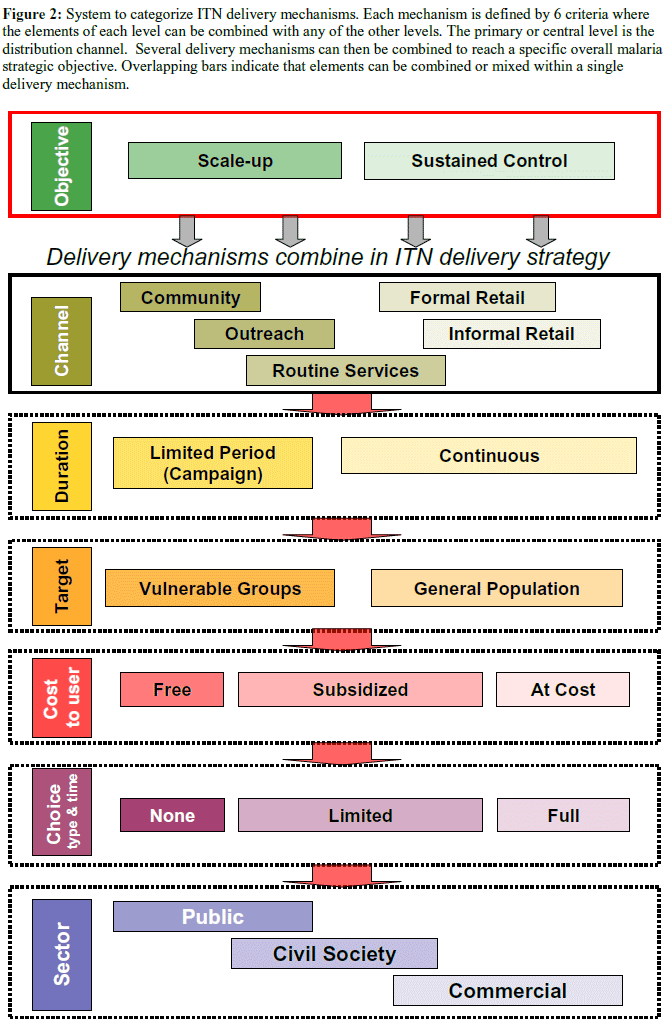
<body><![CDATA[<p><font face="verdana" size="2"><b><i>Conceptual framework for categorization    and evaluation of delivery strategies</i></b></font></p>     <p><font face="verdana" size="2"><i>Descriptive criteria</i></font></p>     <p><font face="verdana" size="2">There currently is no generally agreed system    to capture and categorize net distribution mechanisms in a standardized manner    (6,9,11-21). Rather than using a closed matrix, we here propose an open system    of descriptive categorization which is presented in <a href="/img/revistas/tropika/v1n1/a04fig01.gif">Figure    1</a>. Each ITN delivery mechanism can be uniquely described by six specific    criteria allowing flexible combinations between the elements of each category.    Several delivery mechanisms can then be combined forming the ITN delivery strategy    in order to achieve scale-up (attack phase) or sustained control, which that    roughly equate to the terms "catch up" and "keep up" (22). The first and central    category for each delivery mechanism is the channel or outlet which is then    further described by population group(s) targeted, duration of distribution,     cost to user, choices of net recipient and finally by sectors involved. While    elements of the channel and sector can be combined or mixed within a delivery    mechanism, the elements of the other categories are mutually exclusive.  The    categories are defined as follows: </font></p>     <p><font face="verdana" size="2"><b>Channel</b>: the delivery channel is described    by its endpoints or outlets and includes </font></p>     <p><font face="verdana" size="2">i) direct community delivery, meaning that the    community (or the targeted group within the community) has direct and indiscriminate    access to nets outside commercial outlets, either through house to house delivery,    or at a specific gathering point which could be a church, school, health facility    or any other common meeting place. This channel, when undertaken over a limited    period of time, is commonly referred to as a "campaign"; </font></p>     <p><font face="verdana" size="2">ii) routine services (generally health services,    but could also be others). Access to nets is associated with the utilization    of these services; </font></p>     <p><font face="verdana" size="2">iii) outreach activities of health services,    such as mobile brigades/clinics or immunization outreach (also referred to as    enhanced routine); </font></p>     <p><font face="verdana" size="2">iv) formal retail outlets (shops, pharmacies,    supermarkets etc); </font></p>     <p><font face="verdana" size="2">v) informal retail outlets (mobile vendors, open    markets).</font></p>     <p><font face="verdana" size="2">Each of these represents a distribution channel    that involves several stations through which nets flow such as government supply    chain, commercial wholesalers or distributors. Multiple elements of the channel    category can be combined within the same delivery mechanism as occurs in voucher<a name="tx01"></a><a href="#nt01"><sup>1</sup></a>    schemes.</font></p>     ]]></body>
<body><![CDATA[<p><font face="verdana" size="2"><b>Duration: </b>this category distinguishes    between time-limited and continuous distribution and refers to the time period    nets are available to the potential recipient at a specific outlet. We define    distribution as continuous if this period is longer than one month. This implies    that what is commonly referred to as a "campaign" is categorized as time-limited    distribution and therefore the term "campaign" is used synonymous with a time-limited,    community-based distribution. A continuous delivery mechanism on the other hand    may be interrupted at times of stock-out or be discontinued after a project    ends.  </font></p>     <p><font face="verdana" size="2"><b>Target: </b>the target group can either be    the general population (either national or a limited geographical area) which    is termed universal coverage or alternatively a vulnerable biological, social    or economic group.</font></p>     <p><font face="verdana" size="2"><b>Cost to user: </b>the three mutually exclusive    categories are free (or fully subsidized), subsidized to any degree other than    fully, and commercially sustainable cost.</font></p>     <p><font face="verdana" size="2"><b>Choice</b>: refers to the net user's ability    to a) obtain the net of choice (shape, size and/or colour) and to b) get it    when he or she needs it to either cater for additional sleeping places in the    family or replace a net which is no longer in the household's possession or    cannot be used any longer. </font></p>     <p><font face="verdana" size="2"><b>Sector</b>: the public sector refers to local    or national government, while the private sector is split into civil society    (NGO, faith or community-based organizations) and the commercial sector is comprised    of the for-profit health care providers and  the ITN market. We further define    a delivery mechanism as a mixed sector approach if there is a significant logistical    or human resource contribution beyond financing or manufacturing.</font></p>     <p><font face="verdana" size="2"><i>Evaluation criteria</i></font></p>     <p><font face="verdana" size="2">As with other health interventions, ITN distribution    mechanisms and strategies need to be subjected to rigorous effectiveness and    cost-effectiveness assessments. In line with criteria suggested by Victoria    et al. (23), we have used the following measures:</font></p>     <p><font face="verdana" size="2"><b>Coverage</b>: the principle criterion for    achieved coverage at a given point in time following start of net distribution    is the proportion of households in the general population with at least one    net or ITN and within subgroups of households for targeted distributions. As    this indicator does not capture the intra-household net saturation, the average    proportion of sleeping places covered, or people to nets ratio within a household    would ideally be used as a secondary criterion, but these data were rarely reported    and can, therefore, not be considered here. We explicitly do not consider net    use as an outcome, as this involves many additional factors such as behaviour    and seasonality that are independent of the performance of the actual net distribution    strategy.</font></p>     <p><font face="verdana" size="2"><b>Equity</b>: describes the degree to which    the poor have access to nets or ITN compared to the wealthier groups of society    or a community. The concentration index or curve would be the most comprehensive    way to assess equity of net distribution (17) which is most often only described    as an equity ratio, i.e. the ratio (range zero to infinity) between proportion    of households owning a net/ITN in the poorest quintile compared to that in the    least poor quintile, where a ratio of 1.0 describes perfect equity, values below    1.0 inequity towards the least poor and values above 1.0 in favour of the poor.    In contrast, the concentration index includes not only the highest and lowest    wealth quintiles but takes into account the full data set. A value of zero represents    perfect equity, while a negative value indicates disproportionate concentration    of net ownership among the poor, and a positive value disproportionate concentration    among the wealthier.</font></p>     <p><font face="verdana" size="2"><b>Cost</b>: in the context of net delivery mechanisms    and strategies, we only considered cost per net delivered to the end user, and    not cost-effectiveness measures such as cost per life saved, cost per DALY or    cost per treated net life, as these latter measures include aspects of the net    (ability to prevent malaria and/or durability of the material) which are independent    of the distribution mechanism.</font></p>     ]]></body>
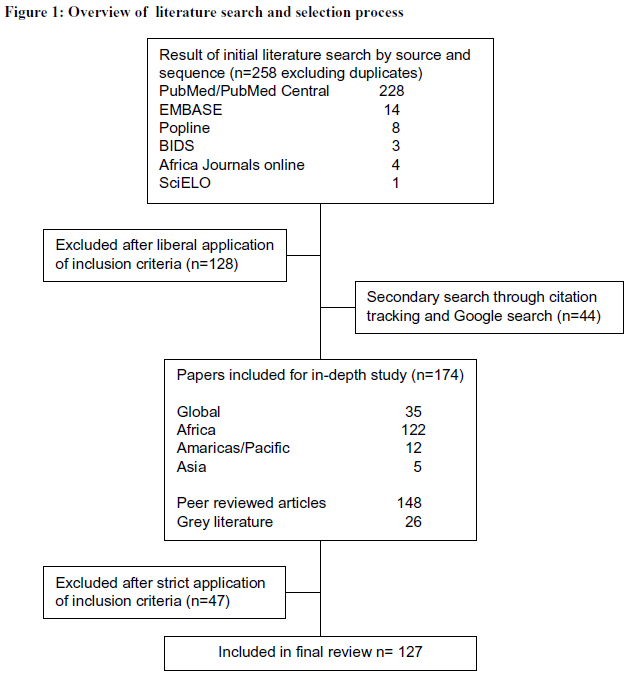
<body><![CDATA[<p>&nbsp;</p>     <p><font face="verdana" size="3"><b>Results  </b></font></p>     <p><font face="verdana" size="2">Results of the search and selection process are    summarized in <a href="/img/revistas/tropika/v1n1/a04fig02.gif">Figure 2</a>.    Of the 174 selected studies whose primary topic was the description of net distributions:    48% discussed coverage outcome or impact; 20% dealt primarily with cost, equity    or other economic aspects; and 19% were general discussions, strategy or opinion    papers. Seven percent were survey reports such as Malaria Indicator Surveys    (MIS), Multi-Indicator Cluster Surveys (MICS) or Demographic and Health Surveys    (DHS) and 6% dealt with issues of net maintenance, physical condition and durability    of nets. DHS, MIS and MICS were not generally consulted but rather served as    a source of information in specific scenarios identified for a sub-analysis    of outcomes (see <a href="#box02">box 2</a>).</font></p>     <p><font face="verdana" size="2"><b>Delivery channel </b></font></p>     <p><font face="verdana" size="2"><i>Community-based</i></font></p>     <p><font face="verdana" size="2">A total of 25 studies were identified that describe    community-based distributions outside of net efficacy studies.  Community-based    distribution occurs in three ways: i) as a house to house delivery with the    number of nets determined according to pre-set criteria, ii) distribution from    one or several delivery points where the community members receive or buy a    net without pre-registration and iii) a combination of these two approaches,    i.e. the households are registered during a house to house activity and are    allocated nets which they obtain from a central distribution point immediately    thereafter or after a certain time interval. </font></p>     <p><font face="verdana" size="2"><i>Time-limited campaigns</i></font></p>     <p><font face="verdana" size="2">This type clearly is currently the dominant form    of community-based distributions with 19 studies found. These campaigns were    conducted for a few days in each community using any of the three delivery scenarios    described above. Seven studies had campaigns that were combined with immunization    programs (measles, polio or both), four of which used central distribution points    without pre-registration (22,24-29). In Togo (24) and Niger (25) these were    national campaigns, while in Ghana, Kenya, Tanzania, Zambia and Mozambique they    were geographically limited (22, 26-29). However, according to the measles-malaria    partnership, at least 33 campaigns have been carried out between 2004 and 2007,    of which seven were national campaigns (Grabowsky, personal communication).    In the Mozambique campaign, a coupon<a name="tx02"></a><a href="#nt02"><sup>2</sup></a> was issued    at the vaccination point because nets where not available at the time of the    immunization (29) and in Zambia, a voucher was given with the immunization that    could be redeemed at a retail outlet (28). These can be seen as variants of    a pre-registration with later net delivery (scenario iii above). Ritmeijer et al. (30) describe a net distribution campaign in the context of visceral    leishmaniasis control in Sudan, where a household level pre-registration was    used followed by distribution at a central point in each village according to    that register.   In the Niger polio/ITN campaign, coupons were given during    the house to house vaccinations and nets were then collected at a central delivery    point (25). </font></p>     <p><font face="verdana" size="2">A direct house-to house delivery has been reported    from camps of Internally Displaced People in Western Uganda (31) and Central    Nigeria (32). In the latter case, the campaign was integrated with mass drug    administration (MDA) for onchocerciasis and lymphatic filariasis.  The delivery    for each village was only a few days but the overall roll-out to the two districts    (Local Government Areas) took five months. Stand alone community-based campaigns,    i.e. not integrated with other interventions, have been reported in Eritrea    (33), Ethiopia (34), Kenya (26), Vietnam (35,36) and Vanuatu (37), however no    detailed information was provided on delivery point procedures. In three further    cases, community distribution (sales) days without pre-registration were organized    by community committees in Tanzania (38) and project staff with support from    government officials in Burundi (39) and Afghanistan (40). </font></p>     <p><font face="verdana" size="2"><i>Continuous distribution</i></font></p>     ]]></body>
<body><![CDATA[<p><font face="verdana" size="2">In six cases community-based distributions have    been carried out as a continuous activity over longer periods of time from particular    delivery points (scenario ii above). All of these were either part of implementation    research, smaller scale projects, or social marketing approaches that have since    been terminated. Community health workers or community leaders have been used    to sell subsidized nets in Afghan refugee camps in Pakistan (41), in several    communities in Latin America (42), and in social marketing projects in Kilombero,    Tanzania (43) and Sofala and Manica Provinces in Mozambique (44). In other cases,    community-based organizations such as committees or cooperatives have been used    for the same purpose in four areas in Kenya (45), Mexico and Columbia (46).    </font></p>     <p><font face="verdana" size="2"><i>Net allocation per household</i></font></p>     <p><font face="verdana" size="2">The allocation of nets to households varied from    one for each person (except children sleeping with their mother) in Sudan (30)    to one net per every two persons (35,36)  to 1-4 per family in Uganda (31)     to an average of two per household in Ethiopia (34).</font></p>     <p><font face="verdana" size="2">In the integrated immunization/ITN campaigns    nets were targeted at children under 5. In two cases, the target group for the    immunization differed from that of the nets, specifically measles catch-up vaccinations    in Ghana (47) and Zambia (28) where children up to 14 years were eligible. Net    allocation generally was one net per child under 5 with three exceptions: in    Niger (25), Mozambique (29) and Ghana (47) one net was allocated per mother    or household with one or more children under 5. The Nigerian integrated ITN/MDA    campaign targeted children and pregnant women with one free net for each sleeping    place used by this target group (32). Among the stand alone campaigns, children    were targeted in Kenya (26) while all the others targeted all household members    aiming for universal coverage. In Eritrea the target was on average two nets    per household but children and pregnant women were given special emphasis (33).    </font></p>     <p><font face="verdana" size="2"><i>Cost to user</i></font></p>     <p><font face="verdana" size="2">Nets were generally free of charge except in    the three projects with social marketing characteristics and campaign style    sales at subsidized prices in Tanzania, Burundi and Afghanistan (38-40). Interestingly,    in the leishmaniasis control programme in Sudan (30), a fee of US$ 0.80 was    charged but poor families were exempt. </font></p>     <p><font face="verdana" size="2"><i>User's choice</i></font></p>     <p><font face="verdana" size="2">Large scale community-based, time-limited distributions    (campaigns) generally require the net user to obtain the net within the days    the net delivery point is open, with the exception of a study from Zambia where    a voucher was given during the campaign for redemption at a commercial outlet    over a longer period of time (28). Similarly, these distributions generally    provided only one type of net, with the exception of a campaign in Tanzania    where three different sizes of nets were offered during community-based sale    days (38). Of the six studies on continuous distribution, two reported a choice    in net type with two different sizes of nets offered in Tanzania (43) and two    shapes (rectangular and conical) offered in Mozambique (44). In all the continuous    distributions studies,  the user could choose when to acquire the  net, within    the time frame of the project (41-46).</font></p>     <p><font face="verdana" size="2"><i>Sector involvement</i></font></p>     <p><font face="verdana" size="2">Only the distributions in Eritrea (33) and Pakistan    (41) were carried out by a single sector (public and CSO respectively) whilst    all others were implemented by a public/CSO mix, or in the case of the campaign-based    voucher scheme in Zambia (28), all the three sectors were involved.</font></p>     ]]></body>
<body><![CDATA[<p><font face="verdana" size="2"><i>Routine services and outreach activities</i></font></p>     <p><font face="verdana" size="2">Net delivery outreach activities by the health    services (enhanced routine) have been defined as a separate category in a review    by Webster et al. (10) and a recent WHO manual (48). However, while Webster    et al. mentioned such activities in the context of child health days    in Ghana and Senegal, we are aware of net distributions through mobile brigades    in Mozambique (Brownlow, personal communication) but were unable to identify    any source in the  literature describing this distribution mechanism. </font></p>     <p><font face="verdana" size="2"><i>ANC and EPI services</i></font></p>     <p><font face="verdana" size="2">For the net distributions through ANC or EPI    services found in this literature search, delivery was in principle continuous,    i.e. the recipient had the opportunity to obtain a net at any service outlet    as long as they fulfilled the eligibility criteria. Similarly, all  used targeted    distribution. Direct free distribution of nets during ANC services was reported    in Eritrea (33, 49), Burkina Faso (50) and Kenya (51). This was implemented    by the public sector alone or in collaboration with NGOs. In Lawra district,    Ghana they were sold at a subsidized price in line with national policy (22).    Direct delivery of nets at the point of service was also implemented in Malawi    (62) and Kenya (26). In both cases, nets were sold at highly subsidized prices    through a public/CSO sector social marketing project with the target group expanded    to include mothers bringing their children for immunization. </font></p>     <p><font face="verdana" size="2">The alternative to direct delivery of nets during    ANC services is to distribute a voucher, which then provides a price subsidy    for the purchase of an ITN at retail outlets participating in the voucher scheme.    Pilots or geographically limited implementation have been conducted in  Ghana    (53), Uganda (54) and Tanzania (43), the latter being the only country that    then went on to implement the voucher scheme at a national scale (55, 56). All    these and other voucher schemes described by Worrall et al. (57) were    implemented involving all three sectors, public, CSO and commercial. </font></p>     <p><font face="verdana" size="2"><i>Small scale projects</i></font></p>     <p><font face="verdana" size="2">Using routine health services for delivery of    subsidized nets, i.e. allowing all clients to benefit, has been used by social    marketing projects in Pakistan (41) and Tanzania (38) both of which were implemented    by a public/CSO sector mix. In contrast, three reports of continuous, routine    distributions were found that utilized specialized services. In Malawi, LLIN    were given free to people living with HIV/AIDS attending antiretroviral treatment    clinics (59), in Uganda a health insurance scheme offered ITNs at a 50% subsidy    to their clients (60) and in Kenya large employers partnered with an NGO to    make ITNs available to their employees at full cost recovery, but with credit    attached (45).</font></p>     <p><font face="verdana" size="2"><i>User's choice</i></font></p>     <p><font face="verdana" size="2">While all these delivery mechanisms made ITNs    available on a continuous basis, recipients did not always have a flexible choice    of time when to acquire the net. Particularly when distribution was targeted    to clients of ANC and EPI services, the choice of time was limited to the pregnancy    or when the child was being immunized. Choice of net also differed in these    approaches from none during ANC/EPI distributions (22,26,49-52) to a maximum    of five different nets offered in a project in Tanzania (58). A varying but    generally high level of choice of net shapes, sizes and colours was found in    the voucher schemes (43, 53-55).</font></p>     <p><font face="verdana" size="2"><i>Retail outlets</i></font></p>     ]]></body>
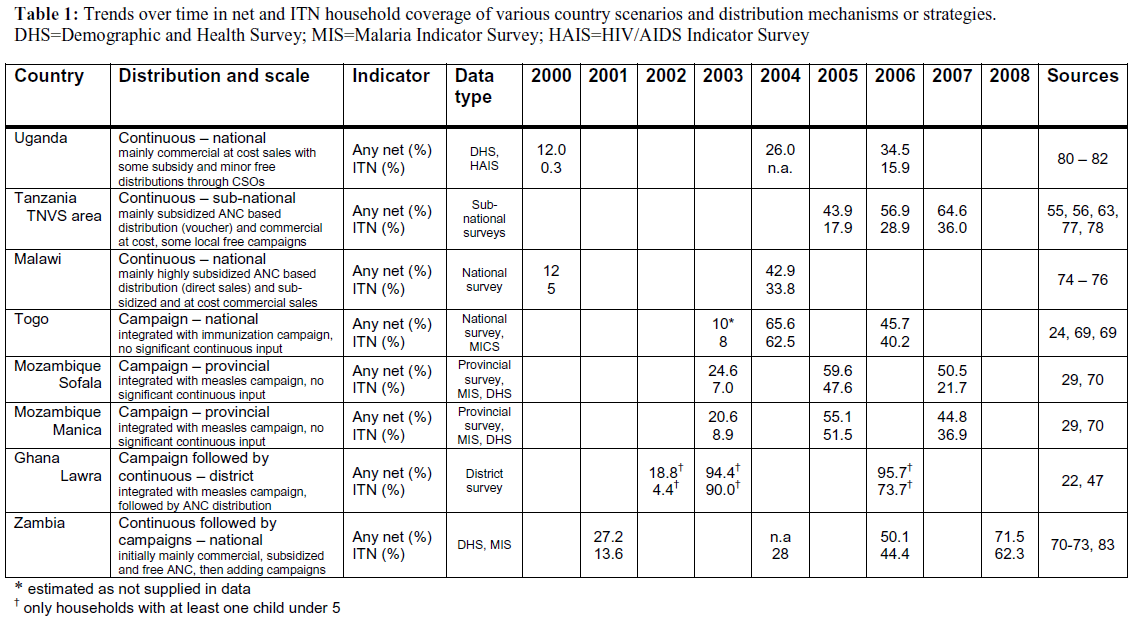
<body><![CDATA[<p><font face="verdana" size="2">It has been repeatedly shown that commercial    delivery mechanisms, in particular the informal retail channels, represent the    most important source of nets in many countries and settings (9,17,61-64). This    may not be quite the case for ITN and specifically LLIN, as there were very    few sources other than social marketing projects found in our literature search    describing commercial delivery mechanisms (9,10,12,19). </font></p>     <p><font face="verdana" size="2">Commercial deliveries are continuous. The un-assisted    commercial sector sold nets to anybody who was able to buy at a profit. There    was normally full consumer choice on when to purchase the net and the type of    net. This situation differed only when the commercial sector was supported by    the public and/or CSO sectors in a "total market approach" (9) with either a    voucher scheme, or in the classical social marketing approach, the CSO delivered    nets through formal commercial retail outlets (10). In these cases net sales    were mostly subsidized to some degree, although at times the support by the    CSO only applied to the distribution and marketing cost but not the price to    the customer (10,44,65,66). The target group was restricted in voucher schemes    with vouchers given either to pregnant women during ANC (43,53,54) or children    during a vaccination campaign (28).  </font></p>     <p><font face="verdana" size="2"><b>Outcomes of distribution mechanisms and strategies</b></font></p>     <p><font face="verdana" size="2"><b><i>Coverage </i></b></font></p>     <p><font face="verdana" size="2">While many of the reviewed sources provided some    measurement of net coverage, not all of these were suitable to make inferences    on the potential of a particular delivery mechanism to increase net ownership,    partially because in some cases only use rather than ownership was reported.    As Webster and colleagues have pointed out in their 2007 review (10) the time    since (for time-limited) or duration of distribution (continuous) needs to be    taken into account as well as the scope of operation, i.e. has the delivery    mechanism been implemented to its maximum operational capacity or was its output    limited by available funding for ITN or subsidies? We suggest that several points    in time should be examined to assess the gains in coverage in settings where    only one delivery mechanism is used or is the most dominant in distributing    ITN.</font></p>     <p><font face="verdana" size="2"><i>Direct comparison of distribution mechanisms</i></font></p>     <p><font face="verdana" size="2">Three studies made comparisons between either    delivery mechanisms, combination approaches, or variations of one mechanism.    Grabowsky et al. (28) compared the outcome of direct distribution of    LLINs to every child under five attending the central measles vaccination point    in four districts in Zambia with one district where a coupon was given at the    vaccination point that could be redeemed against a particular ITN brand in retail    shops later. The ITN coverage in households with at least one child under five    was measured six months after the campaign, with baseline values estimated retrospectively    from the post-campaign survey. With direct distribution, coverage increased    from 21% to 88% and with the coupon, from 49% to 82%, showing no major difference.    Müller et al.. (50) compared a rural province in Burkina Faso, which subsidized    sales of LLINs through retail outlets using a classical social marketing approach,    to a combined market and free LLIN distribution through ANC service providers.    After one year social marketing alone showed a 6%-point increase of household    ITN coverage (25-31%) while the increase was 22%-points for the combination    (21-43%). Cohen and Dupas in Kenya (67) compared the uptake of nets from ANC    clinics when they were either free or had different levels of subsidy. They    found that uptake, which would eventually translate into coverage, reduced by    75% when the price of ITN was increased from zero to $ 0.75, indicating that    free net distribution would produce a higher coverage in a given time period    than subsidized ANC distribution.</font></p>     <p><font face="verdana" size="2"><i>Distribution by multiple sources</i></font></p>     <p><font face="verdana" size="2">As few reports provided a series of coverage    estimates over more than one year, we have tried to identify scenarios from    multiple sources that allow a comparison of coverage outcomes of different distribution    mechanisms or strategies along the criteria outlined above (22,24,29,47,63,68-83).    The inclusion criteria for this sub-analysis are presented in <a href="#box02">box    2</a>. Results are presented in <a href="/img/revistas/tropika/v1n1/a04tab1.gif">Table    1</a> and <a href="/img/revistas/tropika/v1n1/a04fig03.gif">Figure 3</a>. For    Ghana, the publication only reported coverage for households with at least one    child under five years of age. In order to allow a comparison with the general    population results from the other countries, these coverage rates were adjusted    assuming 65% of households having at least one under-five (24,29,68) and 5%    of non-targeted households having any nets. There was no significant difference    between the patterns of coverage increase between ITN and any mosquito net.    Continuous distribution strategies showed a constant increase averaging 6.7%-points/year    with slightly higher increases (7-10%-points/year) for the combination of commercial    sector and subsidized ANC distributions in Malawi and Tanzania, and lower rates    (3-4%-points/year) for commercial sector alone in Uganda. This is supported    by the pattern shown in Zambia, where increases were around 6%-points in the    first years and between 9 and 11%-points/year when focal campaigns were added.    In contrast, the examples with exclusive or primary campaign distributions to    under-fives show very steep initial increases between 35 and 60%-points and    then drop off again in the following two years at a rate between 5 and 13%-points/year,    ending up only slightly above the rates of coverage increase achieved by continuous    distributions after this time. The only exception is the Ghana study, where    campaigns were followed by subsidized ANC distribution and coverage remained    high even after three years. The observed drop in ITN coverage was due to the    conventional treatment of nets and failure to re-treat and would not have been    seen with LLIN (22). The proportion of target group reached by the campaign    was above 90% both in Togo (24) and Ghana (47), where ITNs were given directly    at the distribution point, and somewhat lower in Mozambique (68%) where coupons    were issued for pick-up of nets two months later (29). However, as the proportion    of families with at least one child below 5 years ranged between 50% and 79%    of all households (24, 25, 29, 49), the overall result with respect to universal    coverage achieved by these campaigns did not exceed 65-72%.  </font></p>     <p><font face="verdana" size="2"><i>Other sources: campaigns</i></font></p>     ]]></body>
<body><![CDATA[<p><font face="verdana" size="2">The picture seen in <a href="/img/revistas/tropika/v1n1/a04tab1.gif">Table    1</a> and <a href="/img/revistas/tropika/v1n1/a04fig03.gif">Figure 3</a> is supported by other data    not presented in the table as they did not fulfil all the selection criteria.    In the Lindi region in Tanzania, an integrated immunization/ITN campaign reached    85% of children less than five years and 80% of them received a net (27). However,    due to only 53% of households in the area having any eligible children, the    overall household net coverage only increased from 53% to 69%. In a nationwide    polio/ITN campaign in Niger where 79% of rural households had children &lt;5    years, 73% of eligible households picked up an LLIN at the distribution point    after receiving a coupon during the house-to-house immunizations (25). One month    after the campaign general household ITN coverage had increased from 6% to 61%.    Interestingly, any net coverage was already 67% pre-campaign and increased to    81%, indicating that the general population had considerable access to untreated    nets, presumably from the commercial sector. Better household ITN coverage of    74% (up from 9% pre-campaign) was achieved in Nigeria following a house-to-house    campaign during a mass drug administration. It targeted households with both    children under five and pregnant women, which therefore made the proportion    of eligible households higher (32). Higher coverage rates were achieved with    campaigns that included all households or family members (universal access)    (30,31,49,84). LLIN distribution among displaced people in a post conflict situation    in Bundibugyo district, Uganda, achieved 98% ITN coverage immediately after    the campaign (31). In Gadaref, Sudan ITN distributions as part of leishmaniasis    control reached 94% of households (30) and community distributions in Eritrea    reached 82% (49). Lower figures for net (73%) and ITN coverage (68%) were reported    in three regions in Ethiopia following a community-based general LLIN campaign    (84).    </font></p>     <p><font face="verdana" size="2">The decline following campaigns without further    net input is also documented from Bundibugyo where coverage with nets dropped    from 98% to 76% after 12 months (85). However, part of the loss was due to people    moving away and taking their nets. When only nets from people still present    were considered, the loss was 11% of the originally distributed nets. In Nigeria    (32), the loss after one year was 6%, and in Sudan (30) 20% after two years    (excluding people who had moved away with their nets). Hassan et al..    carried out a follow-up study 18 months after community distribution of 150    denier polyethylene nets in Kassala, Sudan, and they reported a loss of 7% and    further 19% "totally damaged" (86). All these rates of post-campaign loss are    in the same range as those shown in <a href="/img/revistas/tropika/v1n1/a04tab1.gif">Table 1</a>.</font></p>     <p><font face="verdana" size="2"><i>Other sources: continuous distribution</i></font></p>     <p><font face="verdana" size="2">Continuous distributions using the commercial    sector and a classical social marketing approach, including health facility    based sales or a voucher scheme, have been reported from Malawi and Tanzania.    These are very similar to those examples presented in <a href="/img/revistas/tropika/v1n1/a04tab1.gif">Table    1</a> and <a href="/img/revistas/tropika/v1n1/a04fig03.gif">Figure 3</a> but limited to smaller    geographical areas and preceding the data points used at national scale. Holtz    and colleagues (87) reported an approximate 20%-point increase of net coverage    within 15 months (16.0%-points per year) in Blantyre district, Malawi, and 6%-points    (4.8%-points per year) in rural areas. The KINET project in Kilombero and Ulamga    districts, Tanzania described earlier reached an increase of net coverage from    37% to 72% in three years (11.7%-points per year). While during the same time,    the unassisted commercial sector sales in a neighbouring district produced a    household coverage increase from 21% to 28% (2.3%-points per year) (88). </font></p>     <p><font face="verdana" size="2"><i>The NetMark commercial sector experience</i></font></p>     <p><font face="verdana" size="2">Baume and Marin (89) present the results of repeated    surveys between 2000 and 2004 in Nigeria, Senegal, Uganda and Zambia, all of    which at the time had predominantly continuous distribution through retail outlets    (unassisted and assisted) and some routine ANC distribution in Zambia. The increase    in net coverage was 3.5%-points/year in Uganda, 3.4%-points in Nigeria, 5.6%-points    in Senegal and 5.8%-points in Zambia. The rates for Uganda and Zambia are identical    to those found in the national surveys (<a href="/img/revistas/tropika/v1n1/a04tab1.gif">Table 1</a>    and <a href="/img/revistas/tropika/v1n1/a04fig03.gif">Figure 3</a>) with 3-4%-points per year for    Uganda and 6%-points in the early phase in Zambia. </font></p>     <p><font face="verdana" size="2"><i>Continuous mechanisms </i></font></p>     <p><font face="verdana" size="2">The increases observed with continuous distribution    suggest that, given sufficient time, these mechanisms can reach the targeted    coverage levels in 8 to 18 years (<a href="/img/revistas/tropika/v1n1/a04fig03.gif">Figure 3</a>).     There are, indeed, several examples to show that continuous delivery mechanisms    can reach high coverage. These include The Gambia, with net coverage in the    four regions reported between 51% and 76% in 1991 (90), and countries like Mali,    Guinea Bissau, China (61) and Cambodia (91) with net coverage exceeding 90%.    </font></p>     <p><font face="verdana" size="2"><i>Success of mixed models </i></font></p>     <p><font face="verdana" size="2">Bhattarai et al. provide evidence from    Zanzibar (92) of sequential use of different distribution mechanisms, where    2 years of free distribution to children and pregnant women through ANC and    local leaders was followed by a campaign targeting the same group. Three household    surveys were undertaken at baseline, before and after the campaign. During the    two years of continuous distribution a 12%-point annual increase in net use    rates in children was achieved (from 35% to 59%) and another 34%-point increase    following the campaign (59% to 93%), very much like the rates seen in <a href="/img/revistas/tropika/v1n1/a04fig03.gif">Figure    3</a>. Khatib et al.(63) reported from Rufiji district, Tanzania where    commercial sector sales, social marketing and the National Voucher Scheme were    combined in an integrated child health campaign to deliver ITN to children.    While the immediate result of the campaign was already reported above (27),    this survey was undertaken 3 years after. Again only net use rates are given    (87% for infants, 82% young children, 54% older children, 60% adults) but these    suggest a sustained high coverage following the 69% household coverage rate    achieved after the campaign. Most importantly, analysis of source of existing    nets by age group (63) demonstrates  the contributions of each mechanism, with    the voucher scheme being the most important source for infants (42%), campaign    nets for young children (50%), campaign and commercial market equal for older    children (37% and 38%) and commercial market for adults (60%). Another mixed    approach is reported from Kenya by Noor et al. (26). Three annual surveys    in four districts coincided with three distinct phases of ITN delivery. Following    two years of subsidized commercial sales (classical social marketing model),    the household net coverage was 25% (approximately 10%-point increase per year    assuming a 5% baseline coverage). This was followed by highly subsidized ANC    based distribution in the second year, increasing net coverage by 22%-points    to 46% and then a measles/ITN campaign targeting children in the third year    added another 33%-points to reach 79% coverage. Noor et al.  also recently    compared the outcome of ITN distribution efforts in Africa based on nationally    representative surveys (93), categorizing countries in to predominantly free    distribution, routine subsidized delivery and full cost recovery. Although only    ITN use by children is presented and the duration of distribution by each mechanism    is not considered, the main conclusion is in keeping with the findings presented    so far: free distributions achieved the highest (fastest) increases followed    by subsidised routine service delivery while full cost recovery was lowest (slowest).</font></p>     ]]></body>
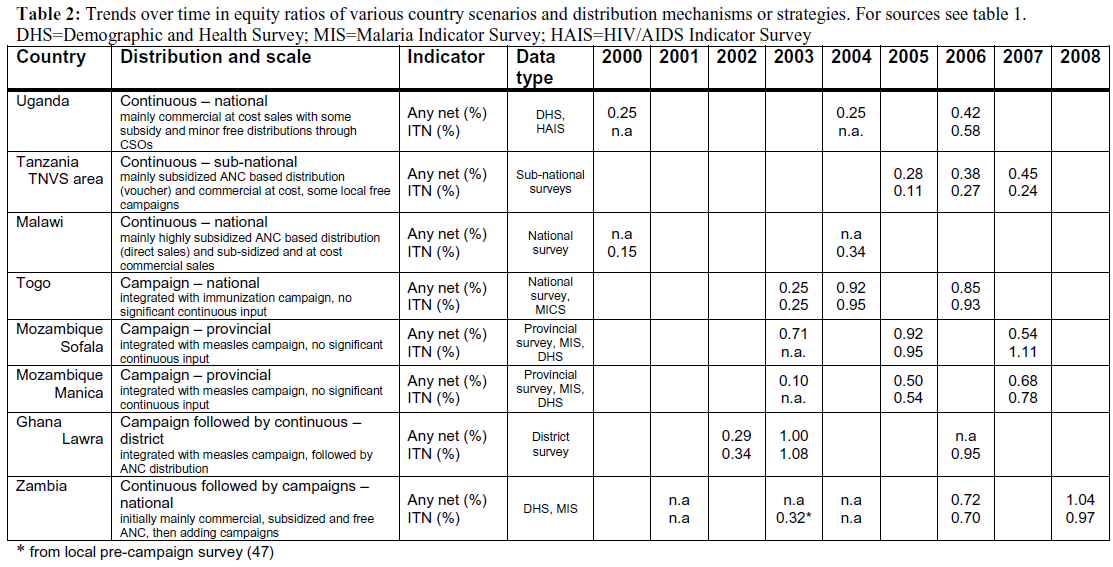
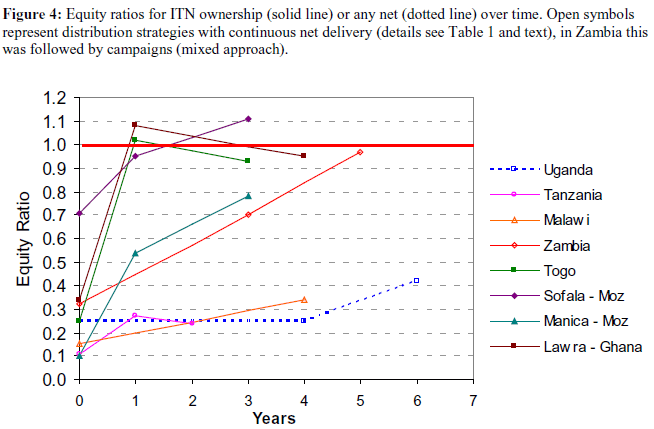
<body><![CDATA[<p><font face="verdana" size="2"><i>Evidence from modelling</i></font></p>     <p><font face="verdana" size="2">Further evidence on the coverage outcome of distribution    mechanisms or strategies comes from simulation models (94). A simple compartmental    model was used that applies the relationship between mean number of nets per    net-owning households and coverage with any net derived from empirical data    similar to that shown by Miller et al. (95) to translate annual net crop    (i.e. the existing nets at the end of the year) into coverage estimates. The    net crop for each year is adjusted for losses of previously distributed nets    by using a non-linear loss function, which implies a loss of 3% or 7% after    one year depending on net type, and 10% or 26% after two years, and has a mean    net durability of 3 and 5 years respectively. This is a loss rate very similar    to that which has been reported from the field (see above).  Simulating implementation    of only campaign-style distributions repeated every three to five years resulted    in model output with high initial coverage but drop in coverage of up to 40%-points    before the next campaign. Continuous distribution models based on ANC and EPI    coverage plus 20% of households obtaining an additional net from the commercial    sector, on the other hand, reached coverage levels of 70% and more only after    8 years of implementation. Rapid scale-up combined with continuous high coverage    levels was only obtained in these simulations with mixed delivery strategies    combining campaigns with continuous distributions.</font></p>     <p><font face="verdana" size="2"><i>Intra-household net coverage and "universal    access"</i></font></p>     <p><font face="verdana" size="2">We have so far only considered net ownership    of at least one net or ITN/LLIN per household as assessment of coverage outcome.    While this is a good indicator for geographical spread, it does not say much    about intra-household net coverage or saturation as it is implied in the "universal    coverage" approach now widely accepted (6). There is evidence that the mean    number of nets per household increases as ownership of "at least one net" increases    (93, 94) and also that some intra community redistribution of nets takes place    (63). To fully evaluate this aspect of distribution, a measure such as "proportion    of sleeping places covered", "proportion of households with full coverage" or    at least the ratio between family members and nets would be needed. However,    only very few studies have reported on this aspect. The mean number of people    sharing a net has been reported from several countries in Latin America (42)    where it varied between one and three. In Africa, one study reports from five    countries (96) with an average of 2.03 to 2.37 and a range of 1.7 to 2.7.  In    Mozambique, they reported a mean of 2.1 varying between 1.8 and 2.4 depending    on wealth quintile and number of persons in the house (70). From Eritrea, Macintyre    et al. (97) reported the mean nets-per-two-occupant ratio as 0.82 to    1.0; equivalent to a mean people-to-net ratio of 2.0-2.43 following a combined    campaign/ANC services distribution. This study, in addition, presented the proportion    of households with all members using a net last night as only 32.9% even when    90.6% of households had at least one net. The same indicator was also reported    from the Tanzania National Voucher Scheme surveys (78), which showed an increase    from 23.4% to 38.4% over three years. The Cambodian Malaria Baseline Survey    reported the proportion of households with "sufficient" nets, which is defined    as at least one net per 2.3 persons (91), as 37.2% of households, although at    the same time, 84% of all household members reported to have slept under a net    the night before the survey, and the mean people-to-net ratio was 2.6. Only    two sources were found reporting the average number of children under 5 sharing    one net, which was estimated to be 1.4 in Ghana (22) and 1.2 in Mozambique (70).    These results are not sufficient to allow a detailed analysis of intra-household    coverage outcomes by distribution mechanism, and more data needs to be generated    in a comparable fashion to more clearly define "universal access" within households    in the future.</font></p>     <p><font face="verdana" size="2"><b><i>Equity</i></b> </font></p>     <p><font face="verdana" size="2"><i>Equity ratios</i></font></p>     <p><font face="verdana" size="2">The equity ratios of household net and ITN ownership    for those scenarios presented in <a href="/img/revistas/tropika/v1n1/a04tab1.gif">Table 1</a> are    shown in <a href="/img/revistas/tropika/v1n1/a04tab2.gif">Table 2</a>.  Campaign distribution achieved    the most dramatic changes with equity ratios around 1.0 (equal probability for    the poorest and the least poor) after the campaign with equity ratios continuing    to increase in Mozambique or showing only minimal declines in Ghana and Togo    (<a href="/img/revistas/tropika/v1n1/a04fig04.gif">Figure 4</a>). In contrast, the three settings    with predominantly continuous distributions showed significantly lower increases    not exceeding a ratio of 0.50.  </font></p>     <p><font face="verdana" size="2"><i>Evidence from other sources</i></font></p>     <p><font face="verdana" size="2">Post-campaign equity ratio improvements of a    similar magnitude have been reported from the Lindi region, Tanzania, where    three months after the campaign the ratio for any net ownership had increased    from 0.60 pre-campaign to 0.86 and for ITN from 0.30 to 0.48 (27). A study in    Zambia (28) shows an increase from 0.32 to 0.89 for ITN ownership among households,    with at least one eligible child in four rural districts, and an increase from    0.60 to 1.19 in one urban district. A study also among households with children    in Niger (25) showed an increase from 0.17 to 0.79 for ITN ownership. </font></p>     <p><font face="verdana" size="2">From a continuous distribution in Tanzania, the    frequently mentioned KINET social marketing project, Nathan et al. (98)    reported an increase in equity ratio for any net ownership over a period of    three years from 0.3 to 0.6. A similarly high equity ratio of 0.68 was also    reported from Nigeria based on a consumer survey in 2000 when no campaign distributions    had yet taken place and the commercial sector was the primary source of nets    (64). These ratios are somewhat higher than those presented in <a href="/img/revistas/tropika/v1n1/a04tab2.gif">Table    2</a> but clearly did not reach the same level as post-campaign results.</font></p>     ]]></body>
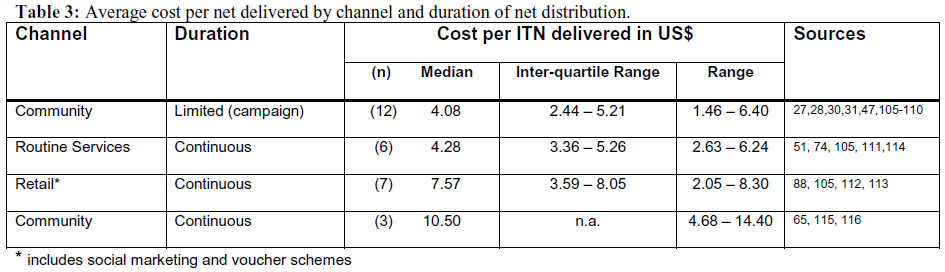
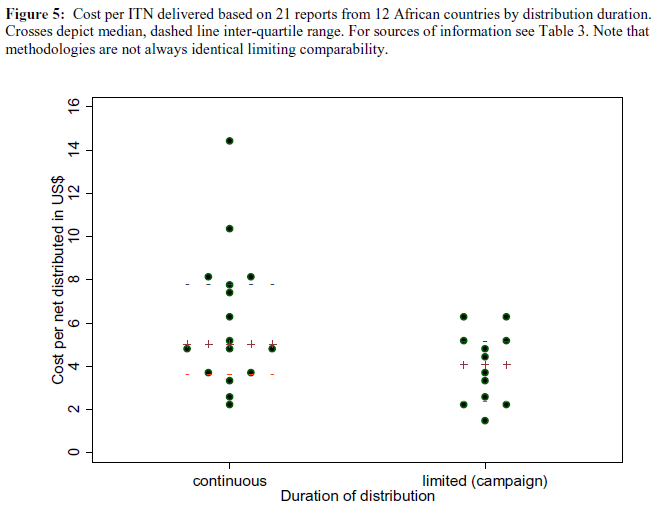
<body><![CDATA[<p><font face="verdana" size="2"><i>Concentration index</i></font></p>     <p><font face="verdana" size="2">Other authors have used the concentration index    to assess the equity of net distributions. Mathanga and Bowie (75) calculated    concentration indices for the same Malawi data as presented in <a href="/img/revistas/tropika/v1n1/a04tab2.gif">Table    2</a> as 0.33 for 2000 and 0.11 for 2004, showing a similar improvement as the    equity ratio in this case. In Zambia, districts with classical social marketing    distribution through commercial outlets were compared to districts with unassisted    commercial sector sales and the reported concentration index for "ever had an    ITN" was 0.34 and 0.71 respectively (99).  Equity for three different, sequential    distribution scenarios is described from Kenya, comparing the concentration    indices for classical social marketing approach (0.28), additional highly subsidized    distributions through routine services (0.13) and additional campaign with free    nets targeted to children under five (0.00) (26). A similar result is provided    from Rufiji district, Tanzania (63) where a concentration index for commercially    obtained nets (unassisted) was found to be 0.25, that for subsidized nets from    the voucher scheme 0.07 and free campaign nets 0.02. Finally, Webster et al. compared concentration indices from 28 national surveys for never-treated    nets, thought to represent the unsupported commercial sector, with ever-treated    nets (ITNs) as a proxy for publicly supported and subsidized net distributions    and child immunization coverage (17). They found that equity for never-treated    nets (median 0.17) was very similar to that of immunizations (0.08) and generally    more in favour of the poor than ever-treated nets (0.45). They also related    the concentration indices for nets and immunizations to the level of coverage    and show a curvilinear relationship that approaches 0 (perfect equity) when    coverage is above 70-80%. The study showed a decreasing variation of the concentration    index as coverage increases, which is valid as high coverage levels are impossible    to reach without also including significant parts of the lower wealth quintiles.    This suggests that any intervention or distribution mechanism that can achieve    high coverage will also reach reasonably high equity. Therefore the primary    outcome of interest to judge the effectiveness of net distributions should be    achieved coverage rather than equity. </font></p>     <p><font face="verdana" size="2"><i>Wealth index as a basis for equity assessment</i></font></p>     <p><font face="verdana" size="2">Another factor that needs to be considered when    interpreting equity data is the methodology by which it has been obtained. Usually    this was done by an asset based wealth score (obtained by principle component    analysis) from which the sample was divided into equal wealth groups (e.g. quintiles).    While it has been shown that an asset based index is able to adequately reflect    wealth levels (100) and some even have argued that it can better capture inequality    compared to an income and consumption expenditure based score (101), there potentially    are problems with reliability of the asset registration (102) or the selection    of variables and interpretation of data (103) that can cause misleading or non-comparable    results. Of particular importance is the fact that quintiles or other subdivisions    are always data driven and therefore the comparison between the least poor 20%    of the sample to the poorest 20% may mean very different things depending on    whether it is a national sample or a sample of a purely rural population, where    differences between households are small to begin with.</font></p>     <p><font face="verdana" size="2"><b><i>Cost per net delivered</i></b></font></p>     <p><font face="verdana" size="2">A total of 28 data points for cost per ITN or    LLIN delivered were identified from 21 studies of 12 African countries (<a href="/img/revistas/tropika/v1n1/a04tab3.gif">Table    3</a>). Half of the cost estimates (14) came from the comprehensive review of    costing studies for net deliveries by Kolaczinski and Hanson (104), another    five from a recent detailed analysis by Yukich and co-workers (105) and the    remaining 9 from other recent studies or reports.  <a href="/img/revistas/tropika/v1n1/a04fig05.gif">Figure    5</a> plots all estimates of cost per ITN distributed by duration of distributions.    They appear very similar to those of limited duration distribution (campaigns)    slightly lower (median US$ 4.08 per ITN distributed) compared to continuous    distributions (median US$ 5.03). However, when continuous distributions are    further disaggregated by the dominant distribution channel (<a href="/img/revistas/tropika/v1n1/a04tab3.gif">Table    3</a>), the average cost for campaigns are almost identical to those from continuous    distributions through routine health services but clearly higher in retail based    distributions. This group includes classical social marketing schemes (75, 113)    as well as voucher programmes (105, 112). Finally, three community-based programmes    with continuous distributions (65, 115, 116), all of which were medium term    projects of a rather small scale, appear to have higher delivery cost with a    median of $ 10.50 per ITN delivered. Most of the cost estimates are for the    conventional ITN, only 5 studies report on LLIN distributions (all campaigns)    with a median cost of $ 4.67. Direct distribution cost (without the ITN cost)    is provided for 10 distributions, six campaigns (median $ 0.88) and four continuous    distributions (median $ 1.63).</font></p>     <p><font face="verdana" size="2"><i>Methodological constraints</i></font></p>     <p><font face="verdana" size="2">Kolaczinski and Hanson have described in detail    the potential limitations that are inherent in the comparison of costings for    net and ITN distributions (104). They identified as the two major problems differences    regarding which costs are included in the analysis and the failure to adjust    financial costs to arrive at an economic cost estimate. This is also the case    in three of the studies found (28,30,31). Differences in costing methodology    can also be demonstrated with the data presented here, with two estimates from    the same distribution scenario and country having different results. Stevens    et al. (74) report the average cost per net distributed in the social    marketing programme in Malawi as $ 2.63 per bundled ITN while Yukich et al.    (105) report it at $ 3.36.  The latter study includes a longer time period (1999-2005    rather than 1999-2003) but the actual annual estimates for each year also differ    with consistently higher estimates in the Yukich et al. publication. Similarly,    Mueller and co-workers (110) report a cost of $ 4.41 per LLIN distributed in    the Togo campaign in 2004 while Yukich et al. (105) arrive at a cost    of $ 6.11, with the major difference appearing to be the way shared costs in    the integrated LLIN/immunization campaign were handled. </font></p>     <p><font face="verdana" size="2"><i>Changes over time and scale</i></font></p>     <p><font face="verdana" size="2">In addition to methodological problems, some    variation also is due to changes in costs over time as distributions achieve    economies of scale. In Eritrea, the cost per ITN delivered decreased with increasing    net volume from $ 8.51 when 108,000 nets were distributed to $ 3.32 at a volume    of 276,000 (105). In Malawi costs per net delivered in a classical social marketing    scheme decreased continuously from $ 5.04 in the first year to $1.92 in the    fourth in one study (74) and from $  8.17 to $ 3.27 (in the sixth year) in the    other (105). Such a decrease was, however, not always observed as the cost per    ITN distributed in the Tanzania social marketing programme SMARTNET increased    over time from initially $ 3.05 to $ 4.53 in the third year (105). Particularly    continuous distribution mechanisms with significant start-up costs are likely    to show significant declines of cost when run at scale. This is shown for the    Tanzania National Voucher Scheme where the initial annual costs were estimated    at $ 32.39 reducing to $8.37 in the second year and for full scale functioning    projected at $ 4.62-6.84 (105).</font></p>     ]]></body>
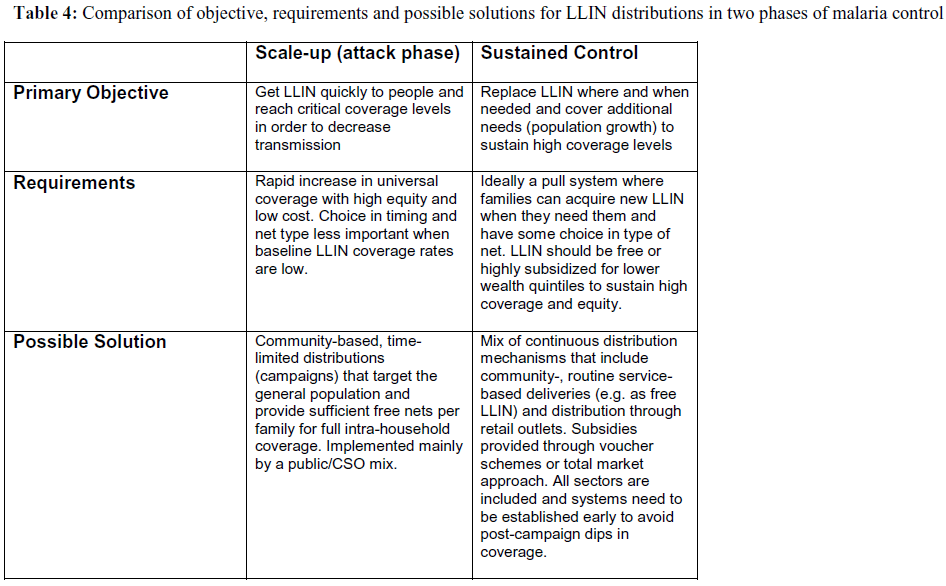
<body><![CDATA[<p><font face="verdana" size="2">In view of the methodological uncertainties and    annual variations in costs, it appears that from the available data, no significant    differences between the major distribution mechanisms can be established that    would justify preference of one over the other.</font></p>     <p>&nbsp;</p>     <p><font face="verdana" size="3"><b>Discussion and Conclusions</b></font></p>     <p><font face="verdana" size="2">In this review, we have analysed delivery mechanisms    by categorizing them in an open descriptive system that uses the distribution    channel as the primary criterion and allows flexibility between five additional    criteria, namely duration, target group, cost to end user, choice in time and    type of net and sectors involved in implementation. It appears that duration    can be defined as the criterion with the second highest descriptive value and     the other categories align themselves predominantly, as presented in <a href="/img/revistas/tropika/v1n1/a04fig02.gif">Figure    2</a>, on the horizontal axis. This is particularly true in the case of targeted    distribution where examples of targeted or general distributions can be found    for almost every channel. Community-based mechanisms seem to offer the highest    flexibility but are mostly time-limited (campaigns) with free ITN delivered    through a public/CSO sector mix with no choice in time or type of net. The examples    in the literature are mainly targeted to vulnerable groups but examples of inclusion    of the general population also exist. </font></p>     <p><font face="verdana" size="2"><i>Limitations</i></font></p>     <p><font face="verdana" size="2">Although a very broad initial search had been    applied through a wide range of search mechanisms, a selection bias may have    occurred. This may have particularly applied to the "grey" literature which    might bias results towards finding what one knows exists and omitting other    relevant experiences. Also, a number of distribution programs – especially campaigns    – are ongoing and have not been published yet, or are only available on various    web-sites in insufficient detail for this review.  However, we believe that    this would not have lead to substantially different conclusions than those presented.    </font></p>     <p><font face="verdana" size="2">Our analysis of the core outcome variables is    based on a group of scenarios for which we have defined inclusion criteria which    we felt suited best the purpose (<a href="#box02">box 2</a>). We are aware that    these are somewhat arbitrary and different criteria may have resulted in other    scenarios being included. In addition, the number of data points thus utilized    are few. However, in the text we also have provided a comprehensive review of    all other reports found in our original search that did not fulfil our inclusion    criteria and have shown that these data in principle agree with the conclusion    drawn from the selected scenarios.</font></p>     <p><font face="verdana" size="2">Finally, we have included also smaller scale    distributions that have later been abandoned in our descriptive analysis. While    this may appear superfluous to some, we believe that documentation of these    approaches is justified as there still is a need to creatively think about new    or better ways of distributions, especially in situations where common approaches    do not work.</font></p>     <p><font face="verdana" size="2">Service deliveries are continuous, limited to    the service users, mostly free or subsidized, provide some choice in time and    sometimes also type of net, and are either implemented by a public/CSO sector    mix or all three sectors in the case of voucher schemes.  Finally, delivery    through formal and informal retail outlets is continuous, untargeted, at cost    prices unless implemented in some form of social marketing approach (classical    or total market approach in a mix with CSO and/or public sector) and provides    the maximum in consumer choice. </font></p>     <p><font face="verdana" size="2">These delivery mechanisms have been combined    in various ways by countries into more comprehensive ITN delivery strategies    either at national level as shown for Zambia (18) and Tanzania (55, 56) or locally    as described for Lawra district in Ghana (28) and Rufiji district in Tanzania    (63). In more general terms, the potential strategic combinations have been    described in the RBM strategic framework of scaling up ITN programmes in Africa    (19). A recent review of the delivery mechanisms for ITN concluded that not    enough comparative studies were available to allow any judgement regarding the    merits of one over the other (10). However, since then new data has become available    a fresh look may allow inferences previously not possible. Two questions are    of particular interest to National Malaria Control Programmes and the RBM community    in view of the reorientation of malaria control towards elimination and ultimately    eradication: i) which delivery mechanisms are most suitable to achieve universal    coverage and ii) which delivery mechanisms, or combinations thereof, are best    for the next critical phases towards elimination, i.e. scale-up (attack phase)    and sustained control?</font></p>     ]]></body>
<body><![CDATA[<p><font face="verdana" size="2"><b><i>Universal access to LLIN</i></b></font></p>     <p><font face="verdana" size="2">Universal access, also referred to as "full population    coverage" (6, 18) is generally understood to mean that every household at risk    of malaria transmission and every person within the household should be protected    with an LLIN. Interestingly, no document specifically defines when "universal    access" can be considered to be achieved, although the target of "80% of people    at risk of malaria protected" formulated in the RBM Global Strategic Plan 2005-2015    can provide orientation (117). Alternatively, one could use the work on mass    effects of ITN as a basis, which has provided solid evidence that households    not protected by ITN can benefit from the ITN presence in their neighbour's    house (118-121). The minimum threshold for such protective effects has been    described as 50% ITN household coverage in Kenya (120) and 35%-65% by modelling    approaches (122). However, these sources also clearly described a dose-response    relationship so that a higher coverage, i.e. at least 80% of households, seems    advantageous and very reasonable. </font></p>     <p><font face="verdana" size="2">In order to explore how different ITN distribution    mechanisms can contribute to full population coverage and where the knowledge    gaps are, it is useful to divide universal access into two distinct aspects,    the spatial and intra-household net coverage. Spatial coverage, i.e. the proportion    of households in a sample of the total population with at least one net or ITN,    is probably the most common indicator for malaria prevention with ITN targets    set at 80% or higher in most country strategic plans. We have reviewed ample    data for the various distributions mechanisms. </font></p>     <p><font face="verdana" size="2"><i>Spatial coverage</i></font></p>     <p><font face="verdana" size="2">Community-based, time-limited distributions (campaigns)    reached 80-98% of the eligible target population even when nets were not free    but rather a small fee was charged. There is no evidence of any significant    difference between integrated and stand-alone campaigns, house-to-house and    fixed point distributions nor between direct and coupon based distributions,    as long as the time interval between coupon and net delivery was short. However,    targeting only households with young children results in coverage rates immediately    following the campaign of rarely more than 70% of all households as the proportion    of eligible households is in the range 50-75% depending on demographics. This    implies that if universal access with household coverage rates exceeding 80%    is the target, then campaigns delivering LLIN only to households with young    children or pregnant women are not likely to be the best way to achieve this.    Additional efforts would have to be undertaken covering the same geographical    area but only a small proportion of the population. However, it does not imply    that integrated campaigns combining immunization for children with LLIN distributions    to the general population will not work as several examples were found that    these campaigns worked well, even if different target groups existed for the    different interventions (28,32,47).</font></p>     <p><font face="verdana" size="2">Continuous distributions through routine health    services have a similar limitation in that they can not generally be expected    to reach 100% of clients for logistical reasons (stock-outs, time pressure during    service delivery) although no actual data on reach of eligible clients was found    in the review. Furthermore, the reach of the services as well as equity in access    is often limited (17) so that even if the general population is the target of    the services, coverage rates in the general population exceeding 80% are not    likely to be reached by a single mechanism, particularly when ANC and EPI services    are the ones most commonly used. Distributions through retail outlets have no    restrictions with respect to eligibility but can be limited in geographical    access and were shown to have the lowest equity if prices are not subsidized.    However, the review has demonstrated from countries such as The Gambia (91),    Mali and Guinea Bissau (17) in Africa, and China (60) and Cambodia (91) in Asia,    that given the right circumstances or subsidies, a combination of continuous    distributions can achieve spatial universal access.</font></p>     <p><font face="verdana" size="2"><i>Intra-household coverage</i></font></p>     <p><font face="verdana" size="2">Coverage within the household is as yet poorly    defined and no generally accepted indicator is available. The two measurements    that were found in this review were a) mean people-to-net ratio with the proportion    of households reaching a specific ratio as the adequate indicator for overall    reach of intra-household coverage and b) the proportion of households where    all members used a net/ITN last night. The latter indicator may be a good programme    indicator but is not suitable for the evaluation of net delivery mechanisms    as it was shown that many aspects other than the delivery influence use (25,27,30,32,40,86).    The former indicator appears better suited to capture the intra-household aspect    of universal coverage but also has its problems. While the available data on    people sharing one net suggest that a ratio of approximately 2 people per net    seems realistic in many settings, the example from Cambodia (91) clearly showed    that in some situations the mean people-to-net ratio is significantly higher    then 2.0, and a too low cut-off (in this case it was 2.3 or better) will lead    to an underestimation of the intra-household coverage. A third option would    be to measure the proportion of households with all sleeping places covered    by a net/ITN. This would avoid the inclusion of behavioural aspects as well    as the variations in people sharing the same net, but would need a clear definition    of a sleeping place and what is to be considered "covered". Most likely a triangulation    of all three measurements would be the best option, but clearly a lot more work    is needed in this area.</font></p>     <p><font face="verdana" size="2">Given the lack of clear indicators and data,    the inferences that can be drawn with respect to suitability of delivery mechanisms    to achieve intra-household coverage are limited. Services based distributions    generally provide one net per client and visit but allow repeated deliveries    over time as they are continuous. Similarly, retail based distributions are    only limited in number of nets accessed by the cost or affordability which,    of course, can be significant (21,50,67). However, both mechanisms can significantly    contribute to coverage of all family members, i.e. provision of  ITNs for those    not reached by campaigns, particularly when subsidies are included which has    been shown in Rufiji district in Tanzania (63). </font></p>     <p><font face="verdana" size="2">Campaigns targeted only at children under five    will not achieve full intra-household coverage even when the allocation is one    net per child rather than one per household with any children. This is another    reason why this type of distribution does not seem adequate if universal access    is the objective. Some campaigns targeting the general population have given    nets according to sleeping places found, such as in Sudan (30) or number of    family members such as in Uganda and Vietnam (30,35,36). These are likely to    have achieved full or high intra-household coverage at least initially even    if it was not documented based on findings from recent surveys in Nigeria, Uganda    and Sudan (Kilian, unpublished data). For other studies in the review, only    an average number of nets per household was given, e.g. two per household (34)    which seems to match the mean number of people sharing a net. However, for the    actual distribution at household level, it is critical how this average is translated    into an allocation algorithm, as survey data on the distribution of number of    members per household (69-73) strongly suggests that just applying the mean    to every household will leave a high proportion of families under- and some    over-supplied. Additional operational research in this area is clearly needed    before any firm conclusions can be drawn.</font></p>     ]]></body>
<body><![CDATA[<p><font face="verdana" size="2"><b><i>Scale-up (attack) versus sustained control    </i></b></font></p>     <p><font face="verdana" size="2">As a first step towards trying to determine which    delivery mechanisms and strategies for LLIN may be most suitable for the scale-up    and sustained control phases of malaria control, we look at the overall objectives    of these phases with respect to prevention with ITN and consider the desirable    characteristics of interventions (<a href="/img/revistas/tropika/v1n1/a04tab4.gif">Table 4</a>).    </font></p>     <p><font face="verdana" size="2"><i>Outcomes campaign vs. continuous distribution</i></font></p>     <p><font face="verdana" size="2">Summarizing the findings from our review, it    can be said that time-limited, community-based distributions (campaigns) achieved    rapid increases in net coverage immediately following distribution with increases    of 30-80%-points among the targeted population depending on the baseline. There    was no evidence that wealthier community members are more likely to receive    LLIN through this mechanism as equity ratios post distribution were found to    be around the 1.0 mark of perfect equity. However, following the campaign distributions    a drop in coverage could be observed if no or minimal nets are delivered thereafter    and this drop was in the range of 5-13%-points per year for the first two years.    In contrast, equity ratios did not seem to follow the same pattern and remained    high, suggesting that losses of nets post-campaign do occur at similar rates    among the lowest and highest wealth quintiles.</font></p>     <p><font face="verdana" size="2">Continuous distribution mechanisms through routine    services and/or retail outlets avoid coverage fluctuations but were much slower    in build-up, ranging between 3 -5%-points increase per year for the unassisted    commercial sector, and 6-25%-points/year for combination of commercial market    with free or highly subsidized nets through routine services. These delivery    mechanisms eventually also achieved high equity if or when they reached high    levels of coverage (after 6-8 years) so that equity increases can be seen as    a secondary effect of high coverage. Cost per net delivered for campaigns appeared    slightly better than other distribution mechanisms but no definite advantage    can be stated for either mechanism, given methodological and within-study variability.</font></p>     <p><font face="verdana" size="2"><i>Consequences for implementation</i></font></p>     <p><font face="verdana" size="2">In conclusion, and keeping in mind what was discussed    previously for universal access, community-based campaigns targeting the general    population and providing "sufficient" LLIN per household at no cost to the user    clearly seem to be the best option for the scale-up phase, as long as pre-campaign    net coverage is not too high. Deciding on the best option for the phase of sustained    control is a bit more ambiguous but the findings seem to support the strategies    outlined in the RBM strategic framework (19) and Global Strategic Plan (117).    Based on improved performance of the timing of when new nets are needed for    replacement or family expansion, a mix of continuous distribution mechanisms    that include community distributions and routine service-based deliveries through    retail outlets appear suitable for this phase in many settings. LLIN should    in part be free, partly subsidized through voucher schemes, classical social    marketing or total market approach and partly at cost. Given the complexity    of some of these approaches, it would be advisable to start implementation of    distribution systems already during the scale-up phase in order to avoid significant    post-campaign reduction of coverage. There may, however, be situations where    commercial markets are not developed and public services not accessible to a    sufficient part of the population, so that the question remains whether or how    campaign style distributions can be used also for the sustained control phase.    </font></p>     <p><font face="verdana" size="2"><i>Replacement using campaigns and "useful life"    of the net</i></font></p>     <p><font face="verdana" size="2">Campaigns usually depend on a very clear eligibility    policy at the point of registration or distribution in order to be implemented    smoothly and perceived as "fair". The challenge is how that could be done in    situations where some but not all households need additional nets and some but    not all nets need to be replaced due to physical destruction or loss. In other    words, the critical issues are centred around our understanding of what has    been termed the "useful life of a net", which is to date very limited.  Estimates    of the average life of a net have been given as early as 1994 (123) and range    from 1-2 years (124) to 3 years (42) up to 7 years (125) depending on net material    and study design or setting. This has lead to the more recent and commonly applied    notion of a "three year" and a "five year" net with the first thought to be    made from polyester and the second from polyethylene (6,18,104,105). Based on    this assumption, a three to five year interval of campaigns has been suggested    as feasible (18). While it is acceptable to work with a mean value of the life    of a net for estimations of needs or cost, its application for campaign distributions    would have to assume that there is no or at least very little variation around    that mean, i.e. all nets are lost at about the same time. But this is clearly    not the case. Post-campaign losses described in this review indicate that loss    of nets begins immediately following distribution, even if initially physical    destruction may not be the most common reason. There is also good evidence that    some nets may survive much longer than the average, exceed 6 years (121) which    is true for 150 denier polyethylene nets (125) as well as 70 denier polyester    nets (126). </font></p>     <p><font face="verdana" size="2">The physical condition of nets has also been    explored (124,127-129) but it remains unclear how many holes make a net unusable    (irrespective of the functionality of the insecticide) and to what extent this    depends on perceptions by the user  are subject to change over time (127). Given    this situation it must be expected that at the time of a repeat or replacement    campaign, a considerable proportion of families still have nets but some are    in a condition that makes them useless. There are two options for the implementation    of the distribution. Either new nets are given out according to the original    distribution strategy ignoring any nets still present, or a detailed pre-distribution    assessment and application of a clearly defined algorithm for net replacements    is undertaken. In the first scenario old nets can either be left with the owners    or attempts be made to collect all previous nets. Neither of these approaches    to repeat campaigns has ever been published and a great number of questions    exist: what happens to excess nets in the community if old nets are left behind?    Can a huge amount of nets be collected and destroyed or recycled after a campaign    within reasonable logistical efforts and cost? How can we arrive at a robust    algorithm of when nets should be replaced that can be applied in the field?     Until these questions are answered, a general recommendation to campaigns as    to the best replacement strategy for LLIN cannot be made.</font></p>     ]]></body>
<body><![CDATA[<p>&nbsp;</p>     <p><font face="verdana" size="3"><b>Summary boxes</b></font></p>     <p><a name="box01"></a><font face="verdana" size="2"><b>Summary Box 1:</b> Summary    of findings</font></p>        <div align="left">        <p><font face="Verdana, Arial, Helvetica, sans-serif" size="2"><b>What is known      with high certainty</b> </font></p>       <p><font face="Verdana, Arial, Helvetica, sans-serif" size="2">   <ul>         <li>Campaigns (community-based, time-limited distribution) can achieve rapid        and equitable spatial net coverage (households with at least one LLIN) among        the target group if implemented well.          <li>Targeted campaigns only to children under five and pregnant women will        not achieve universal coverage.          <li>Shortly after distribution the net coverage will begin to drop at a rate        of 5-13%-points per year if no additional nets are made available. Such        losses can be avoided if this approach is combined with continuous distributions.    <br>         ]]></body>
<body><![CDATA[<li>Continuous distributions (routine health services, retail market etc)        can also achieve high spatial coverage rates but the increase is at a rate        of 3-25% points per year and hence a period of 6-8 years is needed to scale        up from initial low coverage rates.       </ul>   </font>    <br>   <font face="Verdana, Arial, Helvetica, sans-serif" size="2"><b>What is likely    to be true but of less certainty</b></font></div>     <p> <font face="Verdana, Arial, Helvetica, sans-serif" size="2"> <ul>       <li>There is no indication that integrated vs. stand-alone campaigns, house-to-house      vs. central distribution point or coupon vs. direct distribution have different      outcomes with respect to coverage or equity when implemented well.    <br>       <li>Loss of nets seems to be similar among the poor and wealthy groups of society      so that achieved equity levels are maintained after distributions.    <br>       <li>As coverage rates increase above 80% , equity becomes less and less of an      issue because such levels imply reasonably high rates also among the poorest.    <br>       ]]></body>
<body><![CDATA[<li>Cost per net distributed depend on the scale and duration of implementation      as well as the analytical methodology used. Differences between campaign and      continuous distributions are not very high with a possible slight advantage      for campaigns.     </ul>     <br> </font><font face="Verdana, Arial, Helvetica, sans-serif" size="2"><b>Implications  for public health practice</b></font> <ul>         <p align="left"><font face="Verdana, Arial, Helvetica, sans-serif" size="2">    <li> For rapid scale up only campaign style distributions will give quick results.    <br>            <li>  Early establishment of continuous distribution mechanisms is essential to sustain    high coverage levels.       <br>            <li> Campaigns    are not very suitable for replacement distributions at this point in time and    should be avoided where possible. Only if continuous strategies are not applicable    in a given situation should campaigns be used creatively.   </li></font>       </ul>     ]]></body>
<body><![CDATA[<p align="left"><font face="Verdana, Arial, Helvetica, sans-serif" size="2"><b>Priority    research areas</b></font></p><ul>     <p align="left"><font face="Verdana, Arial, Helvetica, sans-serif" size="2">    <li>    Better understanding of the concept of &#147;useful life&#148; of net, development    of methods to measure it and, based on findings, refinement of algorithms for    calculation of replacement needs and mechanisms.    <br>       <li> Clearly define indicators for intra-household coverage and based on these    explore best algorithms for household net allocation to achieve universal coverage.</li></font>       </ul>      <p><a name="box02"></a><font face="verdana" size="2"><b>Summary Box 2:</b> Inclusion    criteria for comparison of coverage and equity outcomes (<a href="/img/revistas/tropika/v1n1/a04tab1.gif">Tables    1</a> and <a href="/img/revistas/tropika/v1n1/a04tab2.gif">2</a>, <a href="/img/revistas/tropika/v1n1/a04fig03.gif">Figures    3</a> and <a href="/img/revistas/tropika/v1n1/a04fig04.gif">4</a>).</font></p>     <p><font face="verdana" size="2">Implementation at scale within the target area,    which should ideally be national but at a minimum district-wide.</font></p> <ul>       <li><font face="verdana" size="2">For continuous distributions, minimum time      frame of more than one year.</font></li>       <li><font face="verdana" size="2">Clearly defined distribution strategies within      the area which can be categorized as either continuous, time-limited (campaign)      or campaign combined with continuous.</font></li>       ]]></body>
<body><![CDATA[<li><font face="verdana" size="2">Sequence of household surveys representative      for the implementation area with relevant information on coverage and equity      indicators over a minimum of three years.</font></li>       <li><font face="verdana" size="2">Low initial net coverage rates so that increases      are not limited by the already high starting point.</font></li>     </ul>     <p>&nbsp;</p>     <p><font face="verdana" size="3"><b>References</b></font></p>     <!-- ref --><p><font face="verdana" size="2">1.&nbsp;Lengeler C (2004). Insecticide treated    bed nets and curtains for preventing malaria (review). Cochrane Database Syst    Rev.;(2):CD000363.    &nbsp;&nbsp;&nbsp;&nbsp;&nbsp;&nbsp;&nbsp;&nbsp;[&#160;<a href="javascript:void(0);" onclick="javascript: window.open('/scielo.php?script=sci_nlinks&ref=002545&pid=S2078-8606201000010000400001&lng=','','width=640,height=500,resizable=yes,scrollbars=1,menubar=yes,');">Links</a>&#160;]<!-- end-ref --></font></p>     <!-- ref --><p><font face="verdana" size="2">2. Binka FN, Hodgson A, Adjuik M, Smith T (2002).    Mortality in a seven-and-a-half-year follow-up of a trial of insecticide-treated    mosquito nets in Ghana. Trans R Soc Trop Med Hyg;96:597-9</font>&nbsp;&nbsp;&nbsp;&nbsp;&nbsp;&nbsp;&nbsp;&nbsp;[&#160;<a href="javascript:void(0);" onclick="javascript: window.open('/scielo.php?script=sci_nlinks&ref=002547&pid=S2078-8606201000010000400002&lng=','','width=640,height=500,resizable=yes,scrollbars=1,menubar=yes,');">Links</a>&#160;]<!-- end-ref --><!-- ref --><p><font face="verdana" size="2">3. Diallo DA, Cousens SN, Cizin-Ouattara N, Nebié    I, Ilboudo-Sanogo E, Esposito F (2004). Child mortality in a West African population    protected with insecticide-treated curtains for a period of up to 6 years. Bull    World Health Organ;82(2):85-91</font>&nbsp;&nbsp;&nbsp;&nbsp;&nbsp;&nbsp;&nbsp;&nbsp;[&#160;<a href="javascript:void(0);" onclick="javascript: window.open('/scielo.php?script=sci_nlinks&ref=002548&pid=S2078-8606201000010000400003&lng=','','width=640,height=500,resizable=yes,scrollbars=1,menubar=yes,');">Links</a>&#160;]<!-- end-ref --><!-- ref --><p><font face="verdana" size="2">4. Lindblade KA, Eisele TP, Gimnig JE, Alaii    JA, Odhiambo F, ter Kuile FO Hawley WA, Wannemuehler KA, Phillips-Howard PA,    Rosen DH, Nahlen BL, Terlouw DJ, Adazu K, Vulule JM, Slutsker L(2004). Sustainability    of reductions in malaria transmission and infant mortality in western Kenya    with use of insecticide treated bednets. JAMA;291(21):2571-80</font>&nbsp;&nbsp;&nbsp;&nbsp;&nbsp;&nbsp;&nbsp;&nbsp;[&#160;<a href="javascript:void(0);" onclick="javascript: window.open('/scielo.php?script=sci_nlinks&ref=002549&pid=S2078-8606201000010000400004&lng=','','width=640,height=500,resizable=yes,scrollbars=1,menubar=yes,');">Links</a>&#160;]<!-- end-ref --><!-- ref --><p><font face="verdana" size="2">5. Guillet P, Alnwick D, Cham MK, Neira M, Zaim    M, Heyman D, Mukelabai K. ( 2001). Long-lasting treated mosquito nets: breakthrough    in malaria prevention. Bull  World Health Organ;79:998</font>&nbsp;&nbsp;&nbsp;&nbsp;&nbsp;&nbsp;&nbsp;&nbsp;[&#160;<a href="javascript:void(0);" onclick="javascript: window.open('/scielo.php?script=sci_nlinks&ref=002550&pid=S2078-8606201000010000400005&lng=','','width=640,height=500,resizable=yes,scrollbars=1,menubar=yes,');">Links</a>&#160;]<!-- end-ref --><!-- ref --><p><font face="verdana" size="2">6. Insecticide treated mosquito nets: a position    statement. Global Malaria Programme, World Health Organization, 2007 Aug, Geneva    <a href="http://www.who.int/malaria/docs/itn/ITNspospaperfinal.pdf" target="_blank">http://www.who.int/malaria/docs/itn/ITNspospaperfinal.pdf</a>    (accessed 17.11.2008)</font>&nbsp;&nbsp;&nbsp;&nbsp;&nbsp;&nbsp;&nbsp;&nbsp;[&#160;<a href="javascript:void(0);" onclick="javascript: window.open('/scielo.php?script=sci_nlinks&ref=002551&pid=S2078-8606201000010000400006&lng=','','width=640,height=500,resizable=yes,scrollbars=1,menubar=yes,');">Links</a>&#160;]<!-- end-ref --><!-- ref --><p><font face="verdana" size="2">7. Roberts L, Enserik M (2007). Did they really    say…eradication? Science;  318:1544-5</font>&nbsp;&nbsp;&nbsp;&nbsp;&nbsp;&nbsp;&nbsp;&nbsp;[&#160;<a href="javascript:void(0);" onclick="javascript: window.open('/scielo.php?script=sci_nlinks&ref=002552&pid=S2078-8606201000010000400007&lng=','','width=640,height=500,resizable=yes,scrollbars=1,menubar=yes,');">Links</a>&#160;]<!-- end-ref --><!-- ref --><p><font face="verdana" size="2">8. WHO recommended long-lasting insecticidal    mosquito nets. Updated Dec 2007. <a href="http://www.who.int/entity/whopes/Long-lasting_insecticidal_nets_ok2.pdf" target="_blank">http://www.who.int/entity/whopes/Long-lasting_insecticidal_nets_ok2.pdf</a>    (accessed 17.11.2008)</font>&nbsp;&nbsp;&nbsp;&nbsp;&nbsp;&nbsp;&nbsp;&nbsp;[&#160;<a href="javascript:void(0);" onclick="javascript: window.open('/scielo.php?script=sci_nlinks&ref=002553&pid=S2078-8606201000010000400008&lng=','','width=640,height=500,resizable=yes,scrollbars=1,menubar=yes,');">Links</a>&#160;]<!-- end-ref --><!-- ref --><p><font face="verdana" size="2">9. Hill J, Lines J, Rowland M (2006). Insecticide    treated nets. Adv Parasitol;61: 78-128</font>&nbsp;&nbsp;&nbsp;&nbsp;&nbsp;&nbsp;&nbsp;&nbsp;[&#160;<a href="javascript:void(0);" onclick="javascript: window.open('/scielo.php?script=sci_nlinks&ref=002554&pid=S2078-8606201000010000400009&lng=','','width=640,height=500,resizable=yes,scrollbars=1,menubar=yes,');">Links</a>&#160;]<!-- end-ref --><!-- ref --><p><font face="verdana" size="2">10. Webster J, Hill J, Lines J, Hanson K (2007).    Delivery systems for insecticide treated und untreated mosquito nets in Africa:    categorization and outcomes achieved. Health Policy Plan;22: 277-93</font>&nbsp;&nbsp;&nbsp;&nbsp;&nbsp;&nbsp;&nbsp;&nbsp;[&#160;<a href="javascript:void(0);" onclick="javascript: window.open('/scielo.php?script=sci_nlinks&ref=002555&pid=S2078-8606201000010000400010&lng=','','width=640,height=500,resizable=yes,scrollbars=1,menubar=yes,');">Links</a>&#160;]<!-- end-ref --><!-- ref --><p><font face="verdana" size="2">11. Lengeler C, Grabowsky M, Mcguire D, Desavigny    D (2007). Quick wins versus sustainability: options for the upscaling of insecticide    treated nets. Am J Trop Med Hyg;77(Suppl 6): 222-6</font>&nbsp;&nbsp;&nbsp;&nbsp;&nbsp;&nbsp;&nbsp;&nbsp;[&#160;<a href="javascript:void(0);" onclick="javascript: window.open('/scielo.php?script=sci_nlinks&ref=002556&pid=S2078-8606201000010000400011&lng=','','width=640,height=500,resizable=yes,scrollbars=1,menubar=yes,');">Links</a>&#160;]<!-- end-ref --><!-- ref --><p><font face="verdana" size="2">12. Stevens W (2005). Untangling the debate surrounding    strategies for achieving sustainable high coverage of insecticide-treated nets.    Appl Health Econ Health Policy;4(1): 5-8</font>&nbsp;&nbsp;&nbsp;&nbsp;&nbsp;&nbsp;&nbsp;&nbsp;[&#160;<a href="javascript:void(0);" onclick="javascript: window.open('/scielo.php?script=sci_nlinks&ref=002557&pid=S2078-8606201000010000400012&lng=','','width=640,height=500,resizable=yes,scrollbars=1,menubar=yes,');">Links</a>&#160;]<!-- end-ref --><!-- ref --><p><font face="verdana" size="2">13. Feilden RM. Experience of implementation.    In: Lengeler L, Cattani J, de Savigny D, editors. Net gain, a new method for    preventing malaria deaths. Ottawa, Geneva: IDRC &amp; WHO; 1996. p. 59</font>&nbsp;&nbsp;&nbsp;&nbsp;&nbsp;&nbsp;&nbsp;&nbsp;[&#160;<a href="javascript:void(0);" onclick="javascript: window.open('/scielo.php?script=sci_nlinks&ref=002558&pid=S2078-8606201000010000400013&lng=','','width=640,height=500,resizable=yes,scrollbars=1,menubar=yes,');">Links</a>&#160;]<!-- end-ref --><!-- ref --><p><font face="verdana" size="2">14. Curtis C, Maxwell C, Lemnge M, Kilama WL,    Steketee RW, Hawley WA Bergevin Y, Campbell CC, Sachs J, Teklehaimanot A, Ochola    S, Guyatt H, Snow RW(2003). Scaling-up coverage with insecticide-treated nets    against malaria in Africa: who should pay? Lancet Inf Dis;3:304-7</font>&nbsp;&nbsp;&nbsp;&nbsp;&nbsp;&nbsp;&nbsp;&nbsp;[&#160;<a href="javascript:void(0);" onclick="javascript: window.open('/scielo.php?script=sci_nlinks&ref=002559&pid=S2078-8606201000010000400014&lng=','','width=640,height=500,resizable=yes,scrollbars=1,menubar=yes,');">Links</a>&#160;]<!-- end-ref --><!-- ref --><p><font face="verdana" size="2">15.&nbsp;Lines J, Lengeler C, Cham K, de Savigny    D, Chimumbwa J, Langi P, Carroll D, Mills A, Hanson K, Webster J, Lynch M, Addington    W, Hill J, Rowland M, Worrall E, MacDonald M, Kilian A (2003). Scaling-up and    sustaining insecticide-treated net coverage. Lancet Inf Dis;3:465-6</font>&nbsp;&nbsp;&nbsp;&nbsp;&nbsp;&nbsp;&nbsp;&nbsp;[&#160;<a href="javascript:void(0);" onclick="javascript: window.open('/scielo.php?script=sci_nlinks&ref=002560&pid=S2078-8606201000010000400015&lng=','','width=640,height=500,resizable=yes,scrollbars=1,menubar=yes,');">Links</a>&#160;]<!-- end-ref --><!-- ref --><p><font face="verdana" size="2">16. Müller O, Jahn A. Editorial: Expanding insecticide-treated    mosquito net coverage in Adrica: tradeoffs between public and commercial strategies    (2003). Trop Med Int Health;8(10):853-6</font>&nbsp;&nbsp;&nbsp;&nbsp;&nbsp;&nbsp;&nbsp;&nbsp;[&#160;<a href="javascript:void(0);" onclick="javascript: window.open('/scielo.php?script=sci_nlinks&ref=002561&pid=S2078-8606201000010000400016&lng=','','width=640,height=500,resizable=yes,scrollbars=1,menubar=yes,');">Links</a>&#160;]<!-- end-ref --><!-- ref --><p><font face="verdana" size="2">17. Webster J, Lines J, Bruce J, Armstrong Schellenberg    JRM, Hansen K (2005). Which delivery systems reach the poor? A review of equity    of coverage of ever-treated nets, never-treated nets, and immunization to reduce    child mortality in Africa. Lancet Inf Dis;5: 709-17</font>&nbsp;&nbsp;&nbsp;&nbsp;&nbsp;&nbsp;&nbsp;&nbsp;[&#160;<a href="javascript:void(0);" onclick="javascript: window.open('/scielo.php?script=sci_nlinks&ref=002562&pid=S2078-8606201000010000400017&lng=','','width=640,height=500,resizable=yes,scrollbars=1,menubar=yes,');">Links</a>&#160;]<!-- end-ref --><!-- ref --><p><font face="verdana" size="2">18. WHO. Long-lasting insecticidal nets for malaria    prevention – a manual for malaria programme managers. Trial edition. Global    Malaria Programme, World Health Organization, 2007, Geneva <a href="http://www.who.int/malaria/docs/itn/LLINmanual.pdf" target="_blank">http://www.who.int/malaria/docs/itn/LLINmanual.pdf</a>    (accessed 17.11.2008)</font>&nbsp;&nbsp;&nbsp;&nbsp;&nbsp;&nbsp;&nbsp;&nbsp;[&#160;<a href="javascript:void(0);" onclick="javascript: window.open('/scielo.php?script=sci_nlinks&ref=002563&pid=S2078-8606201000010000400018&lng=','','width=640,height=500,resizable=yes,scrollbars=1,menubar=yes,');">Links</a>&#160;]<!-- end-ref --><!-- ref --><p><font face="verdana" size="2">19. Scaling up insecticide-treated netting programmes    in Africa. A strategic framework for coordinated action. 2<sup>nd</sup> edition    2005. RBM Working Group for Scalable Malaria Vector Control (WIN), <a href="http://www.rollbackmalaria.org/partnership/wg/wg_itn/docs/WINITN_StrategicFramework.pdf" target="_blank">http://www.rollbackmalaria.org/partnership/wg/wg_itn/docs/WINITN_StrategicFramework.pdf</a>    (accessed 17.11.2008)</font>&nbsp;&nbsp;&nbsp;&nbsp;&nbsp;&nbsp;&nbsp;&nbsp;[&#160;<a href="javascript:void(0);" onclick="javascript: window.open('/scielo.php?script=sci_nlinks&ref=002564&pid=S2078-8606201000010000400019&lng=','','width=640,height=500,resizable=yes,scrollbars=1,menubar=yes,');">Links</a>&#160;]<!-- end-ref --><!-- ref --><p><font face="verdana" size="2">20. Alliance for Malaria Prevention. A toolkit    for developing integrated campaigns to encourage the distribution and use  of    long lasting insecticide-treated nets. 1<sup>st</sup> edition 2008 <a href="http://www.4shared.com/file/62383724/944fbc44/LLIN_toolkit.html" target="_blank">http://www.4shared.com/file/62383724/944fbc44/LLIN_toolkit.html</a>    (accessed 17.11.2008)</font>&nbsp;&nbsp;&nbsp;&nbsp;&nbsp;&nbsp;&nbsp;&nbsp;[&#160;<a href="javascript:void(0);" onclick="javascript: window.open('/scielo.php?script=sci_nlinks&ref=002565&pid=S2078-8606201000010000400020&lng=','','width=640,height=500,resizable=yes,scrollbars=1,menubar=yes,');">Links</a>&#160;]<!-- end-ref --><!-- ref --><p><font face="verdana" size="2">21. Noor AM, Mutheu JJ, Tatem AJ, Hay SI, Snow    RW (2009). Insecticide-treated net coverage in Africa: mapping progress in 2000-07.    Lancet;3;373(9657):58-67 </font>&nbsp;&nbsp;&nbsp;&nbsp;&nbsp;&nbsp;&nbsp;&nbsp;[&#160;<a href="javascript:void(0);" onclick="javascript: window.open('/scielo.php?script=sci_nlinks&ref=002566&pid=S2078-8606201000010000400021&lng=','','width=640,height=500,resizable=yes,scrollbars=1,menubar=yes,');">Links</a>&#160;]<!-- end-ref --><!-- ref --><p><font face="verdana" size="2">22. Grabowsky M, Nobiya T, Selanikio J (2007).    Sustained high coverage of insecticide treated bednets through combined catch-up    and keep-up strategies. Trop Med Int Health; 12(7): 815-22</font>&nbsp;&nbsp;&nbsp;&nbsp;&nbsp;&nbsp;&nbsp;&nbsp;[&#160;<a href="javascript:void(0);" onclick="javascript: window.open('/scielo.php?script=sci_nlinks&ref=002567&pid=S2078-8606201000010000400022&lng=','','width=640,height=500,resizable=yes,scrollbars=1,menubar=yes,');">Links</a>&#160;]<!-- end-ref --><!-- ref --><p><font face="verdana" size="2">23. Victoria CG, Hanson K, Bryce J, Vaughan JP    (2004). Achieving universal coverage with health interventions. Lancet ; 364:1541-8</font>&nbsp;&nbsp;&nbsp;&nbsp;&nbsp;&nbsp;&nbsp;&nbsp;[&#160;<a href="javascript:void(0);" onclick="javascript: window.open('/scielo.php?script=sci_nlinks&ref=002568&pid=S2078-8606201000010000400023&lng=','','width=640,height=500,resizable=yes,scrollbars=1,menubar=yes,');">Links</a>&#160;]<!-- end-ref --><!-- ref --><p><font face="verdana" size="2">24. Takpa V, Morgah K, Dare A, Anipah M, Wolkon    A, Hawley WA. Multidisciplinary evaluation of the impact of the 2004 Togo national    integrated child health campaign: final report of the community-based cross-sectional    coverage survey one-month post campaign. Ministry of Health, Lomé, Togo, March    2005</font>&nbsp;&nbsp;&nbsp;&nbsp;&nbsp;&nbsp;&nbsp;&nbsp;[&#160;<a href="javascript:void(0);" onclick="javascript: window.open('/scielo.php?script=sci_nlinks&ref=002569&pid=S2078-8606201000010000400024&lng=','','width=640,height=500,resizable=yes,scrollbars=1,menubar=yes,');">Links</a>&#160;]<!-- end-ref --><!-- ref --><p><font face="verdana" size="2">25. Thwing J, Hochberg N, Vanden Eng J, Issifi    S, Eliades MJ, Minkoulou E et al (2008). Insecticide-treated net ownership and    usage in Niger after a nationwide integrated campaign. Trop Med Int Health;    13(6):827-34</font>&nbsp;&nbsp;&nbsp;&nbsp;&nbsp;&nbsp;&nbsp;&nbsp;[&#160;<a href="javascript:void(0);" onclick="javascript: window.open('/scielo.php?script=sci_nlinks&ref=002570&pid=S2078-8606201000010000400025&lng=','','width=640,height=500,resizable=yes,scrollbars=1,menubar=yes,');">Links</a>&#160;]<!-- end-ref --><!-- ref --><p><font face="verdana" size="2">26. Noor AM, Amin AA, Akhwale WS, Snow RW (2007).    Increasing coverage and decreasing inequity in insecticide-treated be net use    among rural Kenyan children. PLoS Med; 4(8):e255</font>&nbsp;&nbsp;&nbsp;&nbsp;&nbsp;&nbsp;&nbsp;&nbsp;[&#160;<a href="javascript:void(0);" onclick="javascript: window.open('/scielo.php?script=sci_nlinks&ref=002571&pid=S2078-8606201000010000400026&lng=','','width=640,height=500,resizable=yes,scrollbars=1,menubar=yes,');">Links</a>&#160;]<!-- end-ref --><!-- ref --><p><font face="verdana" size="2">27. Skarbinski J, Massaga JJ, Rowe AK, Kachur    SP (2007). Distribution of free untreated bednets bundled with insecticide via    an integrated child health campaign in Lindi region, Tanzania: lessons for future    campaigns. Am J Trop Med Hyg; 76(6): 1100-6</font>&nbsp;&nbsp;&nbsp;&nbsp;&nbsp;&nbsp;&nbsp;&nbsp;[&#160;<a href="javascript:void(0);" onclick="javascript: window.open('/scielo.php?script=sci_nlinks&ref=002572&pid=S2078-8606201000010000400027&lng=','','width=640,height=500,resizable=yes,scrollbars=1,menubar=yes,');">Links</a>&#160;]<!-- end-ref --><!-- ref --><p><font face="verdana" size="2">28. Grabowsky M, Farrell N, Hawley W, Chimumbwa    J, Hoyer S, Wolkon A et al (2005). Integrating insecticide-treated bednets into    a measles vaccination campaign achieves high, rapid and equitable coverage with    direct and voucher-based methods. Trop Med Int Health; 10(11):1151-60</font>&nbsp;&nbsp;&nbsp;&nbsp;&nbsp;&nbsp;&nbsp;&nbsp;[&#160;<a href="javascript:void(0);" onclick="javascript: window.open('/scielo.php?script=sci_nlinks&ref=002573&pid=S2078-8606201000010000400028&lng=','','width=640,height=500,resizable=yes,scrollbars=1,menubar=yes,');">Links</a>&#160;]<!-- end-ref --><!-- ref --><p><font face="verdana" size="2">29. Macedo de Oliveira A, Wolkon A, Krishnamurthy    R. Final report on the evaluation of free insecticide treated bednet distribution    in Sofala and Manica provinces, Mozambique, 2005. Centers of Disease Control,    Atlanta, USA, May 2006</font>&nbsp;&nbsp;&nbsp;&nbsp;&nbsp;&nbsp;&nbsp;&nbsp;[&#160;<a href="javascript:void(0);" onclick="javascript: window.open('/scielo.php?script=sci_nlinks&ref=002574&pid=S2078-8606201000010000400029&lng=','','width=640,height=500,resizable=yes,scrollbars=1,menubar=yes,');">Links</a>&#160;]<!-- end-ref --><!-- ref --><p><font face="verdana" size="2">30. Ritmeijer K, Davies C, van Zorge R, Wang    S-J, Schorscher J, Dongu'du SI et al (2007). Evaluation of a mass distribution    programme for fine-mesh impregnated bednets against visceral leishmaniasis in    eastern Sudan. Trop Med Int Health; 12(3):404-14</font>&nbsp;&nbsp;&nbsp;&nbsp;&nbsp;&nbsp;&nbsp;&nbsp;[&#160;<a href="javascript:void(0);" onclick="javascript: window.open('/scielo.php?script=sci_nlinks&ref=002575&pid=S2078-8606201000010000400030&lng=','','width=640,height=500,resizable=yes,scrollbars=1,menubar=yes,');">Links</a>&#160;]<!-- end-ref --><!-- ref --><p><font face="verdana" size="2">31. Nijhof S. Evaluation of the vector control    programme Bundibugyo district, Uganda. MSF Report, Epicentre, August 2001</font>&nbsp;&nbsp;&nbsp;&nbsp;&nbsp;&nbsp;&nbsp;&nbsp;[&#160;<a href="javascript:void(0);" onclick="javascript: window.open('/scielo.php?script=sci_nlinks&ref=002576&pid=S2078-8606201000010000400031&lng=','','width=640,height=500,resizable=yes,scrollbars=1,menubar=yes,');">Links</a>&#160;]<!-- end-ref --><!-- ref --><p><font face="verdana" size="2">32. Blackburn BG, Eigege A, Gotau H, Gerlong    G, Miri E, Hawley , Mathieu E, Richards F(2006). Successful integration of insecticide-treated    bed net distribution with mass drug administration in Central Nigeria. Am J    Trop Med Hyg; 75(4):650-5</font>&nbsp;&nbsp;&nbsp;&nbsp;&nbsp;&nbsp;&nbsp;&nbsp;[&#160;<a href="javascript:void(0);" onclick="javascript: window.open('/scielo.php?script=sci_nlinks&ref=002577&pid=S2078-8606201000010000400032&lng=','','width=640,height=500,resizable=yes,scrollbars=1,menubar=yes,');">Links</a>&#160;]<!-- end-ref --><!-- ref --><p><font face="verdana" size="2">33. Nyarango PM, Gebremeskel T, Mebrahtu G, Mufunda    J, Abdulmumini U, Ogbamariam A, Kosia A, Gebremichael A, Gunawardena D, Ghebrat    Y, Okbaldet Y (2006). A steep decline of malaria morbidity and mortality trends    in Eritrea between 2000 and 2004: the effect of combination of control methods.    Malar J; 5:33</font>&nbsp;&nbsp;&nbsp;&nbsp;&nbsp;&nbsp;&nbsp;&nbsp;[&#160;<a href="javascript:void(0);" onclick="javascript: window.open('/scielo.php?script=sci_nlinks&ref=002578&pid=S2078-8606201000010000400033&lng=','','width=640,height=500,resizable=yes,scrollbars=1,menubar=yes,');">Links</a>&#160;]<!-- end-ref --><!-- ref --><p><font face="verdana" size="2">34. Shargie EB, Gebre T, Ngondi J, Graves PM,    Mosher AW, Emerson PM, Ejigsemahu Y, Endeshaw T, Olana D, WeldeMeskel A, Teferra    A, Tadesse Z, Tilahun A, Yohannes G, Richards FO Jr (2008). Malaria prevalence    and mosquito net coverage in Oromia and SNNPR regions of Ethiopia. BMC Public    Health; 8:321</font>&nbsp;&nbsp;&nbsp;&nbsp;&nbsp;&nbsp;&nbsp;&nbsp;[&#160;<a href="javascript:void(0);" onclick="javascript: window.open('/scielo.php?script=sci_nlinks&ref=002579&pid=S2078-8606201000010000400034&lng=','','width=640,height=500,resizable=yes,scrollbars=1,menubar=yes,');">Links</a>&#160;]<!-- end-ref --><!-- ref --><p><font face="verdana" size="2">35. Nam NV, de Vries PJ, Toi LV, Nagelkerke N    (2005). Malaria control in Vietnam: the Binh Thuan experience. Trop Med Int    Health; 10(4):357-65</font>&nbsp;&nbsp;&nbsp;&nbsp;&nbsp;&nbsp;&nbsp;&nbsp;[&#160;<a href="javascript:void(0);" onclick="javascript: window.open('/scielo.php?script=sci_nlinks&ref=002580&pid=S2078-8606201000010000400035&lng=','','width=640,height=500,resizable=yes,scrollbars=1,menubar=yes,');">Links</a>&#160;]<!-- end-ref --><!-- ref --><p><font face="verdana" size="2">36. Hung LQ, de Vries PJ, Giao PT, Nam NV, Binh    TQ, Chong MT, Quoc NT, Thanh TN, Hung LN, Kager PA. (2002). Control of malaria:    a successful experience from Viet Nam. Bull World Health Organ; 80(8): 660-6</font>&nbsp;&nbsp;&nbsp;&nbsp;&nbsp;&nbsp;&nbsp;&nbsp;[&#160;<a href="javascript:void(0);" onclick="javascript: window.open('/scielo.php?script=sci_nlinks&ref=002581&pid=S2078-8606201000010000400036&lng=','','width=640,height=500,resizable=yes,scrollbars=1,menubar=yes,');">Links</a>&#160;]<!-- end-ref --><!-- ref --><p><font face="verdana" size="2">37. Kaneko A, Taleo G, Kalkoa M, Yamar S, Kobayakawa    T, Björkman A (2000). Malaria eradication on islands. Lancet ; 356:1560-4</font>&nbsp;&nbsp;&nbsp;&nbsp;&nbsp;&nbsp;&nbsp;&nbsp;[&#160;<a href="javascript:void(0);" onclick="javascript: window.open('/scielo.php?script=sci_nlinks&ref=002582&pid=S2078-8606201000010000400037&lng=','','width=640,height=500,resizable=yes,scrollbars=1,menubar=yes,');">Links</a>&#160;]<!-- end-ref --><!-- ref --><p><font face="verdana" size="2">38. Makemba AM, Winch PJ, Kamazima SR, Makame    VR, Sengo F, Lubega PB, Minjas JN, Shiff C (1995). Community-based sale, distribution    and insecticide impregnation of mosquito nets in Bagamoyo District, Tanzania.    Health Policy Plan;10(1):50-9</font>&nbsp;&nbsp;&nbsp;&nbsp;&nbsp;&nbsp;&nbsp;&nbsp;[&#160;<a href="javascript:void(0);" onclick="javascript: window.open('/scielo.php?script=sci_nlinks&ref=002583&pid=S2078-8606201000010000400038&lng=','','width=640,height=500,resizable=yes,scrollbars=1,menubar=yes,');">Links</a>&#160;]<!-- end-ref --><!-- ref --><p><font face="verdana" size="2">39. Van Bortel W, Barutwanayo M, Delacollette    C, Coosemans M (1996). Motivation à l'acquisition et à l'utilisation des moustiquaires    imprégnées dans une zone à paludisme stable au Burundi. Trop Med Int Health&nbsp;;    1(1)&nbsp;:71-80</font>&nbsp;&nbsp;&nbsp;&nbsp;&nbsp;&nbsp;&nbsp;&nbsp;[&#160;<a href="javascript:void(0);" onclick="javascript: window.open('/scielo.php?script=sci_nlinks&ref=002584&pid=S2078-8606201000010000400039&lng=','','width=640,height=500,resizable=yes,scrollbars=1,menubar=yes,');">Links</a>&#160;]<!-- end-ref --><!-- ref --><p><font face="verdana" size="2">40. Rowland M, Webster J, Saleh P, Chandramohan    D, Freeman T, Pearcy B, Durrani N, Rab A, Mohammed N (2002). Prevention of malaria    in Afghanistan through social marketing of insecticide treated nets: evaluation    of coverage and effectiveness by cross-sectional surveys and passive surveillance.    Trop Med Int Health; 7(10):813-22</font>&nbsp;&nbsp;&nbsp;&nbsp;&nbsp;&nbsp;&nbsp;&nbsp;[&#160;<a href="javascript:void(0);" onclick="javascript: window.open('/scielo.php?script=sci_nlinks&ref=002585&pid=S2078-8606201000010000400040&lng=','','width=640,height=500,resizable=yes,scrollbars=1,menubar=yes,');">Links</a>&#160;]<!-- end-ref --><!-- ref --><p><font face="verdana" size="2">41. Kolaczinski, JH, Muhammad N, Khan SQ, Jan    Z, Rehman N, Leslie TJ, Rowland M. (2004). Subsidized sales of insecticide-treated    nets in Afghan refugee camps demonstrate the feasibility of a transition from    humanitarian aid towards sustainability. Malar J; 3:15</font>&nbsp;&nbsp;&nbsp;&nbsp;&nbsp;&nbsp;&nbsp;&nbsp;[&#160;<a href="javascript:void(0);" onclick="javascript: window.open('/scielo.php?script=sci_nlinks&ref=002586&pid=S2078-8606201000010000400041&lng=','','width=640,height=500,resizable=yes,scrollbars=1,menubar=yes,');">Links</a>&#160;]<!-- end-ref --><!-- ref --><p><font face="verdana" size="2">42. Kroeger A, Meyer R, Mancheno M, Gonzalez    M, Pesse K (1997). Operational aspects of bednet impregnation for community-based    malaria control in Nicaragua, Ecuador, Peru and Columbia. Trop Med Int Health;    2(6): 589-602</font>&nbsp;&nbsp;&nbsp;&nbsp;&nbsp;&nbsp;&nbsp;&nbsp;[&#160;<a href="javascript:void(0);" onclick="javascript: window.open('/scielo.php?script=sci_nlinks&ref=002587&pid=S2078-8606201000010000400042&lng=','','width=640,height=500,resizable=yes,scrollbars=1,menubar=yes,');">Links</a>&#160;]<!-- end-ref --><!-- ref --><p><font face="verdana" size="2">43. Armstrong Schellenberg JRM, Abdulla S, Minja    H, Nathan R, Mukasa O, Marchant T, Mponda H, Kikumbih N, Lyimo E, Manchester    T, Tanner M, Lengeler C.l (1999). KINET: a social marketing programme of treated    nets and net treatment for malaria control in Tanzania, with evaluation of child    health and long-term survival. Trans R Soc Trop Med Hyg;93:225-231</font>&nbsp;&nbsp;&nbsp;&nbsp;&nbsp;&nbsp;&nbsp;&nbsp;[&#160;<a href="javascript:void(0);" onclick="javascript: window.open('/scielo.php?script=sci_nlinks&ref=002588&pid=S2078-8606201000010000400043&lng=','','width=640,height=500,resizable=yes,scrollbars=1,menubar=yes,');">Links</a>&#160;]<!-- end-ref --><!-- ref --><p><font face="verdana" size="2">44. Brentlinger PE, Chadreque Correia MA, Chinhacata    FS, Gimbel-Sherr KH, Stubbs B, Mercer MA (2007). Lessons learned from bednet    distribution in Central Mozambique. Health Policy Plan;22:103-110</font>&nbsp;&nbsp;&nbsp;&nbsp;&nbsp;&nbsp;&nbsp;&nbsp;[&#160;<a href="javascript:void(0);" onclick="javascript: window.open('/scielo.php?script=sci_nlinks&ref=002589&pid=S2078-8606201000010000400044&lng=','','width=640,height=500,resizable=yes,scrollbars=1,menubar=yes,');">Links</a>&#160;]<!-- end-ref --><!-- ref --><p><font face="verdana" size="2">45. Wacira DG, Hill J, McCall PJ, Kroeger A (2007).    Delivery of insecticide-treated net services through employer and community-based    approaches in Kenya. Trop Med Int Health;12(1):140-9</font>&nbsp;&nbsp;&nbsp;&nbsp;&nbsp;&nbsp;&nbsp;&nbsp;[&#160;<a href="javascript:void(0);" onclick="javascript: window.open('/scielo.php?script=sci_nlinks&ref=002590&pid=S2078-8606201000010000400045&lng=','','width=640,height=500,resizable=yes,scrollbars=1,menubar=yes,');">Links</a>&#160;]<!-- end-ref --><!-- ref --><p><font face="verdana" size="2">46. Kroeger A, Aviñna A, Ordoñnez-Gonzalez, Escandon    C (2002). Community cooperatives and insecticide-treated materials for malaria    control: a new experience in Latin America. Malar J; 1:15</font>&nbsp;&nbsp;&nbsp;&nbsp;&nbsp;&nbsp;&nbsp;&nbsp;[&#160;<a href="javascript:void(0);" onclick="javascript: window.open('/scielo.php?script=sci_nlinks&ref=002591&pid=S2078-8606201000010000400046&lng=','','width=640,height=500,resizable=yes,scrollbars=1,menubar=yes,');">Links</a>&#160;]<!-- end-ref --><!-- ref --><p><font face="verdana" size="2">47. Grabowsky M, Nobiya T, Ahun M, Donna R, Lengor    M, Zimmerman D, Ladd H, Hoekstra E, Bello A, Baffoe-Wilmot A, Amofah G. (2005).    Distributing insecticide-treated bednets during measles vaccination: a low-cost    means of achieving high and equitable coverage. Bull World Health Organ;83:195-201</font>&nbsp;&nbsp;&nbsp;&nbsp;&nbsp;&nbsp;&nbsp;&nbsp;[&#160;<a href="javascript:void(0);" onclick="javascript: window.open('/scielo.php?script=sci_nlinks&ref=002592&pid=S2078-8606201000010000400047&lng=','','width=640,height=500,resizable=yes,scrollbars=1,menubar=yes,');">Links</a>&#160;]<!-- end-ref --><!-- ref --><p><font face="verdana" size="2">48. WHO. Long-lasting insecticidal nets for malaria    prevention – a manual for malaria programme managers. Trial edition. World Health    Organization 2007, Geneva. <a href="http://www.who.int/malaria/docs/itn/LLINmanual.pdf" target="_blank">http://www.who.int/malaria/docs/itn/LLINmanual.pdf</a>    (accessed 17.11.2008)</font>&nbsp;&nbsp;&nbsp;&nbsp;&nbsp;&nbsp;&nbsp;&nbsp;[&#160;<a href="javascript:void(0);" onclick="javascript: window.open('/scielo.php?script=sci_nlinks&ref=002593&pid=S2078-8606201000010000400048&lng=','','width=640,height=500,resizable=yes,scrollbars=1,menubar=yes,');">Links</a>&#160;]<!-- end-ref --><!-- ref --><p><font face="verdana" size="2">49. Eisele TP, Macintyre K, Yukich J, Ghebremeskel    T (2006). Interpreting survey data intended to measure insecticide-treated bednet    coverage: results from two surveys in Eritrea. Malar J; 5:36</font>&nbsp;&nbsp;&nbsp;&nbsp;&nbsp;&nbsp;&nbsp;&nbsp;[&#160;<a href="javascript:void(0);" onclick="javascript: window.open('/scielo.php?script=sci_nlinks&ref=002594&pid=S2078-8606201000010000400049&lng=','','width=640,height=500,resizable=yes,scrollbars=1,menubar=yes,');">Links</a>&#160;]<!-- end-ref --><!-- ref --><p><font face="verdana" size="2">50. Müller O, De Allegri M, Becher H, Tiendrebogo    J, Beiersmann C, Ye M, Kouyate B, Sie A, Jahn A (2008). Distribution systems    of insecticide-treated bed nets for malaria control in rural Burkina Faso: cluster-randomized    controlled trial. PLoS ONE; 3(9): e3182</font>&nbsp;&nbsp;&nbsp;&nbsp;&nbsp;&nbsp;&nbsp;&nbsp;[&#160;<a href="javascript:void(0);" onclick="javascript: window.open('/scielo.php?script=sci_nlinks&ref=002595&pid=S2078-8606201000010000400050&lng=','','width=640,height=500,resizable=yes,scrollbars=1,menubar=yes,');">Links</a>&#160;]<!-- end-ref --><!-- ref --><p><font face="verdana" size="2">51. Guyatt HL, Gotink MH, Ochola SA, Snow RW    (2002). Free bednets to pregnant women through antenatal clinics in Kenya: a    cheap, simple and equitable approach to delivery. Trop Med Int Health; 7(5):    409-20</font>&nbsp;&nbsp;&nbsp;&nbsp;&nbsp;&nbsp;&nbsp;&nbsp;[&#160;<a href="javascript:void(0);" onclick="javascript: window.open('/scielo.php?script=sci_nlinks&ref=002596&pid=S2078-8606201000010000400051&lng=','','width=640,height=500,resizable=yes,scrollbars=1,menubar=yes,');">Links</a>&#160;]<!-- end-ref --><!-- ref --><p><font face="verdana" size="2">52. Chevasse D, Kolwicz C, Smith B (2001). Preventing    malaria in Malawi. Essent Drugs Monit; 3:2-3</font>&nbsp;&nbsp;&nbsp;&nbsp;&nbsp;&nbsp;&nbsp;&nbsp;[&#160;<a href="javascript:void(0);" onclick="javascript: window.open('/scielo.php?script=sci_nlinks&ref=002597&pid=S2078-8606201000010000400052&lng=','','width=640,height=500,resizable=yes,scrollbars=1,menubar=yes,');">Links</a>&#160;]<!-- end-ref --><!-- ref --><p><font face="verdana" size="2">53. Kweku M, Webster J, Taylor I, Burns S, Dedzo    M (2007). Public-private delivery of insecticide-treated nets: a voucher scheme    in Volta Region, Ghana. Malar J; 6:4</font>&nbsp;&nbsp;&nbsp;&nbsp;&nbsp;&nbsp;&nbsp;&nbsp;[&#160;<a href="javascript:void(0);" onclick="javascript: window.open('/scielo.php?script=sci_nlinks&ref=002598&pid=S2078-8606201000010000400053&lng=','','width=640,height=500,resizable=yes,scrollbars=1,menubar=yes,');">Links</a>&#160;]<!-- end-ref --><!-- ref --><p><font face="verdana" size="2">54. Kilian A. Uganda ITN voucher scheme pilot    project – analysis of data. USAID/CDC Kampala September 2004</font>&nbsp;&nbsp;&nbsp;&nbsp;&nbsp;&nbsp;&nbsp;&nbsp;[&#160;<a href="javascript:void(0);" onclick="javascript: window.open('/scielo.php?script=sci_nlinks&ref=002599&pid=S2078-8606201000010000400054&lng=','','width=640,height=500,resizable=yes,scrollbars=1,menubar=yes,');">Links</a>&#160;]<!-- end-ref --><!-- ref --><p><font face="verdana" size="2">55. Magesa SM, Lengeler C, deSavigny D, Miller    JE, Njau RJA Kramer K, Kitua A, Mwita A (2005). Creating an "enabling environment"    for taking insecticide treated nets to national scale: the Tanzanian experience.    Malar J; 4:34</font>&nbsp;&nbsp;&nbsp;&nbsp;&nbsp;&nbsp;&nbsp;&nbsp;[&#160;<a href="javascript:void(0);" onclick="javascript: window.open('/scielo.php?script=sci_nlinks&ref=002600&pid=S2078-8606201000010000400055&lng=','','width=640,height=500,resizable=yes,scrollbars=1,menubar=yes,');">Links</a>&#160;]<!-- end-ref --><!-- ref --><p><font face="verdana" size="2">56. Hanson K, Marchant T, Nathan R, Mponda H,    Jones C, Bruce J,  Mshinda H, Schellenberg JA. (2009). Household ownership and    use of insecticide treated nets among target groups after implementation of    a national voucher scheme in the United Republic of Tanzania&nbsp;: plausibility    study using three annual cross-sectional household surveys. BMJ;338:b2434</font>&nbsp;&nbsp;&nbsp;&nbsp;&nbsp;&nbsp;&nbsp;&nbsp;[&#160;<a href="javascript:void(0);" onclick="javascript: window.open('/scielo.php?script=sci_nlinks&ref=002601&pid=S2078-8606201000010000400056&lng=','','width=640,height=500,resizable=yes,scrollbars=1,menubar=yes,');">Links</a>&#160;]<!-- end-ref --><!-- ref --><p><font face="verdana" size="2">57. Worrall E, Hill J, Webster J, Mortimer J    (2005). Experience of targeting subsidies on insecticide-treated nets: what    do we know and what are the gaps? Trop Med Int Health; 10(1): 19-31</font>&nbsp;&nbsp;&nbsp;&nbsp;&nbsp;&nbsp;&nbsp;&nbsp;[&#160;<a href="javascript:void(0);" onclick="javascript: window.open('/scielo.php?script=sci_nlinks&ref=002602&pid=S2078-8606201000010000400057&lng=','','width=640,height=500,resizable=yes,scrollbars=1,menubar=yes,');">Links</a>&#160;]<!-- end-ref --><!-- ref --><p><font face="verdana" size="2">58. Fraser-Hurt N, Lyimo EOK (1998). Insecticide-treated    nets and treatment services: a trial using public and private sector channels    in rural United Republic of Tanzania. Bull World Health Organ; 76(6): 607-15</font>&nbsp;&nbsp;&nbsp;&nbsp;&nbsp;&nbsp;&nbsp;&nbsp;[&#160;<a href="javascript:void(0);" onclick="javascript: window.open('/scielo.php?script=sci_nlinks&ref=002603&pid=S2078-8606201000010000400058&lng=','','width=640,height=500,resizable=yes,scrollbars=1,menubar=yes,');">Links</a>&#160;]<!-- end-ref --><!-- ref --><p><font face="verdana" size="2">59. Makombe SD, Lowrance DW, Kamoto K, Kabuluzi    S, Zoya J Schouten EJ, Kamoto K, Harries AD. (2007). Providing insecticide treated    bed nets in antiretroviral treatment clinics in Malawi: a pilot study. Malawi    Med J; 19(3): 111-5</font>&nbsp;&nbsp;&nbsp;&nbsp;&nbsp;&nbsp;&nbsp;&nbsp;[&#160;<a href="javascript:void(0);" onclick="javascript: window.open('/scielo.php?script=sci_nlinks&ref=002604&pid=S2078-8606201000010000400059&lng=','','width=640,height=500,resizable=yes,scrollbars=1,menubar=yes,');">Links</a>&#160;]<!-- end-ref --><!-- ref --><p><font face="verdana" size="2">60. Churchill C. Protecting the poor: a micro-insurance    compendium. International Labour Organization, Geneva 2007, p.317-9</font>&nbsp;&nbsp;&nbsp;&nbsp;&nbsp;&nbsp;&nbsp;&nbsp;[&#160;<a href="javascript:void(0);" onclick="javascript: window.open('/scielo.php?script=sci_nlinks&ref=002605&pid=S2078-8606201000010000400060&lng=','','width=640,height=500,resizable=yes,scrollbars=1,menubar=yes,');">Links</a>&#160;]<!-- end-ref --><!-- ref --><p><font face="verdana" size="2">61. Dapeng L, Leyuan S, Xili L, Xiance Y (1996).    A successful control programme for falciparum malaria in Xinyang, China. Trans    R Soc Trop Med Hyg; 90: 100-2</font>&nbsp;&nbsp;&nbsp;&nbsp;&nbsp;&nbsp;&nbsp;&nbsp;[&#160;<a href="javascript:void(0);" onclick="javascript: window.open('/scielo.php?script=sci_nlinks&ref=002606&pid=S2078-8606201000010000400061&lng=','','width=640,height=500,resizable=yes,scrollbars=1,menubar=yes,');">Links</a>&#160;]<!-- end-ref --><!-- ref --><p><font face="verdana" size="2">62. Guyatt HL, Noor AM, Ochola SA, Snow RW (2004).    Use of intermittent presumptive treatment and insecticide treated nets by pregnant    women in four Kenyan districts. Trop Med Int health; 9(2):255-61</font>&nbsp;&nbsp;&nbsp;&nbsp;&nbsp;&nbsp;&nbsp;&nbsp;[&#160;<a href="javascript:void(0);" onclick="javascript: window.open('/scielo.php?script=sci_nlinks&ref=002607&pid=S2078-8606201000010000400062&lng=','','width=640,height=500,resizable=yes,scrollbars=1,menubar=yes,');">Links</a>&#160;]<!-- end-ref --><!-- ref --><p><font face="verdana" size="2">63. Khatib RA, Killeen GF, Abdalla SMK, Kahigwa    E, McElroy PD, Gerrets RPM, Mshinda H, Mwita A, Kachur SP (2008). Markets, voucher    subsidies and free nets combine to achieve high bed net coverage in rural Tanzania.    Malar J; 7:98</font>&nbsp;&nbsp;&nbsp;&nbsp;&nbsp;&nbsp;&nbsp;&nbsp;[&#160;<a href="javascript:void(0);" onclick="javascript: window.open('/scielo.php?script=sci_nlinks&ref=002608&pid=S2078-8606201000010000400063&lng=','','width=640,height=500,resizable=yes,scrollbars=1,menubar=yes,');">Links</a>&#160;]<!-- end-ref --><!-- ref --><p><font face="verdana" size="2">64. Vyas S, Hanson K, Lines J (2007). Investigating    mosquito-net coverage in Nigeria. How useful are consumer marketing surveys?    Ann Trop Med Parasitol; 101(3): 233-45</font>&nbsp;&nbsp;&nbsp;&nbsp;&nbsp;&nbsp;&nbsp;&nbsp;[&#160;<a href="javascript:void(0);" onclick="javascript: window.open('/scielo.php?script=sci_nlinks&ref=002609&pid=S2078-8606201000010000400064&lng=','','width=640,height=500,resizable=yes,scrollbars=1,menubar=yes,');">Links</a>&#160;]<!-- end-ref --><!-- ref --><p><font face="verdana" size="2">65. Rashed S, Johnson H, Dongier P, Gbaguidi    CC, Laleye S, Tchobo S, Gyorkos TW, Maclean JD, Moreau R (1997). Sustaining    malaria prevention in Benin: local production of bednets. Health Policy Plan;    12(1):67-76</font>&nbsp;&nbsp;&nbsp;&nbsp;&nbsp;&nbsp;&nbsp;&nbsp;[&#160;<a href="javascript:void(0);" onclick="javascript: window.open('/scielo.php?script=sci_nlinks&ref=002610&pid=S2078-8606201000010000400065&lng=','','width=640,height=500,resizable=yes,scrollbars=1,menubar=yes,');">Links</a>&#160;]<!-- end-ref --><!-- ref --><p><font face="verdana" size="2">66. Netmark: A case study in sustainable malaria    prevention through partnership with business. An AED case study. Academy for    Educational Development, Center for Private Sector Health Initiatives. <a href="http://www.netmarkafrica.org/Communications/FINAL%20NetMark%20Case%20Study%20102505.pdf" target="_blank">http://www.netmarkafrica.org/Communications/FINAL%20NetMark%20Case%20Study%20102505.pdf</a>    (accessed 17.11.2008)</font>&nbsp;&nbsp;&nbsp;&nbsp;&nbsp;&nbsp;&nbsp;&nbsp;[&#160;<a href="javascript:void(0);" onclick="javascript: window.open('/scielo.php?script=sci_nlinks&ref=002611&pid=S2078-8606201000010000400066&lng=','','width=640,height=500,resizable=yes,scrollbars=1,menubar=yes,');">Links</a>&#160;]<!-- end-ref --><!-- ref --><p><font face="verdana" size="2">67. Cohen J, Dupas P. Free distribution or cost-sharing?    Evidence from a randomized malaria prevention experiment. Brookings Global Economy    &amp; Development, Working Paper 11, December 2007, <a href="http://papers.ssrn.com/sol3/Delivery.cfm/SSRN_ID1109155_code856024.pdf?abstractid=1080301&amp;mirid=1" target="_blank">http://papers.ssrn.com/sol3/Delivery.cfm/SSRN_ID1109155_code856024.pdf?abstractid=1080301    &amp; mirid=1</a>  (accessed 5.1.2009)</font>&nbsp;&nbsp;&nbsp;&nbsp;&nbsp;&nbsp;&nbsp;&nbsp;[&#160;<a href="javascript:void(0);" onclick="javascript: window.open('/scielo.php?script=sci_nlinks&ref=002612&pid=S2078-8606201000010000400067&lng=','','width=640,height=500,resizable=yes,scrollbars=1,menubar=yes,');">Links</a>&#160;]<!-- end-ref --><!-- ref --><p><font face="verdana" size="2">68. Wolkon A, Vanden Eng J, Terlow DJ. Multidisciplinary    evaluation of the impact of the 2004 Togo national integrated child health campaign:    final report of the nine-month post campaign community-based cross-sectional    ITN coverage survey. Ministry of Health, Lomé, Togo, October 2005</font>&nbsp;&nbsp;&nbsp;&nbsp;&nbsp;&nbsp;&nbsp;&nbsp;[&#160;<a href="javascript:void(0);" onclick="javascript: window.open('/scielo.php?script=sci_nlinks&ref=002613&pid=S2078-8606201000010000400068&lng=','','width=640,height=500,resizable=yes,scrollbars=1,menubar=yes,');">Links</a>&#160;]<!-- end-ref --><!-- ref --><p><font face="verdana" size="2">69. MICS: Résultats de l'enquête national à indicateurs    multiples Togo 2006.  UNICEF et Direction Générale de la Statistique et de la    Comptabilité National, Lomé, Togo, August 2007</font>&nbsp;&nbsp;&nbsp;&nbsp;&nbsp;&nbsp;&nbsp;&nbsp;[&#160;<a href="javascript:void(0);" onclick="javascript: window.open('/scielo.php?script=sci_nlinks&ref=002614&pid=S2078-8606201000010000400069&lng=','','width=640,height=500,resizable=yes,scrollbars=1,menubar=yes,');">Links</a>&#160;]<!-- end-ref --><!-- ref --><p><font face="verdana" size="2">70. Mabunda S, Mathe G, Streat E, Nery S, Kilian    A. Malaria Indicator Survey, Mozambique(MIS 2007). Ministry of Health: National    Directorate of Health; Maputo 2009</font>&nbsp;&nbsp;&nbsp;&nbsp;&nbsp;&nbsp;&nbsp;&nbsp;[&#160;<a href="javascript:void(0);" onclick="javascript: window.open('/scielo.php?script=sci_nlinks&ref=002615&pid=S2078-8606201000010000400070&lng=','','width=640,height=500,resizable=yes,scrollbars=1,menubar=yes,');">Links</a>&#160;]<!-- end-ref --><!-- ref --><p><font face="verdana" size="2">71. Demographic and health survey Zambia 2001-2002.    Central Statistics Office, Lusaka, Zambia, Central Board of health, Lusaka,    Zambia, ORC Macro, Calverton, Maryland, USA, February 2003</font>&nbsp;&nbsp;&nbsp;&nbsp;&nbsp;&nbsp;&nbsp;&nbsp;[&#160;<a href="javascript:void(0);" onclick="javascript: window.open('/scielo.php?script=sci_nlinks&ref=002616&pid=S2078-8606201000010000400071&lng=','','width=640,height=500,resizable=yes,scrollbars=1,menubar=yes,');">Links</a>&#160;]<!-- end-ref --><!-- ref --><p><font face="verdana" size="2">72. Malaria Indicator Survey Zambia 2006. Ministry    of Health, Lusaka, Zambia, August 2006</font>&nbsp;&nbsp;&nbsp;&nbsp;&nbsp;&nbsp;&nbsp;&nbsp;[&#160;<a href="javascript:void(0);" onclick="javascript: window.open('/scielo.php?script=sci_nlinks&ref=002617&pid=S2078-8606201000010000400072&lng=','','width=640,height=500,resizable=yes,scrollbars=1,menubar=yes,');">Links</a>&#160;]<!-- end-ref --><!-- ref --><p><font face="verdana" size="2">73. Malaria Indicator Survey Zambia 2008. Ministry    of Health, Lusaka, Zambia, 2008, <a href="http://www.path.org/files/MACEPA_malaria_survey.pdf" target="_blank">http://www.path.org/files/MACEPA_malaria_survey.pdf</a>    (accessed 9.2.2009)</font>&nbsp;&nbsp;&nbsp;&nbsp;&nbsp;&nbsp;&nbsp;&nbsp;[&#160;<a href="javascript:void(0);" onclick="javascript: window.open('/scielo.php?script=sci_nlinks&ref=002618&pid=S2078-8606201000010000400073&lng=','','width=640,height=500,resizable=yes,scrollbars=1,menubar=yes,');">Links</a>&#160;]<!-- end-ref --><!-- ref --><p><font face="verdana" size="2">74. Stevens W, Wiseman V, Ortiz J, Chavasse D    (2005). The cost and effects of a nationwide insecticide-treated net programme:    the case of Malawi. Malar J;4:22</font>&nbsp;&nbsp;&nbsp;&nbsp;&nbsp;&nbsp;&nbsp;&nbsp;[&#160;<a href="javascript:void(0);" onclick="javascript: window.open('/scielo.php?script=sci_nlinks&ref=002619&pid=S2078-8606201000010000400074&lng=','','width=640,height=500,resizable=yes,scrollbars=1,menubar=yes,');">Links</a>&#160;]<!-- end-ref --><!-- ref --><p><font face="verdana" size="2">75. Mathanga DP, Bowie C (2007). Malaria control    in Malawi: are the poor being served? Int J Equity Health;6:22</font>&nbsp;&nbsp;&nbsp;&nbsp;&nbsp;&nbsp;&nbsp;&nbsp;[&#160;<a href="javascript:void(0);" onclick="javascript: window.open('/scielo.php?script=sci_nlinks&ref=002620&pid=S2078-8606201000010000400075&lng=','','width=640,height=500,resizable=yes,scrollbars=1,menubar=yes,');">Links</a>&#160;]<!-- end-ref --><!-- ref --><p><font face="verdana" size="2">76. Kadzandira JM, Munthali AC. The coverage    and utilization of insecticide treated nets and malaria prevention and treatment    practices at the community level in Malawi. Centre for Social Research, University    of Malawi, Zomba, Malawi, December 2004</font>&nbsp;&nbsp;&nbsp;&nbsp;&nbsp;&nbsp;&nbsp;&nbsp;[&#160;<a href="javascript:void(0);" onclick="javascript: window.open('/scielo.php?script=sci_nlinks&ref=002621&pid=S2078-8606201000010000400076&lng=','','width=640,height=500,resizable=yes,scrollbars=1,menubar=yes,');">Links</a>&#160;]<!-- end-ref --><!-- ref --><p><font face="verdana" size="2">77. Hanson K, Nathan R, Marchant T, Mponda H,    Jones C, Bruce J, Stephen G, Mulligan J, Mshinda H, Schellenberg JA (2008).    Vouchers for scaling up insecticide-treated nets in Tanzania&nbsp;: methods    for monitoring and evaluation of a national health system intervention. BMC    Public Health;8:205</font>&nbsp;&nbsp;&nbsp;&nbsp;&nbsp;&nbsp;&nbsp;&nbsp;[&#160;<a href="javascript:void(0);" onclick="javascript: window.open('/scielo.php?script=sci_nlinks&ref=002622&pid=S2078-8606201000010000400077&lng=','','width=640,height=500,resizable=yes,scrollbars=1,menubar=yes,');">Links</a>&#160;]<!-- end-ref --><p><font face="verdana" size="2">78. Marchant T, Bruce J, Nathan R, Mponda H,    Sedekai J, Hanson K. Monitoring and evaluation of the TNVS: report on 2007 TNSV    household, facility services and facility users surveys (a comparison across    three survey years). Ifakara Health Research and Development Centre and London    School of Hygiene and Tropical Medicine, March 2008</font></p>     <p><font face="verdana" size="2">79. Uganda malaria control strategic plan 2005/06-2009/10.    Malaria Control Programme, Ministry of Health, Kampala, Uganda </font></p>     <p><font face="verdana" size="2">80. Demographic and health survey Uganda 2000-2001.    Uganda Bureau of Statistics, Entebbe, Uganda and ORC Macro, Calverton, Maryland,    USA, December 2001</font></p>     <p><font face="verdana" size="2">81. HIV/AIDS sero-behavioral survey Uganda 2004-2005.    Ministry of Health, Kampala, Uganda and ORC Macro, Calverton, Maryland, USA,    March 2006</font></p>     <p><font face="verdana" size="2">82. Demographic and health survey Uganda 2006.    Uganda Bureau of Statistics, Entebbe, Uganda and ORC Macro, Calverton, Maryland,    USA, August 2007</font></p>     <p><font face="verdana" size="2">83. Steketee RW, Sipilanyambe N, Chimumbwa J,    Banda J, Mohammed A, Miller J, Basu S, Miti SK, Campbell CC.l (2008). National    malaria control and scaling up for impact: the Zambia experience through 2006.    Am J Trop Med Hyg;79(1):45-52</font></p>     <p><font face="verdana" size="2">84. Shargie EB, Graves PM, Getachew A, Hwang    J, Richards FO Emerson PM, Ejigsemahu Y, Endeshaw T, Olana D, WeldeMeskel A,    Teferra A, Tadesse Z, Tilahun A, Yohannes G, Richards FO Jrl (2008). Rapid increase    in coverage with long-lasting insecticidal nets in Amhara, Oromia and SNNPR    regions of Ethiopia. Am J Trop Med Hyg;79(6): 11</font></p>     ]]></body>
<body><![CDATA[<p><font face="verdana" size="2">85. Spencer S, Grant AD, Piola P, Tukpo K, Okia    M, Garcia M, Salignon P, Genevier C, Kiguli J, Guthmann JP (2004). Malaria in    camps for internally-displaced persons in Uganda: evaluation of an insecticide-treated    bednet distribution programme. Trans R Soc Trop Med Hyg;98: 719-27</font></p>     <p><font face="verdana" size="2">86. Hassan SHE, Malik EM, Okoued SI, Eltayeb    EM (2008). Retention and efficacy of long-lasting insecticide-treated nets distributed    in eastern Sudan: a two-step community-based study. Malar J; 7:85</font></p>     <p><font face="verdana" size="2">87. Holtz TH, Marum LH, Mkandala C, Chizani N,    Roberts JM, Macheso A, Parise ME, Kachur SP et al (2002). Insecticide-treated    bednet use, anaemia, and malaria parasitaemis in Blantyre District, Malawi.    Trop Med Int Health; 7(3): 220-30</font></p>     <p><font face="verdana" size="2">88. Kikumbih N, Hanson K, Mills A, Mponda H,    Armstrong Schellenberg J (2005). The economics of social marketing: the case    of mosquito nets in Tanzania. Soc Sci Med; 60: 369-81</font></p>     <p><font face="verdana" size="2">89. Baume CA, Marin MC (2008). Gains in awareness,    ownership and use of insecticide-treated nets in Nigeria, Senegal, Uganda and    Zambia. Malar J; 7:153</font></p>     <p><font face="verdana" size="2">90. D'Allessandro U, Aikins MK, Langerock P,    Bennett S, Greenwood BM (1994). Nationwide survey of bednet use in rural Gambia.    Bull World Health Organ; 72 (3): 391-4</font></p>     <p><font face="verdana" size="2">91. Report of the Cambodia national malaria baseline    survey. National Institute of Public Health, Cambodia, Malaria Consortium, August    2005</font></p>     <p><font face="verdana" size="2">92. Bhattarai A, Ali AS, Kachur SP, Mårtensson    A, Abbas AK, Khatib R, Al-Mafazy AW, Ramsan M, Rotllant G, Gerstenmaier JF,    Molteni F, Abdulla S, Montgomery SM, Kaneko A, Björkman A. (2007). Impact of    artemisinin-based combination therapy and insecticide-treated nets on malaria    burden in Zanzibar. PLOS Medicine; 4(11):e309</font></p>     <p><font face="verdana" size="2">93. Noor AM, Mutheu JJ, Tatem AJ, Hay S, Snow    RW (2009). Insecticide-treated net coverage in Africa: mapping progress in 2000-07.    Lancet; 373 (9657): 58-67</font></p>     <p><font face="verdana" size="2">94. Kilian A. Useful life of a mosquito net and    its impact on distribution strategies. Forth meeting of the RBM Working Group    on Scalable Malaria Vector Control (WIN) 2007 Oct 24-26 <a href="http://www.rollbackmalaria.org/partnership/wg/wg_itn/docs/rbmwin4ppt/4-4.pdf" target="_blank">http://www.rollbackmalaria.org/partnership/wg/wg_itn/docs/rbmwin4ppt/4-4.pdf</a>    (accessed 17.11.2008)</font></p>     ]]></body>
<body><![CDATA[<p><font face="verdana" size="2">95. Miller JM, Korenromp EL, Nahlen BL, Steketee    RW (2007). Estimating the number of insecticide-treated nets required by African    households to reach continent-wide malaria coverage targets. JAMA; 297 (29);2241-50</font></p>     <p><font face="verdana" size="2">96. Baume CA, Marin MC (2007). Intra-household    mosquito net use in Ethiopia, Ghana, Mali, Nigeria, Senegal, and Zambia: are    nets being used? Who in the household uses them? Am J Trop Med Hyg; 77(5):963-71</font></p>     <p><font face="verdana" size="2">97. Macintyre K, Keating J, Okbaldt YB, Zerom    M, Sosler S, Ghebremeskel T, Eisele TP (2006). Rolling out insecticide treated    nets in Eritrea: examining the determinants of possession and use in malarious    zones during the rainy season. Trop Med Int Health; 11(6): 824-33</font></p>     <p><font face="verdana" size="2">98. Nathan, R, Masanja H, Mshinda H, Schellenberg    JA, de Savigny D, Lengeler C, Tanner M, Victora CG (2004). Mosquito nets and    the poor: can social marketing redress inequities in access? Trop Med Int Health;    9(19): 1121-6</font></p>     <p><font face="verdana" size="2">99. Agha S, Van Rossem R, Stallworthy G, Kusanthan    T (2007). The impact of a hybrid social marketing intervention on inequities    in access, ownership and use of insecticide-treated nets. Malar J; 6:13</font></p>     <p><font face="verdana" size="2">100. Filmer D, Pritchett L (2001). Estimating    wealth effects without expenditure data – or tears: an application to educational    enrollments in states of India. Demography;38(1):115-32</font></p>     <p><font face="verdana" size="2">101. McKenzie DJ (2005). Measuring inequality    with asset indicators. J Popul Econ; 18:229-60</font></p>     <p><font face="verdana" size="2">102. Onwujekwe O, Hanson K, Fox-Rushby J (2006).    Some indicators of socio-economic status may not be reliable and use of indices    with these data could worsen equity. Health Econ;15:639-44</font></p>     <p><font face="verdana" size="2">103. Vyas S, Kumaranayke L (2006). Constructing    socio-economic status indices: how to use principle components analysis. Health    Policy Plan; 21(6):459-68</font></p>     <p><font face="verdana" size="2">104.  Kolaczinski J, Hanson K (2006). Costing    the distribution of insecticide-treated nets: a review of cost and cost-effectiveness    studies to provide guidance on standardization of costing methodology. Malar    J; 5:37</font></p>     ]]></body>
<body><![CDATA[<p><font face="verdana" size="2">105. Yukich J, Tediosi, Lengeler C. Operational,    costs and cost-effectiveness of five insecticide treated net programs (Eritrea,    Malawi, Tanzania, Togo, Senegal) and two indoor residual spraying programs (KwaZulu-Natal,    Mozambique), Swiss Tropical Institute, Basel 2005, <a href="http://www.rollbackmalaria.org/partnership/wg/wg_itn/docs/Yukich2007.pdf" target="_blank">http://www.rollbackmalaria.org/partnership/wg/wg_itn/docs/Yukich2007.pdf</a>    (accessed 23.04.2009)</font></p>     <p><font face="verdana" size="2">106. Wiseman V, Hawley W, Ter Kuile F, Phillips-Howard    P, Vulule J, Nahlen  BL, Mills AJ  (2003). The cost-effectiveness of permethrin-treated    bed nets in an area of intense malaria transmission in western Kenya. Am J Trop    Med Hyg; 68:161-7</font></p>     <p><font face="verdana" size="2">107. Binka F, Mensah O, Mills A (1997). The cost-effectiveness    of permethrin impregnated bednets in preventing child mortality in Kassena-Nakana    district Northern Ghana. Health Policy; 41:229-39</font></p>     <p><font face="verdana" size="2">108. Curtis C, Maxwell C, Finch R, Njunwa K (1997).    A comparison of use of pyrethroid either for house spraying or for bednet treatment    against malaria vectors. Trop Med Int Health; 3:619-31</font></p>     <p><font face="verdana" size="2">109. Aikins MK, Fox-Rushby J, D'Alessandro U,    Langerock P, Cham K, New L, Bennett S, Greenwood B, Mills A (1998). The Gambian    national impregnated bednet programme: costs, consequences and net cost-effectiveness.    Soc Sci Med; 46(2): 181-91</font></p>     <p><font face="verdana" size="2">110. Mueller DH, Wiseman V, Bakusa D, Morgah    K, Daré A, Tchandja P (2008). Cost-effectiveness analysis of insecticide-treated    net distribution as part of the Togo integrated child health campaign. Malar    J; 7:73</font></p>     <p><font face="verdana" size="2">111. Evans  DB, Azene G, Kirigia J (1997). Should    governments subsidize the use of insecticide-impregnated mosquito nets in Africa?    Implications of a cost-effectiveness analysis. Health Policy Plan; 12(2): 107-14</font></p>     <p><font face="verdana" size="2">112. Mulligan J-A, Yukich J, Hanson K (2008).    Costs and effects of the Tanzanian national voucher scheme for insecticide treated    nets. Malar J; 7:32</font></p>     <p><font face="verdana" size="2">113. Hanson K, Kikumbih N, Armstrong Schellenberg    J, Mponda H, Nathan R, Lake S (2003). Cost-effectiveness of social marketing    of insecticide-treated nets for malaria control in the United Republic of Tanzania.    Bull World Health Organ; 81(3):269-76</font></p>     <p><font face="verdana" size="2">114. MacCormack C, Snow B, Greenwood B (1989).    Use of insecticide-impregnated bed nets in Gambian primary health care: economic    aspects. Bull World Health Organ; 87:209-14</font></p>     ]]></body>
<body><![CDATA[<p><font face="verdana" size="2">115. Ngugi I, Chiguzo AN, Guyatt H (2004). A    cost analysis of the employer-based bednet programme in coastal and western    Kenya. Health Policy Plan; 19(2):111-9</font></p>     <p><font face="verdana" size="2">116. Guyatt H, Kinnear J, Burini M, Snow RW (2002).    A comparative cost analysis of insecticide-treated nets and indoor residual    spraying in highland Kenya. Health Policy Plan;17(2):144-53</font></p>     <p><font face="verdana" size="2">117. Global strategic plan, Roll Back Malaria    2005-2015. RBM Partnership Secretariat 2005, Geneva</font></p>     <p><font face="verdana" size="2">118. Binka FN, Indome F, Smith T (1998). Impact    of spatial distribution of permethrin-impregnated bed nets on child mortality    in rural Northern Ghana. Am J Trop Med Hyg; 59(1): 80-5</font></p>     <p><font face="verdana" size="2">119. Howard SC, Omumbo J, Nevill C, Some ES,    Donnelly CA, Snow RW (2000). Evidence for a mass community effect of insecticide-treated    bednets on the incidence of malaria on the Kenyan coast. Trans R Soc Trop Med    Hyg; 94: 357-60</font></p>     <p><font face="verdana" size="2">120. Hawley WA, Phillips-Howard PA, Ter Kuile    FO, Terlouw DJ, Vuluule JM, Ombok M, Nahlen BL, Gimnig JE, Kariuki SK, Kolczak    MS, Hightower AW (2003). Community-wide effects of permethrin-treated bed nets    on child mortality and malaria morbidity in Western Kenya. Am J Trop Med Hyg;    68(Suppl 4): 121-7</font></p>     <p><font face="verdana" size="2">121. Killeen GF, Tami A, Kihonda J, Okumu FO,    Kotas ME, Grundmann H, Kasigudi N, Ngonyani H, Mayagaya V, Nathan R, Abdulla    S, Charlwood JD, Smith TA, Lengeler C (2007). Cost-sharing strategies combining    targeted public subsidies with private-sector delivery achieve high bednet coverage    and reduced malaria transmission in Kilombero Valley, southern Tanzania. BMC    Infect Dis; 7:121</font></p>     <p><font face="verdana" size="2">122. Killeen GF, Smith TA, Ferguson HM, Mshinda    H, Abdalla S, Lengeler C, Kachur SP (2007) Preventing childhood malaria in Africa    by protecting adults from mosquitoes with Insecticide-treated nets. PLoS Med;    4(7): e229</font></p>     <p><font face="verdana" size="2">123. Sexton JD (1994). Impregnated bed nets for    malaria control: biological success and social responsibility. Am L Trop Med    Hyg; 50 (Suppl): 72-81</font></p>     <p><font face="verdana" size="2">124. Erlanger TE, Enayati AA, Hemingway J, Mshinda    H, Tami A, Lengeler C (2004). Field issues related to effectiveness of insecticide-treated    nets in Tanzania. Med Vet Entomol; 18: 153-60</font></p>     ]]></body>
<body><![CDATA[<p><font face="verdana" size="2">125. Tami A, Muyazi G, Talbert A, Mshinda H,    Duchon S, Lengeler C (2004). Evaluation of Olyset insecticide-treated nets distributed    seven years previously in Tanzania. Malar J; 3:19</font></p>     <p><font face="verdana" size="2">126. Maxwell CA, Rwegoshora RT, Magesa SM, Curtis    CF (2006). Comparison of coverage with insecticide-treated nets in a Tanzanian    town and villages where nets and insecticide are either marketed or provided    free of charge. Malar J; 5:44</font></p>     <p><font face="verdana" size="2">127. Kilian A, Byamukama W, Pigeon O, Atieli    F, Duchon S, Phan C (2008). Long-term field performance of a polyester-based    log-lasting insecticidal mosquito net in rural Uganda. Malar J; 7:49</font></p>     <p><font face="verdana" size="2">128. Smith SC, Joshi UB, Grabowsky M, Selanikio    J, Nobiya T, Aapore T (2007). Evaluation of bednets after 38 months of household    use in northwest Ghana. Am J Trop Med Hyg; 77 (Suppl 6): 243-48</font></p>     <p><font face="verdana" size="2">129. Shirayama Y, Phompida S, Kuroiwa C, Miyosji    M, Okumura J, Kobayashi J (2007). Maintenance behaviour and long-lasting insecticide-treated    nets (LLITNs) previously introduced into Bourpar district, Khammouane province,    Lao PDR. Public Health; 121: 122-9</font></p>     <p>&nbsp;</p>     <p>&nbsp;</p>     <p><a name="nt"></a><font face="verdana" size="2"><a href="#top">*</a> corresponding    author    <br>   <a name="nt01"></a><a href="#tx01">1</a> A voucher is a bond with a specific    monetary value that can be exchanged against a variety of different ITN/LLIN    products. It must be distinguished from a coupon as it is used in house-to-house    campaigns and can only be exchanged against one particular LLIN at the distribution    point.    <br>   <a name="nt02"></a><a href="#tx02">2</a> These coupons have sometimes also been    called vouchers but strictly speaking they are not as they are only valid for    one particular product</font></p>     ]]></body>
<body><![CDATA[ ]]></body>
<back>
<ref-list>
<ref id="B1">
<label>1</label><nlm-citation citation-type="journal">
<person-group person-group-type="author">
<name>
<surname><![CDATA[Lengeler]]></surname>
<given-names><![CDATA[C]]></given-names>
</name>
</person-group>
<article-title xml:lang="en"><![CDATA[Insecticide treated bed nets and curtains for preventing malaria: review]]></article-title>
<source><![CDATA[Cochrane Database Syst Rev.]]></source>
<year></year>
<numero>2</numero>
<issue>2</issue>
</nlm-citation>
</ref>
<ref id="B2">
<label>2</label><nlm-citation citation-type="journal">
<person-group person-group-type="author">
<name>
<surname><![CDATA[Binka]]></surname>
<given-names><![CDATA[FN]]></given-names>
</name>
<name>
<surname><![CDATA[Hodgson]]></surname>
<given-names><![CDATA[A]]></given-names>
</name>
<name>
<surname><![CDATA[Adjuik]]></surname>
<given-names><![CDATA[M]]></given-names>
</name>
<name>
<surname><![CDATA[Smith]]></surname>
<given-names><![CDATA[T]]></given-names>
</name>
</person-group>
<article-title xml:lang="en"><![CDATA[Mortality in a seven-and-a-half-year follow-up of a trial of insecticide-treated mosquito nets in Ghana]]></article-title>
<source><![CDATA[Trans R Soc Trop Med Hyg]]></source>
<year></year>
<volume>96</volume>
<page-range>597-9</page-range></nlm-citation>
</ref>
<ref id="B3">
<label>3</label><nlm-citation citation-type="journal">
<person-group person-group-type="author">
<name>
<surname><![CDATA[Diallo]]></surname>
<given-names><![CDATA[DA]]></given-names>
</name>
<name>
<surname><![CDATA[Cousens]]></surname>
<given-names><![CDATA[SN]]></given-names>
</name>
<name>
<surname><![CDATA[Cizin-Ouattara]]></surname>
<given-names><![CDATA[N]]></given-names>
</name>
<name>
<surname><![CDATA[Nebié]]></surname>
<given-names><![CDATA[I]]></given-names>
</name>
<name>
<surname><![CDATA[Ilboudo-Sanogo]]></surname>
<given-names><![CDATA[E]]></given-names>
</name>
<name>
<surname><![CDATA[Esposito]]></surname>
<given-names><![CDATA[F]]></given-names>
</name>
</person-group>
<article-title xml:lang="en"><![CDATA[Child mortality in a West African population protected with insecticide-treated curtains for a period of up to 6 years]]></article-title>
<source><![CDATA[Bull World Health Organ]]></source>
<year></year>
<volume>82</volume>
<numero>2</numero>
<issue>2</issue>
<page-range>85-91</page-range></nlm-citation>
</ref>
<ref id="B4">
<label>4</label><nlm-citation citation-type="journal">
<person-group person-group-type="author">
<name>
<surname><![CDATA[Lindblade]]></surname>
<given-names><![CDATA[KA]]></given-names>
</name>
<name>
<surname><![CDATA[Eisele]]></surname>
<given-names><![CDATA[TP]]></given-names>
</name>
<name>
<surname><![CDATA[Gimnig]]></surname>
<given-names><![CDATA[JE]]></given-names>
</name>
<name>
<surname><![CDATA[Alaii]]></surname>
<given-names><![CDATA[JA]]></given-names>
</name>
<name>
<surname><![CDATA[Odhiambo]]></surname>
<given-names><![CDATA[F]]></given-names>
</name>
<name>
<surname><![CDATA[ter Kuile]]></surname>
<given-names><![CDATA[FO]]></given-names>
</name>
<name>
<surname><![CDATA[Hawley]]></surname>
<given-names><![CDATA[WA]]></given-names>
</name>
<name>
<surname><![CDATA[Wannemuehler]]></surname>
<given-names><![CDATA[KA]]></given-names>
</name>
<name>
<surname><![CDATA[Phillips-Howard]]></surname>
<given-names><![CDATA[PA]]></given-names>
</name>
<name>
<surname><![CDATA[Rosen]]></surname>
<given-names><![CDATA[DH]]></given-names>
</name>
<name>
<surname><![CDATA[Nahlen]]></surname>
<given-names><![CDATA[BL]]></given-names>
</name>
<name>
<surname><![CDATA[Terlouw]]></surname>
<given-names><![CDATA[DJ]]></given-names>
</name>
<name>
<surname><![CDATA[Adazu]]></surname>
<given-names><![CDATA[K]]></given-names>
</name>
<name>
<surname><![CDATA[Vulule]]></surname>
<given-names><![CDATA[JM]]></given-names>
</name>
<name>
<surname><![CDATA[Slutsker]]></surname>
<given-names><![CDATA[L]]></given-names>
</name>
</person-group>
<article-title xml:lang="en"><![CDATA[Sustainability of reductions in malaria transmission and infant mortality in western Kenya with use of insecticide treated bednets]]></article-title>
<source><![CDATA[JAMA]]></source>
<year></year>
<volume>291</volume>
<numero>21</numero>
<issue>21</issue>
<page-range>2571-80</page-range></nlm-citation>
</ref>
<ref id="B5">
<label>5</label><nlm-citation citation-type="journal">
<person-group person-group-type="author">
<name>
<surname><![CDATA[Guillet]]></surname>
<given-names><![CDATA[P]]></given-names>
</name>
<name>
<surname><![CDATA[Alnwick]]></surname>
<given-names><![CDATA[D]]></given-names>
</name>
<name>
<surname><![CDATA[Cham]]></surname>
<given-names><![CDATA[MK]]></given-names>
</name>
<name>
<surname><![CDATA[Neira]]></surname>
<given-names><![CDATA[M]]></given-names>
</name>
<name>
<surname><![CDATA[Zaim]]></surname>
<given-names><![CDATA[M]]></given-names>
</name>
<name>
<surname><![CDATA[Heyman]]></surname>
<given-names><![CDATA[D]]></given-names>
</name>
<name>
<surname><![CDATA[Mukelabai]]></surname>
<given-names><![CDATA[K.]]></given-names>
</name>
</person-group>
<article-title xml:lang="en"><![CDATA[Long-lasting treated mosquito nets: breakthrough in malaria prevention]]></article-title>
<source><![CDATA[Bull World Health Organ]]></source>
<year></year>
<volume>79</volume>
<page-range>998</page-range></nlm-citation>
</ref>
<ref id="B6">
<label>6</label><nlm-citation citation-type="book">
<source><![CDATA[Insecticide treated mosquito nets]]></source>
<year>2007</year>
<month> A</month>
<day>ug</day>
<publisher-loc><![CDATA[Geneva ]]></publisher-loc>
<publisher-name><![CDATA[a position statement. Global Malaria ProgrammeWorld Health Organization]]></publisher-name>
</nlm-citation>
</ref>
<ref id="B7">
<label>7</label><nlm-citation citation-type="journal">
<person-group person-group-type="author">
<name>
<surname><![CDATA[Roberts]]></surname>
<given-names><![CDATA[L]]></given-names>
</name>
<name>
<surname><![CDATA[Enserik]]></surname>
<given-names><![CDATA[M]]></given-names>
</name>
</person-group>
<article-title xml:lang="en"><![CDATA[Did they really say…eradication?]]></article-title>
<source><![CDATA[Science]]></source>
<year></year>
<volume>318</volume>
<page-range>1544-5</page-range></nlm-citation>
</ref>
<ref id="B8">
<label>8</label><nlm-citation citation-type="">
<collab>WHO</collab>
<source><![CDATA[recommended long-lasting insecticidal mosquito nets: Updated Dec 2007]]></source>
<year></year>
</nlm-citation>
</ref>
<ref id="B9">
<label>9</label><nlm-citation citation-type="journal">
<person-group person-group-type="author">
<name>
<surname><![CDATA[Hill]]></surname>
<given-names><![CDATA[J]]></given-names>
</name>
<name>
<surname><![CDATA[Lines]]></surname>
<given-names><![CDATA[J]]></given-names>
</name>
<name>
<surname><![CDATA[Rowland]]></surname>
<given-names><![CDATA[M]]></given-names>
</name>
</person-group>
<article-title xml:lang="en"><![CDATA[Insecticide treated nets]]></article-title>
<source><![CDATA[Adv Parasitol]]></source>
<year></year>
<volume>61</volume>
<page-range>78-128</page-range></nlm-citation>
</ref>
<ref id="B10">
<label>10</label><nlm-citation citation-type="journal">
<person-group person-group-type="author">
<name>
<surname><![CDATA[Webster]]></surname>
<given-names><![CDATA[J]]></given-names>
</name>
<name>
<surname><![CDATA[Hill]]></surname>
<given-names><![CDATA[J]]></given-names>
</name>
<name>
<surname><![CDATA[Lines]]></surname>
<given-names><![CDATA[J]]></given-names>
</name>
<name>
<surname><![CDATA[Hanson]]></surname>
<given-names><![CDATA[K]]></given-names>
</name>
</person-group>
<article-title xml:lang="en"><![CDATA[Delivery systems for insecticide treated und untreated mosquito nets in Africa: categorization and outcomes achieved]]></article-title>
<source><![CDATA[Health Policy Plan]]></source>
<year></year>
<volume>22</volume>
<page-range>277-93</page-range></nlm-citation>
</ref>
<ref id="B11">
<label>11</label><nlm-citation citation-type="journal">
<person-group person-group-type="author">
<name>
<surname><![CDATA[Lengeler]]></surname>
<given-names><![CDATA[C]]></given-names>
</name>
<name>
<surname><![CDATA[Grabowsky]]></surname>
<given-names><![CDATA[M]]></given-names>
</name>
<name>
<surname><![CDATA[Mcguire]]></surname>
<given-names><![CDATA[D]]></given-names>
</name>
<name>
<surname><![CDATA[Desavigny]]></surname>
<given-names><![CDATA[D]]></given-names>
</name>
</person-group>
<article-title xml:lang="en"><![CDATA[Quick wins versus sustainability: options for the upscaling of insecticide treated nets]]></article-title>
<source><![CDATA[Am J Trop Med Hyg]]></source>
<year></year>
<volume>77</volume>
<numero>^s6</numero>
<issue>^s6</issue>
<supplement>6</supplement>
<page-range>222-6</page-range></nlm-citation>
</ref>
<ref id="B12">
<label>12</label><nlm-citation citation-type="journal">
<person-group person-group-type="author">
<name>
<surname><![CDATA[Stevens]]></surname>
<given-names><![CDATA[W]]></given-names>
</name>
</person-group>
<article-title xml:lang="en"><![CDATA[Untangling the debate surrounding strategies for achieving sustainable high coverage of insecticide-treated nets]]></article-title>
<source><![CDATA[Appl Health Econ Health Policy]]></source>
<year></year>
<volume>4</volume>
<numero>1</numero>
<issue>1</issue>
<page-range>5-8</page-range></nlm-citation>
</ref>
<ref id="B13">
<label>13</label><nlm-citation citation-type="book">
<person-group person-group-type="author">
<name>
<surname><![CDATA[Feilden]]></surname>
<given-names><![CDATA[RM]]></given-names>
</name>
</person-group>
<article-title xml:lang="en"><![CDATA[Experience of implementation]]></article-title>
<person-group person-group-type="editor">
<name>
<surname><![CDATA[Lengeler]]></surname>
<given-names><![CDATA[L]]></given-names>
</name>
<name>
<surname><![CDATA[Cattani]]></surname>
<given-names><![CDATA[J]]></given-names>
</name>
<name>
<surname><![CDATA[de Savigny]]></surname>
<given-names><![CDATA[D]]></given-names>
</name>
</person-group>
<source><![CDATA[Net gain, a new method for preventing malaria deaths]]></source>
<year>1996</year>
<page-range>59</page-range><publisher-loc><![CDATA[Ottawa^eGeneva Geneva]]></publisher-loc>
<publisher-name><![CDATA[IDRC & WHO]]></publisher-name>
</nlm-citation>
</ref>
<ref id="B14">
<label>14</label><nlm-citation citation-type="journal">
<person-group person-group-type="author">
<name>
<surname><![CDATA[Curtis]]></surname>
<given-names><![CDATA[C]]></given-names>
</name>
<name>
<surname><![CDATA[Maxwell]]></surname>
<given-names><![CDATA[C]]></given-names>
</name>
<name>
<surname><![CDATA[Lemnge]]></surname>
<given-names><![CDATA[M]]></given-names>
</name>
<name>
<surname><![CDATA[Kilama]]></surname>
<given-names><![CDATA[WL]]></given-names>
</name>
<name>
<surname><![CDATA[Steketee]]></surname>
<given-names><![CDATA[RW]]></given-names>
</name>
<name>
<surname><![CDATA[Hawley]]></surname>
<given-names><![CDATA[WA]]></given-names>
</name>
<name>
<surname><![CDATA[Bergevin]]></surname>
<given-names><![CDATA[Y]]></given-names>
</name>
<name>
<surname><![CDATA[Campbell]]></surname>
<given-names><![CDATA[CC]]></given-names>
</name>
<name>
<surname><![CDATA[Sachs]]></surname>
<given-names><![CDATA[J]]></given-names>
</name>
<name>
<surname><![CDATA[Teklehaimanot]]></surname>
<given-names><![CDATA[A]]></given-names>
</name>
<name>
<surname><![CDATA[Ochola]]></surname>
<given-names><![CDATA[S]]></given-names>
</name>
<name>
<surname><![CDATA[Guyatt]]></surname>
<given-names><![CDATA[H]]></given-names>
</name>
<name>
<surname><![CDATA[Snow]]></surname>
<given-names><![CDATA[RW]]></given-names>
</name>
</person-group>
<article-title xml:lang="en"><![CDATA[Scaling-up coverage with insecticide-treated nets against malaria in Africa: who should pay?]]></article-title>
<source><![CDATA[Lancet Inf Dis]]></source>
<year></year>
<volume>3</volume>
<page-range>304-7</page-range></nlm-citation>
</ref>
<ref id="B15">
<label>15</label><nlm-citation citation-type="journal">
<person-group person-group-type="author">
<name>
<surname><![CDATA[Lines]]></surname>
<given-names><![CDATA[J]]></given-names>
</name>
<name>
<surname><![CDATA[Lengeler]]></surname>
<given-names><![CDATA[C]]></given-names>
</name>
<name>
<surname><![CDATA[Cham]]></surname>
<given-names><![CDATA[K]]></given-names>
</name>
<name>
<surname><![CDATA[de Savigny]]></surname>
<given-names><![CDATA[D]]></given-names>
</name>
<name>
<surname><![CDATA[Chimumbwa]]></surname>
<given-names><![CDATA[J]]></given-names>
</name>
<name>
<surname><![CDATA[Langi]]></surname>
<given-names><![CDATA[P]]></given-names>
</name>
<name>
<surname><![CDATA[Carroll]]></surname>
<given-names><![CDATA[D]]></given-names>
</name>
<name>
<surname><![CDATA[Mills]]></surname>
<given-names><![CDATA[A]]></given-names>
</name>
<name>
<surname><![CDATA[Hanson]]></surname>
<given-names><![CDATA[K]]></given-names>
</name>
<name>
<surname><![CDATA[Webster]]></surname>
<given-names><![CDATA[J]]></given-names>
</name>
<name>
<surname><![CDATA[Lynch]]></surname>
<given-names><![CDATA[M]]></given-names>
</name>
<name>
<surname><![CDATA[Addington]]></surname>
<given-names><![CDATA[W]]></given-names>
</name>
<name>
<surname><![CDATA[Hill]]></surname>
<given-names><![CDATA[J]]></given-names>
</name>
<name>
<surname><![CDATA[Rowland]]></surname>
<given-names><![CDATA[M]]></given-names>
</name>
<name>
<surname><![CDATA[Worrall]]></surname>
<given-names><![CDATA[E]]></given-names>
</name>
<name>
<surname><![CDATA[MacDonald]]></surname>
<given-names><![CDATA[M]]></given-names>
</name>
<name>
<surname><![CDATA[Kilian]]></surname>
<given-names><![CDATA[A]]></given-names>
</name>
</person-group>
<article-title xml:lang="en"><![CDATA[Scaling-up and sustaining insecticide-treated net coverage]]></article-title>
<source><![CDATA[Lancet Inf Dis]]></source>
<year></year>
<volume>3</volume>
<page-range>465-6</page-range></nlm-citation>
</ref>
<ref id="B16">
<label>16</label><nlm-citation citation-type="journal">
<person-group person-group-type="author">
<name>
<surname><![CDATA[Müller]]></surname>
<given-names><![CDATA[O]]></given-names>
</name>
<name>
<surname><![CDATA[Jahn]]></surname>
<given-names><![CDATA[A.]]></given-names>
</name>
</person-group>
<article-title xml:lang="en"><![CDATA[Expanding insecticide-treated mosquito net coverage in Adrica: tradeoffs between public and commercial strategies]]></article-title>
<source><![CDATA[Trop Med Int Health]]></source>
<year></year>
<volume>8</volume>
<page-range>10</page-range><page-range>853-6</page-range></nlm-citation>
</ref>
<ref id="B17">
<label>17</label><nlm-citation citation-type="journal">
<person-group person-group-type="author">
<name>
<surname><![CDATA[Webster]]></surname>
<given-names><![CDATA[J]]></given-names>
</name>
<name>
<surname><![CDATA[Lines]]></surname>
<given-names><![CDATA[J]]></given-names>
</name>
<name>
<surname><![CDATA[Bruce]]></surname>
<given-names><![CDATA[J]]></given-names>
</name>
<name>
<surname><![CDATA[Armstrong Schellenberg]]></surname>
<given-names><![CDATA[JRM]]></given-names>
</name>
<name>
<surname><![CDATA[Hansen]]></surname>
<given-names><![CDATA[K]]></given-names>
</name>
</person-group>
<article-title xml:lang="en"><![CDATA[Which delivery systems reach the poor?: A review of equity of coverage of ever-treated nets, never-treated nets, and immunization to reduce child mortality in Africa]]></article-title>
<source><![CDATA[Lancet Inf Dis]]></source>
<year></year>
<volume>5</volume>
<page-range>709-17</page-range></nlm-citation>
</ref>
<ref id="B18">
<label>18</label><nlm-citation citation-type="book">
<collab>WHO</collab>
<source><![CDATA[Long-lasting insecticidal nets for malaria prevention: a manual for malaria programme managers]]></source>
<year>2007</year>
<edition>Trial</edition>
<publisher-loc><![CDATA[Geneva ]]></publisher-loc>
<publisher-name><![CDATA[Global Malaria Programme, World Health Organization]]></publisher-name>
</nlm-citation>
</ref>
<ref id="B19">
<label>19</label><nlm-citation citation-type="">
<collab>RBM^dWorking Group for Scalable Malaria Vector Control (WIN)</collab>
<source><![CDATA[Scaling up insecticide-treated netting programmes in Africa: A strategic framework for coordinated action]]></source>
<year>2005</year>
<edition>2</edition>
</nlm-citation>
</ref>
<ref id="B20">
<label>20</label><nlm-citation citation-type="">
<collab>Alliance for Malaria Prevention</collab>
<source><![CDATA[A toolkit for developing integrated campaigns to encourage the distribution and use of long lasting insecticide-treated nets]]></source>
<year>2008</year>
<edition>1</edition>
</nlm-citation>
</ref>
<ref id="B21">
<label>21</label><nlm-citation citation-type="journal">
<person-group person-group-type="author">
<name>
<surname><![CDATA[Noor]]></surname>
<given-names><![CDATA[AM]]></given-names>
</name>
<name>
<surname><![CDATA[Mutheu]]></surname>
<given-names><![CDATA[JJ]]></given-names>
</name>
<name>
<surname><![CDATA[Tatem]]></surname>
<given-names><![CDATA[AJ]]></given-names>
</name>
<name>
<surname><![CDATA[Hay]]></surname>
<given-names><![CDATA[SI]]></given-names>
</name>
<name>
<surname><![CDATA[Snow]]></surname>
<given-names><![CDATA[RW]]></given-names>
</name>
</person-group>
<article-title xml:lang="en"><![CDATA[Insecticide-treated net coverage in Africa: mapping progress in 2000-07]]></article-title>
<source><![CDATA[Lancet]]></source>
<year></year>
<volume>3</volume><volume>373</volume>
<numero>9657</numero>
<issue>9657</issue>
<page-range>58-67</page-range></nlm-citation>
</ref>
<ref id="B22">
<label>22</label><nlm-citation citation-type="journal">
<person-group person-group-type="author">
<name>
<surname><![CDATA[Grabowsky]]></surname>
<given-names><![CDATA[M]]></given-names>
</name>
<name>
<surname><![CDATA[Nobiya]]></surname>
<given-names><![CDATA[T]]></given-names>
</name>
<name>
<surname><![CDATA[Selanikio]]></surname>
<given-names><![CDATA[J]]></given-names>
</name>
</person-group>
<article-title xml:lang="en"><![CDATA[Sustained high coverage of insecticide treated bednets through combined catch-up and keep-up strategies]]></article-title>
<source><![CDATA[Trop Med Int Health]]></source>
<year></year>
<volume>12</volume>
<numero>7</numero>
<issue>7</issue>
<page-range>815-22</page-range></nlm-citation>
</ref>
<ref id="B23">
<label>23</label><nlm-citation citation-type="journal">
<person-group person-group-type="author">
<name>
<surname><![CDATA[Victoria]]></surname>
<given-names><![CDATA[CG]]></given-names>
</name>
<name>
<surname><![CDATA[Hanson]]></surname>
<given-names><![CDATA[K]]></given-names>
</name>
<name>
<surname><![CDATA[Bryce]]></surname>
<given-names><![CDATA[J]]></given-names>
</name>
<name>
<surname><![CDATA[Vaughan]]></surname>
<given-names><![CDATA[JP]]></given-names>
</name>
</person-group>
<article-title xml:lang="en"><![CDATA[Achieving universal coverage with health interventions]]></article-title>
<source><![CDATA[Lancet]]></source>
<year></year>
<volume>364</volume>
<page-range>1541-8</page-range></nlm-citation>
</ref>
<ref id="B24">
<label>24</label><nlm-citation citation-type="book">
<person-group person-group-type="author">
<name>
<surname><![CDATA[Takpa]]></surname>
<given-names><![CDATA[V]]></given-names>
</name>
<name>
<surname><![CDATA[Morgah]]></surname>
<given-names><![CDATA[K]]></given-names>
</name>
<name>
<surname><![CDATA[Dare]]></surname>
<given-names><![CDATA[A]]></given-names>
</name>
<name>
<surname><![CDATA[Anipah]]></surname>
<given-names><![CDATA[M]]></given-names>
</name>
<name>
<surname><![CDATA[Wolkon]]></surname>
<given-names><![CDATA[A]]></given-names>
</name>
<name>
<surname><![CDATA[Hawley]]></surname>
<given-names><![CDATA[WA]]></given-names>
</name>
</person-group>
<source><![CDATA[Multidisciplinary evaluation of the impact of the 2004 Togo national integrated child health campaign: final report of the community-based cross-sectional coverage survey one-month post campaign]]></source>
<year>Marc</year>
<month>h </month>
<day>20</day>
<publisher-loc><![CDATA[Lomé ]]></publisher-loc>
<publisher-name><![CDATA[Ministry of Health]]></publisher-name>
</nlm-citation>
</ref>
<ref id="B25">
<label>25</label><nlm-citation citation-type="journal">
<person-group person-group-type="author">
<name>
<surname><![CDATA[Thwing]]></surname>
<given-names><![CDATA[J]]></given-names>
</name>
<name>
<surname><![CDATA[Hochberg]]></surname>
<given-names><![CDATA[N]]></given-names>
</name>
<name>
<surname><![CDATA[Vanden Eng]]></surname>
<given-names><![CDATA[J]]></given-names>
</name>
<name>
<surname><![CDATA[Issifi]]></surname>
<given-names><![CDATA[S]]></given-names>
</name>
<name>
<surname><![CDATA[Eliades]]></surname>
<given-names><![CDATA[MJ]]></given-names>
</name>
<name>
<surname><![CDATA[Minkoulou]]></surname>
<given-names><![CDATA[E]]></given-names>
</name>
</person-group>
<article-title xml:lang="en"><![CDATA[Insecticide-treated net ownership and usage in Niger after a nationwide integrated campaign]]></article-title>
<source><![CDATA[Trop Med Int Health]]></source>
<year></year>
<volume>13</volume>
<numero>6</numero>
<issue>6</issue>
<page-range>827-34</page-range></nlm-citation>
</ref>
<ref id="B26">
<label>26</label><nlm-citation citation-type="journal">
<person-group person-group-type="author">
<name>
<surname><![CDATA[Noor]]></surname>
<given-names><![CDATA[AM]]></given-names>
</name>
<name>
<surname><![CDATA[Amin]]></surname>
<given-names><![CDATA[AA]]></given-names>
</name>
<name>
<surname><![CDATA[Akhwale]]></surname>
<given-names><![CDATA[WS]]></given-names>
</name>
<name>
<surname><![CDATA[Snow]]></surname>
<given-names><![CDATA[RW]]></given-names>
</name>
</person-group>
<article-title xml:lang="en"><![CDATA[Increasing coverage and decreasing inequity in insecticide-treated be net use among rural Kenyan children]]></article-title>
<source><![CDATA[PLoS Med]]></source>
<year></year>
<volume>4</volume>
<numero>8</numero>
<issue>8</issue>
<page-range>255</page-range></nlm-citation>
</ref>
<ref id="B27">
<label>27</label><nlm-citation citation-type="journal">
<person-group person-group-type="author">
<name>
<surname><![CDATA[Skarbinski]]></surname>
<given-names><![CDATA[J]]></given-names>
</name>
<name>
<surname><![CDATA[Massaga]]></surname>
<given-names><![CDATA[JJ]]></given-names>
</name>
<name>
<surname><![CDATA[Rowe]]></surname>
<given-names><![CDATA[AK]]></given-names>
</name>
<name>
<surname><![CDATA[Kachur]]></surname>
<given-names><![CDATA[SP]]></given-names>
</name>
</person-group>
<article-title xml:lang="en"><![CDATA[Distribution of free untreated bednets bundled with insecticide via an integrated child health campaign in Lindi region, Tanzania: lessons for future campaigns]]></article-title>
<source><![CDATA[Am J Trop Med Hyg]]></source>
<year></year>
<volume>76</volume>
<numero>6</numero>
<issue>6</issue>
<page-range>1100-6</page-range></nlm-citation>
</ref>
<ref id="B28">
<label>28</label><nlm-citation citation-type="journal">
<person-group person-group-type="author">
<name>
<surname><![CDATA[Grabowsky]]></surname>
<given-names><![CDATA[M]]></given-names>
</name>
<name>
<surname><![CDATA[Farrell]]></surname>
<given-names><![CDATA[N]]></given-names>
</name>
<name>
<surname><![CDATA[Hawley]]></surname>
<given-names><![CDATA[W]]></given-names>
</name>
<name>
<surname><![CDATA[Chimumbwa]]></surname>
<given-names><![CDATA[J]]></given-names>
</name>
<name>
<surname><![CDATA[Hoyer]]></surname>
<given-names><![CDATA[S]]></given-names>
</name>
<name>
<surname><![CDATA[Wolkon]]></surname>
<given-names><![CDATA[A]]></given-names>
</name>
</person-group>
<article-title xml:lang="en"><![CDATA[Integrating insecticide-treated bednets into a measles vaccination campaign achieves high, rapid and equitable coverage with direct and voucher-based methods]]></article-title>
<source><![CDATA[Trop Med Int Health]]></source>
<year></year>
<volume>10</volume>
<numero>11</numero>
<issue>11</issue>
<page-range>1151-60</page-range></nlm-citation>
</ref>
<ref id="B29">
<label>29</label><nlm-citation citation-type="book">
<person-group person-group-type="author">
<name>
<surname><![CDATA[Macedo de Oliveira]]></surname>
<given-names><![CDATA[A]]></given-names>
</name>
<name>
<surname><![CDATA[Wolkon]]></surname>
<given-names><![CDATA[A]]></given-names>
</name>
<name>
<surname><![CDATA[Krishnamurthy]]></surname>
<given-names><![CDATA[R]]></given-names>
</name>
</person-group>
<source><![CDATA[Final report on the evaluation of free insecticide treated bednet distribution in Sofala and Manica provinces]]></source>
<year>May </year>
<month>20</month>
<day>06</day>
<publisher-loc><![CDATA[Atlanta ]]></publisher-loc>
<publisher-name><![CDATA[Centers of Disease ControlUSA]]></publisher-name>
</nlm-citation>
</ref>
<ref id="B30">
<label>30</label><nlm-citation citation-type="journal">
<person-group person-group-type="author">
<name>
<surname><![CDATA[Ritmeijer]]></surname>
<given-names><![CDATA[K]]></given-names>
</name>
<name>
<surname><![CDATA[Davies]]></surname>
<given-names><![CDATA[C]]></given-names>
</name>
<name>
<surname><![CDATA[van Zorge]]></surname>
<given-names><![CDATA[R]]></given-names>
</name>
<name>
<surname><![CDATA[Wang]]></surname>
<given-names><![CDATA[S-J]]></given-names>
</name>
<name>
<surname><![CDATA[Schorscher]]></surname>
<given-names><![CDATA[J]]></given-names>
</name>
<name>
<surname><![CDATA[Dongu'du]]></surname>
<given-names><![CDATA[SI]]></given-names>
</name>
</person-group>
<article-title xml:lang="en"><![CDATA[Evaluation of a mass distribution programme for fine-mesh impregnated bednets against visceral leishmaniasis in eastern Sudan]]></article-title>
<source><![CDATA[Trop Med Int Health]]></source>
<year></year>
<volume>12</volume>
<numero>3</numero>
<issue>3</issue>
<page-range>404-14</page-range></nlm-citation>
</ref>
<ref id="B31">
<label>31</label><nlm-citation citation-type="book">
<person-group person-group-type="author">
<name>
<surname><![CDATA[Nijhof]]></surname>
<given-names><![CDATA[S.]]></given-names>
</name>
</person-group>
<source><![CDATA[Evaluation of the vector control programme Bundibugyo district]]></source>
<year>Augu</year>
<month>st</month>
<day> 2</day>
<publisher-name><![CDATA[MSF Report]]></publisher-name>
</nlm-citation>
</ref>
<ref id="B32">
<label>32</label><nlm-citation citation-type="journal">
<person-group person-group-type="author">
<name>
<surname><![CDATA[Blackburn]]></surname>
<given-names><![CDATA[BG]]></given-names>
</name>
<name>
<surname><![CDATA[Eigege]]></surname>
<given-names><![CDATA[A]]></given-names>
</name>
<name>
<surname><![CDATA[Gotau]]></surname>
<given-names><![CDATA[H]]></given-names>
</name>
<name>
<surname><![CDATA[Gerlong]]></surname>
<given-names><![CDATA[G]]></given-names>
</name>
<name>
<surname><![CDATA[Miri]]></surname>
<given-names><![CDATA[E]]></given-names>
</name>
<name>
<surname><![CDATA[Hawley]]></surname>
</name>
<name>
<surname><![CDATA[Mathieu]]></surname>
<given-names><![CDATA[E]]></given-names>
</name>
<name>
<surname><![CDATA[Richards]]></surname>
<given-names><![CDATA[F]]></given-names>
</name>
</person-group>
<article-title xml:lang="en"><![CDATA[Successful integration of insecticide-treated bed net distribution with mass drug administration in Central Nigeria]]></article-title>
<source><![CDATA[Am J Trop Med Hyg]]></source>
<year></year>
<volume>75</volume>
<numero>4</numero>
<issue>4</issue>
<page-range>650-5</page-range></nlm-citation>
</ref>
<ref id="B33">
<label>33</label><nlm-citation citation-type="journal">
<person-group person-group-type="author">
<name>
<surname><![CDATA[Nyarango]]></surname>
<given-names><![CDATA[PM]]></given-names>
</name>
<name>
<surname><![CDATA[Gebremeskel]]></surname>
<given-names><![CDATA[T]]></given-names>
</name>
<name>
<surname><![CDATA[Mebrahtu]]></surname>
</name>
<name>
<surname><![CDATA[Mufunda]]></surname>
<given-names><![CDATA[J]]></given-names>
</name>
<name>
<surname><![CDATA[Abdulmumini]]></surname>
<given-names><![CDATA[U]]></given-names>
</name>
<name>
<surname><![CDATA[Ogbamariam]]></surname>
<given-names><![CDATA[A]]></given-names>
</name>
<name>
<surname><![CDATA[Kosia]]></surname>
<given-names><![CDATA[A]]></given-names>
</name>
<name>
<surname><![CDATA[Gebremichael]]></surname>
<given-names><![CDATA[A]]></given-names>
</name>
<name>
<surname><![CDATA[Gunawardena]]></surname>
<given-names><![CDATA[D]]></given-names>
</name>
<name>
<surname><![CDATA[Ghebrat]]></surname>
<given-names><![CDATA[Y]]></given-names>
</name>
<name>
<surname><![CDATA[Okbaldet]]></surname>
<given-names><![CDATA[Y]]></given-names>
</name>
</person-group>
<article-title xml:lang="en"><![CDATA[A steep decline of malaria morbidity and mortality trends in Eritrea between 2000 and 2004: the effect of combination of control methods]]></article-title>
<source><![CDATA[Malar J]]></source>
<year></year>
<page-range>5:33</page-range></nlm-citation>
</ref>
<ref id="B34">
<label>34</label><nlm-citation citation-type="journal">
<person-group person-group-type="author">
<name>
<surname><![CDATA[Shargie]]></surname>
<given-names><![CDATA[EB]]></given-names>
</name>
<name>
<surname><![CDATA[Gebre]]></surname>
<given-names><![CDATA[T]]></given-names>
</name>
<name>
<surname><![CDATA[Ngondi]]></surname>
<given-names><![CDATA[J]]></given-names>
</name>
<name>
<surname><![CDATA[Graves]]></surname>
<given-names><![CDATA[PM]]></given-names>
</name>
<name>
<surname><![CDATA[Mosher]]></surname>
<given-names><![CDATA[AW]]></given-names>
</name>
<name>
<surname><![CDATA[Emerson]]></surname>
<given-names><![CDATA[PM]]></given-names>
</name>
<name>
<surname><![CDATA[Ejigsemahu]]></surname>
<given-names><![CDATA[Y]]></given-names>
</name>
<name>
<surname><![CDATA[Endeshaw]]></surname>
<given-names><![CDATA[T]]></given-names>
</name>
<name>
<surname><![CDATA[Olana]]></surname>
<given-names><![CDATA[D]]></given-names>
</name>
<name>
<surname><![CDATA[WeldeMeskel]]></surname>
<given-names><![CDATA[A]]></given-names>
</name>
<name>
<surname><![CDATA[Teferra]]></surname>
<given-names><![CDATA[A]]></given-names>
</name>
<name>
<surname><![CDATA[Tadesse]]></surname>
<given-names><![CDATA[Z]]></given-names>
</name>
<name>
<surname><![CDATA[Tilahun]]></surname>
<given-names><![CDATA[A]]></given-names>
</name>
<name>
<surname><![CDATA[Yohannes]]></surname>
<given-names><![CDATA[G]]></given-names>
</name>
<name>
<surname><![CDATA[Richards]]></surname>
<given-names><![CDATA[FO Jr]]></given-names>
</name>
</person-group>
<article-title xml:lang="en"><![CDATA[Malaria prevalence and mosquito net coverage in Oromia and SNNPR regions of Ethiopia]]></article-title>
<source><![CDATA[BMC Public Health]]></source>
<year></year>
<volume>8</volume>
<page-range>321</page-range></nlm-citation>
</ref>
<ref id="B35">
<label>35</label><nlm-citation citation-type="journal">
<person-group person-group-type="author">
<name>
<surname><![CDATA[Nam]]></surname>
<given-names><![CDATA[NV]]></given-names>
</name>
<name>
<surname><![CDATA[de Vries]]></surname>
<given-names><![CDATA[PJ]]></given-names>
</name>
<name>
<surname><![CDATA[Toi]]></surname>
<given-names><![CDATA[LV]]></given-names>
</name>
<name>
<surname><![CDATA[Nagelkerke]]></surname>
<given-names><![CDATA[N]]></given-names>
</name>
</person-group>
<article-title xml:lang="en"><![CDATA[Malaria control in Vietnam: the Binh Thuan experience]]></article-title>
<source><![CDATA[Trop Med Int Health]]></source>
<year></year>
<volume>10</volume>
<numero>4</numero>
<issue>4</issue>
<page-range>357-65</page-range></nlm-citation>
</ref>
<ref id="B36">
<label>36</label><nlm-citation citation-type="journal">
<person-group person-group-type="author">
<name>
<surname><![CDATA[Hung]]></surname>
<given-names><![CDATA[LQ]]></given-names>
</name>
<name>
<surname><![CDATA[de Vries]]></surname>
<given-names><![CDATA[PJ]]></given-names>
</name>
<name>
<surname><![CDATA[Giao]]></surname>
<given-names><![CDATA[PT]]></given-names>
</name>
<name>
<surname><![CDATA[Nam]]></surname>
<given-names><![CDATA[NV]]></given-names>
</name>
<name>
<surname><![CDATA[Binh]]></surname>
<given-names><![CDATA[TQ]]></given-names>
</name>
<name>
<surname><![CDATA[Chong]]></surname>
<given-names><![CDATA[MT]]></given-names>
</name>
<name>
<surname><![CDATA[Quoc]]></surname>
<given-names><![CDATA[NT]]></given-names>
</name>
<name>
<surname><![CDATA[Thanh]]></surname>
<given-names><![CDATA[TN]]></given-names>
</name>
<name>
<surname><![CDATA[Hung]]></surname>
<given-names><![CDATA[LN]]></given-names>
</name>
<name>
<surname><![CDATA[Kager]]></surname>
<given-names><![CDATA[PA]]></given-names>
</name>
</person-group>
<article-title xml:lang="en"><![CDATA[Control of malaria: a successful experience from Viet Nam]]></article-title>
<source><![CDATA[Bull World Health Organ]]></source>
<year></year>
<volume>80</volume>
<numero>8</numero>
<issue>8</issue>
<page-range>660-6</page-range></nlm-citation>
</ref>
<ref id="B37">
<label>37</label><nlm-citation citation-type="journal">
<person-group person-group-type="author">
<name>
<surname><![CDATA[Kaneko]]></surname>
<given-names><![CDATA[A]]></given-names>
</name>
<name>
<surname><![CDATA[Taleo]]></surname>
<given-names><![CDATA[G]]></given-names>
</name>
<name>
<surname><![CDATA[Kalkoa]]></surname>
<given-names><![CDATA[M]]></given-names>
</name>
<name>
<surname><![CDATA[Yamar]]></surname>
<given-names><![CDATA[S]]></given-names>
</name>
<name>
<surname><![CDATA[Kobayakawa]]></surname>
<given-names><![CDATA[T]]></given-names>
</name>
<name>
<surname><![CDATA[Björkman]]></surname>
<given-names><![CDATA[A]]></given-names>
</name>
</person-group>
<article-title xml:lang="en"><![CDATA[Malaria eradication on islands]]></article-title>
<source><![CDATA[Lancet]]></source>
<year></year>
<volume>356</volume>
<page-range>1560-4</page-range></nlm-citation>
</ref>
<ref id="B38">
<label>38</label><nlm-citation citation-type="journal">
<person-group person-group-type="author">
<name>
<surname><![CDATA[Makemba]]></surname>
<given-names><![CDATA[AM]]></given-names>
</name>
<name>
<surname><![CDATA[Winch]]></surname>
<given-names><![CDATA[PJ]]></given-names>
</name>
<name>
<surname><![CDATA[Kamazima]]></surname>
<given-names><![CDATA[SR]]></given-names>
</name>
<name>
<surname><![CDATA[Makame]]></surname>
<given-names><![CDATA[VR]]></given-names>
</name>
<name>
<surname><![CDATA[Sengo]]></surname>
<given-names><![CDATA[F]]></given-names>
</name>
<name>
<surname><![CDATA[Lubega]]></surname>
<given-names><![CDATA[PB]]></given-names>
</name>
<name>
<surname><![CDATA[Minjas]]></surname>
<given-names><![CDATA[JN]]></given-names>
</name>
<name>
<surname><![CDATA[Shiff]]></surname>
<given-names><![CDATA[C]]></given-names>
</name>
</person-group>
<article-title xml:lang="en"><![CDATA[Community-based sale, distribution and insecticide impregnation of mosquito nets in Bagamoyo District, Tanzania]]></article-title>
<source><![CDATA[Health Policy Plan]]></source>
<year></year>
<volume>10</volume>
<numero>1</numero>
<issue>1</issue>
<page-range>50-9</page-range></nlm-citation>
</ref>
<ref id="B39">
<label>39</label><nlm-citation citation-type="journal">
<person-group person-group-type="author">
<name>
<surname><![CDATA[Van Bortel]]></surname>
<given-names><![CDATA[W]]></given-names>
</name>
<name>
<surname><![CDATA[Barutwanayo]]></surname>
<given-names><![CDATA[M]]></given-names>
</name>
<name>
<surname><![CDATA[Delacollette]]></surname>
<given-names><![CDATA[C]]></given-names>
</name>
<name>
<surname><![CDATA[Coosemans]]></surname>
<given-names><![CDATA[M]]></given-names>
</name>
</person-group>
<article-title xml:lang="fr"><![CDATA[Motivation à l'acquisition et à l'utilisation des moustiquaires imprégnées dans une zone à paludisme stable au Burundi]]></article-title>
<source><![CDATA[Trop Med Int Health]]></source>
<year></year>
<volume>1</volume>
<numero>1</numero>
<issue>1</issue>
<page-range>71-80</page-range></nlm-citation>
</ref>
<ref id="B40">
<label>40</label><nlm-citation citation-type="journal">
<person-group person-group-type="author">
<name>
<surname><![CDATA[Rowland]]></surname>
<given-names><![CDATA[M]]></given-names>
</name>
<name>
<surname><![CDATA[Webster]]></surname>
<given-names><![CDATA[J]]></given-names>
</name>
<name>
<surname><![CDATA[Saleh]]></surname>
<given-names><![CDATA[P]]></given-names>
</name>
<name>
<surname><![CDATA[Chandramohan]]></surname>
<given-names><![CDATA[D]]></given-names>
</name>
<name>
<surname><![CDATA[Freeman]]></surname>
<given-names><![CDATA[T]]></given-names>
</name>
<name>
<surname><![CDATA[Pearcy]]></surname>
<given-names><![CDATA[B]]></given-names>
</name>
<name>
<surname><![CDATA[Durrani]]></surname>
<given-names><![CDATA[N]]></given-names>
</name>
<name>
<surname><![CDATA[Rab]]></surname>
<given-names><![CDATA[A]]></given-names>
</name>
<name>
<surname><![CDATA[Mohammed]]></surname>
<given-names><![CDATA[N]]></given-names>
</name>
</person-group>
<article-title xml:lang="en"><![CDATA[Prevention of malaria in Afghanistan through social marketing of insecticide treated nets: evaluation of coverage and effectiveness by cross-sectional surveys and passive surveillance]]></article-title>
<source><![CDATA[Trop Med Int Health]]></source>
<year></year>
<volume>7</volume>
<numero>10</numero>
<issue>10</issue>
<page-range>813-22</page-range></nlm-citation>
</ref>
<ref id="B41">
<label>41</label><nlm-citation citation-type="journal">
<person-group person-group-type="author">
<name>
<surname><![CDATA[Kolaczinski]]></surname>
<given-names><![CDATA[JH]]></given-names>
</name>
<name>
<surname><![CDATA[Muhammad]]></surname>
<given-names><![CDATA[N]]></given-names>
</name>
<name>
<surname><![CDATA[Khan]]></surname>
<given-names><![CDATA[SQ]]></given-names>
</name>
<name>
<surname><![CDATA[Jan]]></surname>
<given-names><![CDATA[Z]]></given-names>
</name>
<name>
<surname><![CDATA[Rehman]]></surname>
<given-names><![CDATA[N]]></given-names>
</name>
<name>
<surname><![CDATA[Leslie]]></surname>
<given-names><![CDATA[TJ]]></given-names>
</name>
<name>
<surname><![CDATA[Rowland]]></surname>
<given-names><![CDATA[M]]></given-names>
</name>
</person-group>
<article-title xml:lang="en"><![CDATA[Subsidized sales of insecticide-treated nets in Afghan refugee camps demonstrate the feasibility of a transition from humanitarian aid towards sustainability]]></article-title>
<source><![CDATA[Malar J]]></source>
<year></year>
<volume>3</volume>
<page-range>15</page-range></nlm-citation>
</ref>
<ref id="B42">
<label>42</label><nlm-citation citation-type="journal">
<person-group person-group-type="author">
<name>
<surname><![CDATA[Kroeger]]></surname>
<given-names><![CDATA[A]]></given-names>
</name>
<name>
<surname><![CDATA[Meyer]]></surname>
<given-names><![CDATA[R]]></given-names>
</name>
<name>
<surname><![CDATA[Mancheno]]></surname>
<given-names><![CDATA[M]]></given-names>
</name>
<name>
<surname><![CDATA[Gonzalez]]></surname>
<given-names><![CDATA[M]]></given-names>
</name>
<name>
<surname><![CDATA[Pesse]]></surname>
<given-names><![CDATA[K]]></given-names>
</name>
</person-group>
<article-title xml:lang="en"><![CDATA[Operational aspects of bednet impregnation for community-based malaria control in Nicaragua, Ecuador, Peru and Columbia]]></article-title>
<source><![CDATA[Trop Med Int Health]]></source>
<year></year>
<volume>2</volume>
<numero>6</numero>
<issue>6</issue>
<page-range>589-602</page-range></nlm-citation>
</ref>
<ref id="B43">
<label>43</label><nlm-citation citation-type="journal">
<person-group person-group-type="author">
<name>
<surname><![CDATA[Armstrong Schellenberg]]></surname>
<given-names><![CDATA[JRM]]></given-names>
</name>
<name>
<surname><![CDATA[Abdulla]]></surname>
<given-names><![CDATA[S]]></given-names>
</name>
<name>
<surname><![CDATA[Minja]]></surname>
<given-names><![CDATA[H]]></given-names>
</name>
<name>
<surname><![CDATA[Nathan]]></surname>
<given-names><![CDATA[R]]></given-names>
</name>
<name>
<surname><![CDATA[Mukasa]]></surname>
<given-names><![CDATA[O]]></given-names>
</name>
<name>
<surname><![CDATA[Marchant]]></surname>
<given-names><![CDATA[T]]></given-names>
</name>
<name>
<surname><![CDATA[Mponda]]></surname>
<given-names><![CDATA[H]]></given-names>
</name>
<name>
<surname><![CDATA[Kikumbih]]></surname>
<given-names><![CDATA[N]]></given-names>
</name>
<name>
<surname><![CDATA[Lyimo]]></surname>
<given-names><![CDATA[E]]></given-names>
</name>
<name>
<surname><![CDATA[Manchester]]></surname>
<given-names><![CDATA[T]]></given-names>
</name>
<name>
<surname><![CDATA[Tanner]]></surname>
<given-names><![CDATA[M]]></given-names>
</name>
<name>
<surname><![CDATA[Lengeler]]></surname>
<given-names><![CDATA[C.l]]></given-names>
</name>
</person-group>
<article-title xml:lang="en"><![CDATA[KINET: a social marketing programme of treated nets and net treatment for malaria control in Tanzania, with evaluation of child health and long-term survival]]></article-title>
<source><![CDATA[Trans R Soc Trop Med Hyg]]></source>
<year></year>
<volume>93</volume>
<page-range>225-231</page-range></nlm-citation>
</ref>
<ref id="B44">
<label>44</label><nlm-citation citation-type="journal">
<person-group person-group-type="author">
<name>
<surname><![CDATA[Brentlinger]]></surname>
<given-names><![CDATA[PE]]></given-names>
</name>
<name>
<surname><![CDATA[Chadreque Correia]]></surname>
<given-names><![CDATA[MA]]></given-names>
</name>
<name>
<surname><![CDATA[Chinhacata]]></surname>
<given-names><![CDATA[FS]]></given-names>
</name>
<name>
<surname><![CDATA[Gimbel-Sherr]]></surname>
<given-names><![CDATA[KH]]></given-names>
</name>
<name>
<surname><![CDATA[Stubbs]]></surname>
<given-names><![CDATA[B]]></given-names>
</name>
<name>
<surname><![CDATA[Mercer]]></surname>
<given-names><![CDATA[MA]]></given-names>
</name>
</person-group>
<article-title xml:lang="en"><![CDATA[Lessons learned from bednet distribution in Central Mozambique]]></article-title>
<source><![CDATA[Health Policy Plan]]></source>
<year></year>
<volume>22</volume>
<page-range>103-110</page-range></nlm-citation>
</ref>
<ref id="B45">
<label>45</label><nlm-citation citation-type="journal">
<person-group person-group-type="author">
<name>
<surname><![CDATA[Wacira]]></surname>
<given-names><![CDATA[DG]]></given-names>
</name>
<name>
<surname><![CDATA[Hill]]></surname>
<given-names><![CDATA[J]]></given-names>
</name>
<name>
<surname><![CDATA[McCall]]></surname>
<given-names><![CDATA[PJ]]></given-names>
</name>
<name>
<surname><![CDATA[Kroeger]]></surname>
<given-names><![CDATA[A]]></given-names>
</name>
</person-group>
<article-title xml:lang="en"><![CDATA[Delivery of insecticide-treated net services through employer and community-based approaches in Kenya]]></article-title>
<source><![CDATA[Trop Med Int Health]]></source>
<year></year>
<volume>12</volume>
<numero>1</numero>
<issue>1</issue>
<page-range>140-9</page-range></nlm-citation>
</ref>
<ref id="B46">
<label>46</label><nlm-citation citation-type="journal">
<person-group person-group-type="author">
<name>
<surname><![CDATA[Kroeger]]></surname>
<given-names><![CDATA[A]]></given-names>
</name>
<name>
<surname><![CDATA[Aviñna]]></surname>
<given-names><![CDATA[A]]></given-names>
</name>
<name>
<surname><![CDATA[Ordoñnez-Gonzalez]]></surname>
</name>
<name>
<surname><![CDATA[Escandon]]></surname>
<given-names><![CDATA[C]]></given-names>
</name>
</person-group>
<article-title xml:lang="en"><![CDATA[Community cooperatives and insecticide-treated materials for malaria control: a new experience in Latin America]]></article-title>
<source><![CDATA[Malar J]]></source>
<year></year>
<volume>1</volume>
<page-range>15</page-range></nlm-citation>
</ref>
<ref id="B47">
<label>47</label><nlm-citation citation-type="journal">
<person-group person-group-type="author">
<name>
<surname><![CDATA[Grabowsky]]></surname>
<given-names><![CDATA[M]]></given-names>
</name>
<name>
<surname><![CDATA[Nobiya]]></surname>
<given-names><![CDATA[T]]></given-names>
</name>
<name>
<surname><![CDATA[Ahun]]></surname>
<given-names><![CDATA[M]]></given-names>
</name>
<name>
<surname><![CDATA[Donna]]></surname>
<given-names><![CDATA[R]]></given-names>
</name>
<name>
<surname><![CDATA[Lengor]]></surname>
<given-names><![CDATA[M]]></given-names>
</name>
<name>
<surname><![CDATA[Zimmerman]]></surname>
<given-names><![CDATA[D]]></given-names>
</name>
<name>
<surname><![CDATA[Ladd]]></surname>
<given-names><![CDATA[H]]></given-names>
</name>
<name>
<surname><![CDATA[Hoekstra]]></surname>
<given-names><![CDATA[E]]></given-names>
</name>
<name>
<surname><![CDATA[Bello]]></surname>
<given-names><![CDATA[A]]></given-names>
</name>
<name>
<surname><![CDATA[Baffoe-Wilmot]]></surname>
<given-names><![CDATA[A]]></given-names>
</name>
<name>
<surname><![CDATA[Amofah]]></surname>
<given-names><![CDATA[G]]></given-names>
</name>
</person-group>
<article-title xml:lang="en"><![CDATA[Distributing insecticide-treated bednets during measles vaccination: a low-cost means of achieving high and equitable coverage]]></article-title>
<source><![CDATA[Bull World Health Organ]]></source>
<year></year>
<volume>83</volume>
<page-range>195-201</page-range></nlm-citation>
</ref>
<ref id="B48">
<label>48</label><nlm-citation citation-type="book">
<collab>WHO</collab>
<source><![CDATA[Long-lasting insecticidal nets for malaria prevention: a manual for malaria programme managers]]></source>
<year>2007</year>
<edition>Trial</edition>
<publisher-loc><![CDATA[Geneva ]]></publisher-loc>
<publisher-name><![CDATA[World Health Organization]]></publisher-name>
</nlm-citation>
</ref>
<ref id="B49">
<label>49</label><nlm-citation citation-type="journal">
<person-group person-group-type="author">
<name>
<surname><![CDATA[Eisele]]></surname>
<given-names><![CDATA[TP]]></given-names>
</name>
<name>
<surname><![CDATA[Macintyre]]></surname>
<given-names><![CDATA[K]]></given-names>
</name>
<name>
<surname><![CDATA[Yukich]]></surname>
<given-names><![CDATA[J]]></given-names>
</name>
<name>
<surname><![CDATA[Ghebremeskel]]></surname>
<given-names><![CDATA[T]]></given-names>
</name>
</person-group>
<article-title xml:lang="en"><![CDATA[Interpreting survey data intended to measure insecticide-treated bednet coverage: results from two surveys in Eritrea]]></article-title>
<source><![CDATA[Malar J]]></source>
<year></year>
<volume>5</volume>
<page-range>36</page-range></nlm-citation>
</ref>
<ref id="B50">
<label>50</label><nlm-citation citation-type="journal">
<person-group person-group-type="author">
<name>
<surname><![CDATA[Müller]]></surname>
<given-names><![CDATA[O]]></given-names>
</name>
<name>
<surname><![CDATA[De Allegri]]></surname>
<given-names><![CDATA[M]]></given-names>
</name>
<name>
<surname><![CDATA[Becher]]></surname>
<given-names><![CDATA[H]]></given-names>
</name>
<name>
<surname><![CDATA[Tiendrebogo]]></surname>
<given-names><![CDATA[J]]></given-names>
</name>
<name>
<surname><![CDATA[Beiersmann]]></surname>
<given-names><![CDATA[C]]></given-names>
</name>
<name>
<surname><![CDATA[Ye]]></surname>
<given-names><![CDATA[M]]></given-names>
</name>
<name>
<surname><![CDATA[Kouyate]]></surname>
<given-names><![CDATA[B]]></given-names>
</name>
<name>
<surname><![CDATA[Sie]]></surname>
<given-names><![CDATA[A]]></given-names>
</name>
<name>
<surname><![CDATA[Jahn]]></surname>
<given-names><![CDATA[A]]></given-names>
</name>
</person-group>
<article-title xml:lang="en"><![CDATA[Distribution systems of insecticide-treated bed nets for malaria control in rural Burkina Faso: cluster-randomized controlled trial]]></article-title>
<source><![CDATA[PLoS ONE]]></source>
<year></year>
<volume>3</volume>
<numero>9</numero>
<issue>9</issue>
<page-range>3182</page-range></nlm-citation>
</ref>
<ref id="B51">
<label>51</label><nlm-citation citation-type="journal">
<person-group person-group-type="author">
<name>
<surname><![CDATA[Guyatt]]></surname>
<given-names><![CDATA[HL]]></given-names>
</name>
<name>
<surname><![CDATA[Gotink]]></surname>
<given-names><![CDATA[MH]]></given-names>
</name>
<name>
<surname><![CDATA[Ochola]]></surname>
<given-names><![CDATA[SA]]></given-names>
</name>
<name>
<surname><![CDATA[Snow]]></surname>
<given-names><![CDATA[RW]]></given-names>
</name>
</person-group>
<article-title xml:lang="en"><![CDATA[Free bednets to pregnant women through antenatal clinics in Kenya: a cheap, simple and equitable approach to delivery]]></article-title>
<source><![CDATA[Trop Med Int Health]]></source>
<year></year>
<volume>7</volume>
<numero>5</numero>
<issue>5</issue>
<page-range>409-20</page-range></nlm-citation>
</ref>
<ref id="B52">
<label>52</label><nlm-citation citation-type="journal">
<person-group person-group-type="author">
<name>
<surname><![CDATA[Chevasse]]></surname>
<given-names><![CDATA[D]]></given-names>
</name>
<name>
<surname><![CDATA[Kolwicz]]></surname>
<given-names><![CDATA[C]]></given-names>
</name>
<name>
<surname><![CDATA[Smith]]></surname>
<given-names><![CDATA[B]]></given-names>
</name>
</person-group>
<article-title xml:lang="en"><![CDATA[Preventing malaria in Malawi]]></article-title>
<source><![CDATA[Essent Drugs Monit]]></source>
<year></year>
<volume>3</volume>
<page-range>2-3</page-range></nlm-citation>
</ref>
<ref id="B53">
<label>53</label><nlm-citation citation-type="journal">
<person-group person-group-type="author">
<name>
<surname><![CDATA[Kweku]]></surname>
<given-names><![CDATA[M]]></given-names>
</name>
<name>
<surname><![CDATA[Webster]]></surname>
<given-names><![CDATA[J]]></given-names>
</name>
<name>
<surname><![CDATA[Taylor]]></surname>
<given-names><![CDATA[I]]></given-names>
</name>
<name>
<surname><![CDATA[Burns]]></surname>
<given-names><![CDATA[S]]></given-names>
</name>
<name>
<surname><![CDATA[Dedzo]]></surname>
<given-names><![CDATA[M]]></given-names>
</name>
</person-group>
<article-title xml:lang="en"><![CDATA[Public-private delivery of insecticide-treated nets: a voucher scheme in Volta Region, Ghana]]></article-title>
<source><![CDATA[Malar J]]></source>
<year></year>
<volume>6</volume>
<page-range>4</page-range></nlm-citation>
</ref>
<ref id="B54">
<label>54</label><nlm-citation citation-type="book">
<person-group person-group-type="author">
<name>
<surname><![CDATA[Kilian]]></surname>
<given-names><![CDATA[A.]]></given-names>
</name>
</person-group>
<source><![CDATA[Uganda ITN voucher scheme pilot project: analysis of data]]></source>
<year>Sept</year>
<month>em</month>
<day>be</day>
<publisher-name><![CDATA[USAID/CDC Kampala]]></publisher-name>
</nlm-citation>
</ref>
<ref id="B55">
<label>55</label><nlm-citation citation-type="journal">
<person-group person-group-type="author">
<name>
<surname><![CDATA[Magesa]]></surname>
<given-names><![CDATA[SM]]></given-names>
</name>
<name>
<surname><![CDATA[Lengeler]]></surname>
<given-names><![CDATA[C]]></given-names>
</name>
<name>
<surname><![CDATA[deSavigny]]></surname>
<given-names><![CDATA[D]]></given-names>
</name>
<name>
<surname><![CDATA[Miller]]></surname>
<given-names><![CDATA[JE]]></given-names>
</name>
<name>
<surname><![CDATA[Njau]]></surname>
<given-names><![CDATA[RJA]]></given-names>
</name>
<name>
<surname><![CDATA[Kramer]]></surname>
<given-names><![CDATA[K]]></given-names>
</name>
<name>
<surname><![CDATA[Kitua]]></surname>
<given-names><![CDATA[A]]></given-names>
</name>
<name>
<surname><![CDATA[Mwita]]></surname>
<given-names><![CDATA[A]]></given-names>
</name>
</person-group>
<article-title xml:lang="en"><![CDATA[Creating an "enabling environment" for taking insecticide treated nets to national scale: the Tanzanian experience]]></article-title>
<source><![CDATA[Malar J]]></source>
<year></year>
<volume>4</volume>
<page-range>34</page-range></nlm-citation>
</ref>
<ref id="B56">
<label>56</label><nlm-citation citation-type="journal">
<person-group person-group-type="author">
<name>
<surname><![CDATA[Hanson]]></surname>
<given-names><![CDATA[K]]></given-names>
</name>
<name>
<surname><![CDATA[Marchant]]></surname>
<given-names><![CDATA[T]]></given-names>
</name>
<name>
<surname><![CDATA[Nathan]]></surname>
<given-names><![CDATA[R]]></given-names>
</name>
<name>
<surname><![CDATA[Mponda]]></surname>
<given-names><![CDATA[H]]></given-names>
</name>
<name>
<surname><![CDATA[Jones]]></surname>
<given-names><![CDATA[C]]></given-names>
</name>
<name>
<surname><![CDATA[Bruce]]></surname>
<given-names><![CDATA[J]]></given-names>
</name>
<name>
<surname><![CDATA[Mshinda]]></surname>
<given-names><![CDATA[H]]></given-names>
</name>
<name>
<surname><![CDATA[Schellenberg]]></surname>
<given-names><![CDATA[JA]]></given-names>
</name>
</person-group>
<article-title xml:lang="en"><![CDATA[Household ownership and use of insecticide treated nets among target groups after implementation of a national voucher scheme in the United Republic of Tanzania: plausibility study using three annual cross-sectional household surveys]]></article-title>
<source><![CDATA[BMJ]]></source>
<year></year>
<volume>338</volume>
<page-range>2434</page-range></nlm-citation>
</ref>
<ref id="B57">
<label>57</label><nlm-citation citation-type="journal">
<person-group person-group-type="author">
<name>
<surname><![CDATA[Worrall]]></surname>
<given-names><![CDATA[E]]></given-names>
</name>
<name>
<surname><![CDATA[Hill]]></surname>
<given-names><![CDATA[J]]></given-names>
</name>
<name>
<surname><![CDATA[Webster]]></surname>
<given-names><![CDATA[J]]></given-names>
</name>
<name>
<surname><![CDATA[Mortimer]]></surname>
<given-names><![CDATA[J]]></given-names>
</name>
</person-group>
<article-title xml:lang="en"><![CDATA[Experience of targeting subsidies on insecticide-treated nets: what do we know and what are the gaps?]]></article-title>
<source><![CDATA[Trop Med Int Health]]></source>
<year></year>
<volume>10</volume>
<numero>1</numero>
<issue>1</issue>
<page-range>19-31</page-range></nlm-citation>
</ref>
<ref id="B58">
<label>58</label><nlm-citation citation-type="journal">
<person-group person-group-type="author">
<name>
<surname><![CDATA[Fraser-Hurt]]></surname>
<given-names><![CDATA[N]]></given-names>
</name>
<name>
<surname><![CDATA[Lyimo]]></surname>
<given-names><![CDATA[EOK]]></given-names>
</name>
</person-group>
<article-title xml:lang="en"><![CDATA[Insecticide-treated nets and treatment services: a trial using public and private sector channels in rural United Republic of Tanzania]]></article-title>
<source><![CDATA[Bull World Health Organ]]></source>
<year></year>
<volume>76</volume>
<numero>6</numero>
<issue>6</issue>
<page-range>607-15</page-range></nlm-citation>
</ref>
<ref id="B59">
<label>59</label><nlm-citation citation-type="journal">
<person-group person-group-type="author">
<name>
<surname><![CDATA[Makombe]]></surname>
<given-names><![CDATA[SD]]></given-names>
</name>
<name>
<surname><![CDATA[Lowrance]]></surname>
<given-names><![CDATA[DW]]></given-names>
</name>
<name>
<surname><![CDATA[Kamoto]]></surname>
<given-names><![CDATA[K]]></given-names>
</name>
<name>
<surname><![CDATA[Kabuluzi]]></surname>
<given-names><![CDATA[S]]></given-names>
</name>
<name>
<surname><![CDATA[Zoya]]></surname>
<given-names><![CDATA[J]]></given-names>
</name>
<name>
<surname><![CDATA[Schouten]]></surname>
<given-names><![CDATA[EJ]]></given-names>
</name>
<name>
<surname><![CDATA[Kamoto]]></surname>
<given-names><![CDATA[K]]></given-names>
</name>
<name>
<surname><![CDATA[Harries]]></surname>
<given-names><![CDATA[AD]]></given-names>
</name>
</person-group>
<article-title xml:lang="en"><![CDATA[Providing insecticide treated bed nets in antiretroviral treatment clinics in Malawi: a pilot study]]></article-title>
<source><![CDATA[Malawi Med J]]></source>
<year></year>
<volume>19</volume>
<numero>3</numero>
<issue>3</issue>
<page-range>111-5</page-range></nlm-citation>
</ref>
<ref id="B60">
<label>60</label><nlm-citation citation-type="book">
<person-group person-group-type="author">
<name>
<surname><![CDATA[Churchill]]></surname>
<given-names><![CDATA[C.]]></given-names>
</name>
</person-group>
<source><![CDATA[Protecting the poor: a micro-insurance compendium]]></source>
<year>2007</year>
<page-range>317-9</page-range><publisher-loc><![CDATA[Geneva ]]></publisher-loc>
<publisher-name><![CDATA[International Labour Organization]]></publisher-name>
</nlm-citation>
</ref>
<ref id="B61">
<label>61</label><nlm-citation citation-type="journal">
<person-group person-group-type="author">
<name>
<surname><![CDATA[Dapeng]]></surname>
<given-names><![CDATA[L]]></given-names>
</name>
<name>
<surname><![CDATA[Leyuan]]></surname>
<given-names><![CDATA[S]]></given-names>
</name>
<name>
<surname><![CDATA[Xili]]></surname>
<given-names><![CDATA[L]]></given-names>
</name>
<name>
<surname><![CDATA[Xiance]]></surname>
<given-names><![CDATA[Y]]></given-names>
</name>
</person-group>
<article-title xml:lang="en"><![CDATA[A successful control programme for falciparum malaria in Xinyang, China]]></article-title>
<source><![CDATA[Trans R Soc Trop Med Hyg]]></source>
<year></year>
<volume>90</volume>
<page-range>100-2</page-range></nlm-citation>
</ref>
<ref id="B62">
<label>62</label><nlm-citation citation-type="journal">
<person-group person-group-type="author">
<name>
<surname><![CDATA[Guyatt]]></surname>
<given-names><![CDATA[HL]]></given-names>
</name>
<name>
<surname><![CDATA[Noor]]></surname>
<given-names><![CDATA[AM]]></given-names>
</name>
<name>
<surname><![CDATA[Ochola]]></surname>
<given-names><![CDATA[SA]]></given-names>
</name>
<name>
<surname><![CDATA[Snow]]></surname>
<given-names><![CDATA[RW]]></given-names>
</name>
</person-group>
<article-title xml:lang="en"><![CDATA[Use of intermittent presumptive treatment and insecticide treated nets by pregnant women in four Kenyan districts]]></article-title>
<source><![CDATA[Trop Med Int health]]></source>
<year></year>
<volume>9</volume>
<numero>2</numero>
<issue>2</issue>
<page-range>255-61</page-range></nlm-citation>
</ref>
<ref id="B63">
<label>63</label><nlm-citation citation-type="journal">
<person-group person-group-type="author">
<name>
<surname><![CDATA[Khatib]]></surname>
<given-names><![CDATA[RA]]></given-names>
</name>
<name>
<surname><![CDATA[Killeen]]></surname>
<given-names><![CDATA[GF]]></given-names>
</name>
<name>
<surname><![CDATA[Abdalla]]></surname>
<given-names><![CDATA[SMK]]></given-names>
</name>
<name>
<surname><![CDATA[Kahigwa]]></surname>
<given-names><![CDATA[E]]></given-names>
</name>
<name>
<surname><![CDATA[McElroy]]></surname>
<given-names><![CDATA[PD]]></given-names>
</name>
<name>
<surname><![CDATA[Gerrets]]></surname>
<given-names><![CDATA[RPM]]></given-names>
</name>
<name>
<surname><![CDATA[Mshinda]]></surname>
<given-names><![CDATA[H]]></given-names>
</name>
<name>
<surname><![CDATA[Mwita]]></surname>
<given-names><![CDATA[A]]></given-names>
</name>
<name>
<surname><![CDATA[Kachur]]></surname>
<given-names><![CDATA[SP]]></given-names>
</name>
</person-group>
<article-title xml:lang="en"><![CDATA[Markets, voucher subsidies and free nets combine to achieve high bed net coverage in rural Tanzania]]></article-title>
<source><![CDATA[Malar J]]></source>
<year></year>
<volume>7</volume>
<numero>98</numero>
<issue>98</issue>
</nlm-citation>
</ref>
<ref id="B64">
<label>64</label><nlm-citation citation-type="journal">
<person-group person-group-type="author">
<name>
<surname><![CDATA[Vyas]]></surname>
<given-names><![CDATA[S]]></given-names>
</name>
<name>
<surname><![CDATA[Hanson]]></surname>
<given-names><![CDATA[K]]></given-names>
</name>
<name>
<surname><![CDATA[Lines]]></surname>
<given-names><![CDATA[J]]></given-names>
</name>
</person-group>
<article-title xml:lang="en"><![CDATA[Investigating mosquito-net coverage in Nigeria: How useful are consumer marketing surveys?]]></article-title>
<source><![CDATA[Ann Trop Med Parasitol]]></source>
<year></year>
<volume>101</volume>
<numero>3</numero>
<issue>3</issue>
<page-range>233-45</page-range></nlm-citation>
</ref>
<ref id="B65">
<label>65</label><nlm-citation citation-type="journal">
<person-group person-group-type="author">
<name>
<surname><![CDATA[Rashed]]></surname>
<given-names><![CDATA[S]]></given-names>
</name>
<name>
<surname><![CDATA[Johnson]]></surname>
<given-names><![CDATA[H]]></given-names>
</name>
<name>
<surname><![CDATA[Dongier]]></surname>
<given-names><![CDATA[P]]></given-names>
</name>
<name>
<surname><![CDATA[Gbaguidi]]></surname>
<given-names><![CDATA[CC]]></given-names>
</name>
<name>
<surname><![CDATA[Laleye]]></surname>
<given-names><![CDATA[S]]></given-names>
</name>
<name>
<surname><![CDATA[Tchobo]]></surname>
<given-names><![CDATA[S]]></given-names>
</name>
<name>
<surname><![CDATA[Gyorkos]]></surname>
<given-names><![CDATA[TW]]></given-names>
</name>
<name>
<surname><![CDATA[Maclean]]></surname>
<given-names><![CDATA[JD]]></given-names>
</name>
<name>
<surname><![CDATA[Moreau]]></surname>
<given-names><![CDATA[R]]></given-names>
</name>
</person-group>
<article-title xml:lang="en"><![CDATA[Sustaining malaria prevention in Benin: local production of bednets]]></article-title>
<source><![CDATA[Health Policy Plan]]></source>
<year></year>
<volume>12</volume>
<numero>1</numero>
<issue>1</issue>
<page-range>67-76</page-range></nlm-citation>
</ref>
<ref id="B66">
<label>66</label><nlm-citation citation-type="book">
<collab>Netmark</collab>
<source><![CDATA[A case study in sustainable malaria prevention through partnership with business: An AED case study]]></source>
<year></year>
<publisher-name><![CDATA[Academy for Educational Development, Center for Private Sector Health Initiatives]]></publisher-name>
</nlm-citation>
</ref>
<ref id="B67">
<label>67</label><nlm-citation citation-type="book">
<person-group person-group-type="author">
<name>
<surname><![CDATA[Cohen]]></surname>
<given-names><![CDATA[J]]></given-names>
</name>
<name>
<surname><![CDATA[Dupas]]></surname>
<given-names><![CDATA[P]]></given-names>
</name>
</person-group>
<source><![CDATA[Free distribution or cost-sharing?: Evidence from a randomized malaria prevention experiment]]></source>
<year>Dece</year>
<month>mb</month>
<day>er</day>
<publisher-name><![CDATA[Brookings Global Economy & Development]]></publisher-name>
</nlm-citation>
</ref>
<ref id="B68">
<label>68</label><nlm-citation citation-type="book">
<person-group person-group-type="author">
<name>
<surname><![CDATA[Wolkon]]></surname>
<given-names><![CDATA[A]]></given-names>
</name>
<name>
<surname><![CDATA[Vanden Eng]]></surname>
<given-names><![CDATA[J]]></given-names>
</name>
<name>
<surname><![CDATA[Terlow]]></surname>
<given-names><![CDATA[DJ]]></given-names>
</name>
</person-group>
<source><![CDATA[Multidisciplinary evaluation of the impact of the 2004 Togo national integrated child health campaign: final report of the nine-month post campaign community-based cross-sectional ITN coverage survey]]></source>
<year>Octo</year>
<month>be</month>
<day>r </day>
<publisher-loc><![CDATA[Lomé ]]></publisher-loc>
<publisher-name><![CDATA[Ministry of Health]]></publisher-name>
</nlm-citation>
</ref>
<ref id="B69">
<label>69</label><nlm-citation citation-type="">
<collab>MICS</collab>
<source><![CDATA[Résultats de l'enquête national à indicateurs multiples Togo 2006: UNICEF et Direction Générale de la Statistique et de la Comptabilité National]]></source>
<year>Augu</year>
<month>st</month>
<day> 2</day>
<publisher-loc><![CDATA[Lomé ]]></publisher-loc>
</nlm-citation>
</ref>
<ref id="B70">
<label>70</label><nlm-citation citation-type="book">
<person-group person-group-type="author">
<name>
<surname><![CDATA[Mabunda]]></surname>
<given-names><![CDATA[S]]></given-names>
</name>
<name>
<surname><![CDATA[Mathe]]></surname>
<given-names><![CDATA[G]]></given-names>
</name>
<name>
<surname><![CDATA[Streat]]></surname>
<given-names><![CDATA[E]]></given-names>
</name>
<name>
<surname><![CDATA[Nery]]></surname>
<given-names><![CDATA[S]]></given-names>
</name>
<name>
<surname><![CDATA[Kilian]]></surname>
<given-names><![CDATA[A]]></given-names>
</name>
</person-group>
<source><![CDATA[Malaria Indicator Survey, Mozambique(MIS 2007)]]></source>
<year>2009</year>
<publisher-name><![CDATA[Ministry of Health: National Directorate of Health; Maputo]]></publisher-name>
</nlm-citation>
</ref>
<ref id="B71">
<label>71</label><nlm-citation citation-type="book">
<source><![CDATA[Demographic and health survey Zambia 2001-2002]]></source>
<year>Febr</year>
<month>ua</month>
<day>ry</day>
<publisher-name><![CDATA[Central Statistics Office, Lusaka, ZambiaCentral Board of health, Lusaka, ZambiaORC Macro, Calverton, Maryland, USA]]></publisher-name>
</nlm-citation>
</ref>
<ref id="B72">
<label>72</label><nlm-citation citation-type="book">
<source><![CDATA[Malaria Indicator Survey Zambia 2006]]></source>
<year>Augu</year>
<month>st</month>
<day> 2</day>
<publisher-loc><![CDATA[Lusaka ]]></publisher-loc>
<publisher-name><![CDATA[Ministry of Health]]></publisher-name>
</nlm-citation>
</ref>
<ref id="B73">
<label>73</label><nlm-citation citation-type="book">
<source><![CDATA[Malaria Indicator Survey Zambia 2008]]></source>
<year>2008</year>
<publisher-loc><![CDATA[Lusaka ]]></publisher-loc>
<publisher-name><![CDATA[Ministry of Health]]></publisher-name>
</nlm-citation>
</ref>
<ref id="B74">
<label>74</label><nlm-citation citation-type="journal">
<person-group person-group-type="author">
<name>
<surname><![CDATA[Stevens]]></surname>
<given-names><![CDATA[W]]></given-names>
</name>
<name>
<surname><![CDATA[Wiseman]]></surname>
<given-names><![CDATA[V]]></given-names>
</name>
<name>
<surname><![CDATA[Ortiz]]></surname>
<given-names><![CDATA[J]]></given-names>
</name>
<name>
<surname><![CDATA[Chavasse]]></surname>
<given-names><![CDATA[D]]></given-names>
</name>
</person-group>
<article-title xml:lang="en"><![CDATA[The cost and effects of a nationwide insecticide-treated net programme: the case of Malawi]]></article-title>
<source><![CDATA[Malar J]]></source>
<year></year>
<volume>4</volume>
<page-range>22</page-range></nlm-citation>
</ref>
<ref id="B75">
<label>75</label><nlm-citation citation-type="journal">
<person-group person-group-type="author">
<name>
<surname><![CDATA[Mathanga]]></surname>
<given-names><![CDATA[DP]]></given-names>
</name>
<name>
<surname><![CDATA[Bowie]]></surname>
<given-names><![CDATA[C]]></given-names>
</name>
</person-group>
<article-title xml:lang="en"><![CDATA[Malaria control in Malawi: are the poor being served?]]></article-title>
<source><![CDATA[Int J Equity Health]]></source>
<year></year>
<volume>6</volume>
<page-range>22</page-range></nlm-citation>
</ref>
<ref id="B76">
<label>76</label><nlm-citation citation-type="book">
<person-group person-group-type="author">
<name>
<surname><![CDATA[Kadzandira]]></surname>
<given-names><![CDATA[JM]]></given-names>
</name>
<name>
<surname><![CDATA[Munthali]]></surname>
<given-names><![CDATA[AC]]></given-names>
</name>
</person-group>
<source><![CDATA[The coverage and utilization of insecticide treated nets and malaria prevention and treatment practices at the community level in Malawi]]></source>
<year>Dece</year>
<month>mb</month>
<day>er</day>
<publisher-loc><![CDATA[Zomba ]]></publisher-loc>
<publisher-name><![CDATA[Centre for Social Research, University of Malawi]]></publisher-name>
</nlm-citation>
</ref>
<ref id="B77">
<label>77</label><nlm-citation citation-type="journal">
<person-group person-group-type="author">
<name>
<surname><![CDATA[Hanson]]></surname>
<given-names><![CDATA[K]]></given-names>
</name>
<name>
<surname><![CDATA[Nathan]]></surname>
<given-names><![CDATA[R]]></given-names>
</name>
<name>
<surname><![CDATA[Marchant]]></surname>
<given-names><![CDATA[T]]></given-names>
</name>
<name>
<surname><![CDATA[Mponda]]></surname>
<given-names><![CDATA[H]]></given-names>
</name>
<name>
<surname><![CDATA[Jones]]></surname>
<given-names><![CDATA[C]]></given-names>
</name>
<name>
<surname><![CDATA[Bruce]]></surname>
<given-names><![CDATA[J]]></given-names>
</name>
<name>
<surname><![CDATA[Stephen]]></surname>
<given-names><![CDATA[G]]></given-names>
</name>
<name>
<surname><![CDATA[Mulligan]]></surname>
<given-names><![CDATA[J]]></given-names>
</name>
<name>
<surname><![CDATA[Mshinda]]></surname>
<given-names><![CDATA[H]]></given-names>
</name>
<name>
<surname><![CDATA[Schellenberg]]></surname>
<given-names><![CDATA[JA]]></given-names>
</name>
</person-group>
<article-title xml:lang="en"><![CDATA[Vouchers for scaling up insecticide-treated nets in Tanzania: methods for monitoring and evaluation of a national health system intervention]]></article-title>
<source><![CDATA[BMC Public Health]]></source>
<year></year>
<volume>8</volume>
<numero>205</numero>
<issue>205</issue>
</nlm-citation>
</ref>
</ref-list>
</back>
</article>